
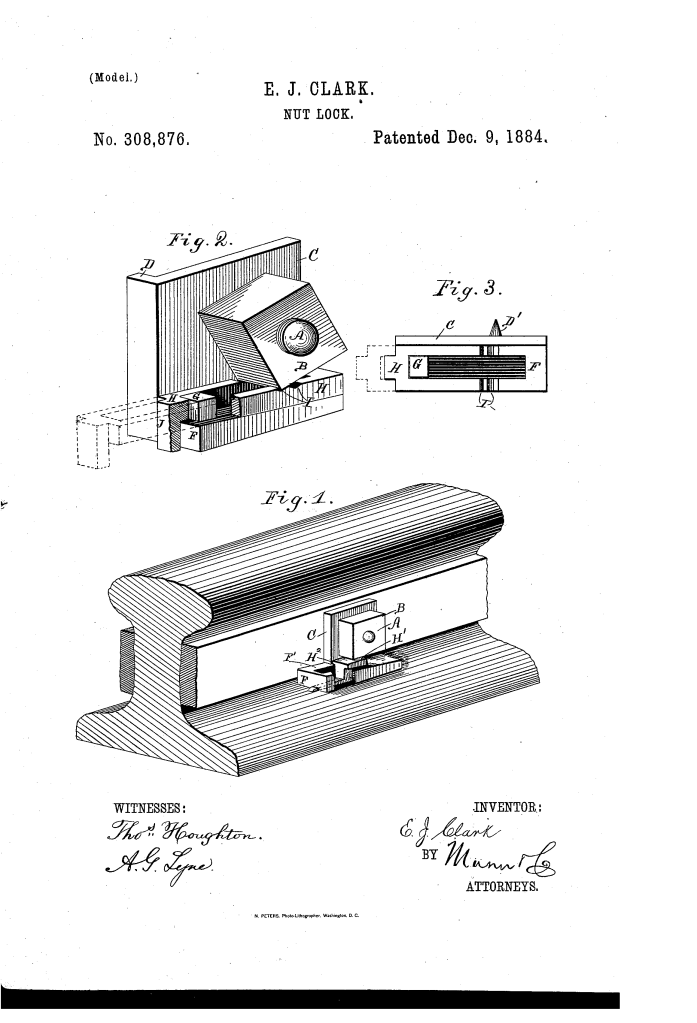
Inventor: Erastus J. Clark
Patent Number: 308,876
Date of Patent: December 9, 1884
Invention: Nut-Lock
Description of the Invention (General Purpose): Erastus J. Clark’s 1884 patent for a “Nut-Lock” aimed to solve a common mechanical problem: preventing nuts from loosening due to vibration, stress, or other forces. In the late 19th century, as machinery and infrastructure (like railways) became more prevalent, the reliability of bolted connections was crucial. A “nut lock” is a device designed to secure a nut firmly onto a bolt, ensuring that the connection remains tight and does not unscrew unintentionally.
Invention and Mechanism (Simplified)
The nut-lock is a two-part system—a washer and a sliding key—that uses gravity to secure the nut and transfers the load to the rail structure.
1. Washer Plate and Guidance
- Washer-Plate: A plate designed to be fixed (non-turning) to the rail (or wood beam) either by a flange or by pointed projections.
- Wedge-Shaped Flange: A flange secured to the outer face of the washer. It is located slightly away from the nut and is wedge-shaped or inclined.
- Slot: In some forms, the flange F has a slot, forming a track for the key.
2. Automatic Sliding Key (Key Innovation)
- Slotted Key: A key designed to slide on the flange. The flange’s incline and the key’s shape allow the key to be positioned between the nut and the flange.
- Gravity and Jar Lock: The top of the key is horizontal, but its support comes from the inclined flange.
- Function: The jarring of the rail (or the natural tilt) causes the key to be thrown and retained in the looking position by gravity (or the wedge action).
- Automatic Engagement: When the nut is being tightened, the movement of the nut automatically pushes the key out of the way. When the nut stops and is turned back slightly, the key slides back into position, locking the nut.
3. Load Transfer (Structural Strength)
Function: When the nut is tightened down against the key, the locking strain is borne entirely by the key and the rail flange, not by the delicate washer-plate or its attached flange. This prevents the washer from breaking or bending under the enormous stresses of rail use.
Rail Contact: The lower end of the key is specifically designed to rest flush with the surface of the flange and the flange of the rail.
Personal Significance (Erastus J. Clark): Erastus J. Clark, the inventor of this nut lock, was identified as residing in Urbana, Illinois, at the time of his patent. While extensive personal biographies are rare for many inventors from this era, public records indicate an Erastus J. Clark born in Tippecanoe County, Indiana, in 1831, who later moved to Champaign County, Illinois (where Urbana is located). This Erastus J. Clark was a farmer and also served as a justice of the peace, and was known for his independent political views.
Although not as widely documented as some more prolific inventors, Clark’s patent for a nut lock demonstrates his practical ingenuity and his ability to address common mechanical challenges. His contribution is a testament to the diverse range of individuals who participated in the era of American innovation.
Historical Significance: Erastus J. Clark’s “Nut Lock” patent holds historical importance within the context of industrial development and fastener technology in the 19th century:
- Growing Need for Secure Fasteners: The mid-to-late 19th century saw rapid industrial expansion, with the widespread use of machinery, steam engines, and extensive railway networks. In these applications, loose nuts could lead to dangerous equipment failures, accidents, and costly downtime. This created a strong demand for reliable fastening solutions.
- Evolution of Nut Locking Technologies: The problem of nuts loosening was well-recognized, leading to numerous inventions in “nut locking” mechanisms. These included early forms of jam nuts, lock washers, and other specialized designs. Clark’s patent contributed to this ongoing effort to develop more secure and efficient ways to maintain bolted connections.
- Impact on Infrastructure and Machinery: Reliable nut locks were essential for the safety and longevity of vital infrastructure like bridges, railways, and large industrial machinery. By preventing fasteners from failing, such inventions played a quiet but critical role in the smooth operation of the industrial economy.
- Everyday Innovation: Beyond large-scale industry, improvements in fasteners also impacted everyday objects and smaller machines, making them more durable and reliable for consumers and workers.
Clark’s patent is an example of the continuous, incremental innovation that underpinned the technological progress of the Industrial Age, addressing seemingly minor but fundamentally important mechanical challenges.
