
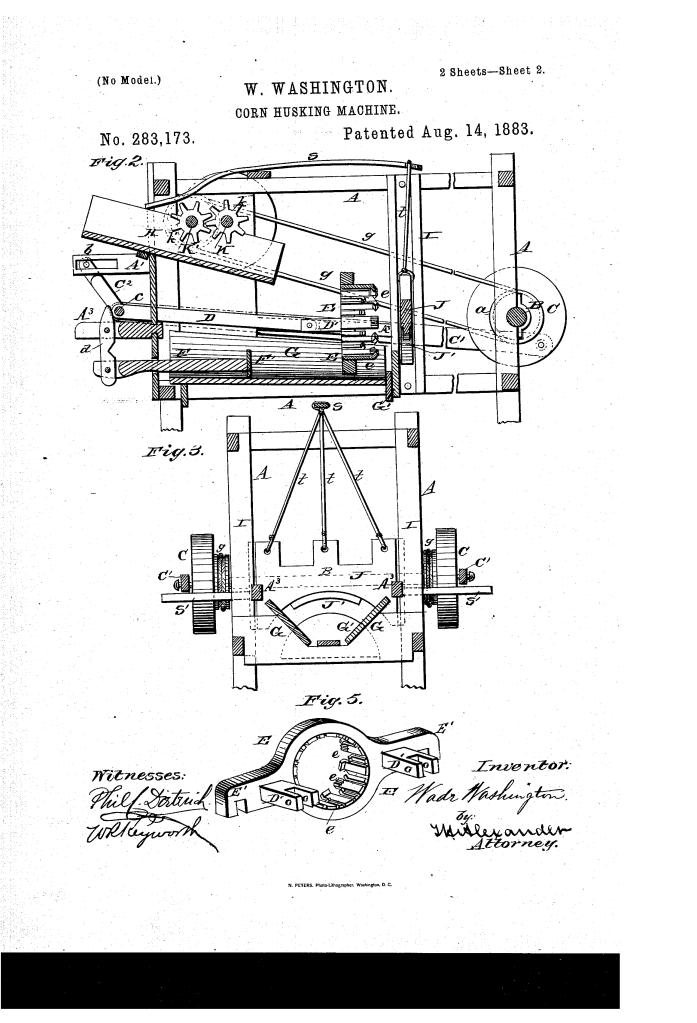
Inventor: Wade Washington Patent Number: 283,173 (US-0283173A) Date of Patent: August 14, 1883 Invention: Corn-Husking Machine
Description of the Invention (from the Patent Document): Wade Washington’s 1883 patent for a “Corn-Husking Machine” aimed to automate and improve the laborious process of removing husks from ears of corn. His invention was designed to efficiently feed, strip, grip, and finally remove the husks, readying the corn for storage or further processing.
Key features and operation of his machine:
- Main Frame and Driving-Shaft: The machine is built on a main frame (A) with a main driving-shaft (B) that receives power via a belt or other means.
- Reciprocating Stripper (E) and Follower (F): The machine uses a reciprocating stripper (E) with beveled spring stripping-teeth (e) to begin the husking process. Ears of corn are fed into a trough (G) through a chute (H) and pushed through the stripper by a follower or feeding-head (F), which also has a rectilinear reciprocating motion.
- Gripping Jaws (J’ and G’): A crucial part of the husking action involves gripping the ear of corn. Below the trough (G), there’s a fixed jaw (G’). Above it, a movable sash (J) with a concave holding-jaw (J’) is guided by slotted pieces. This sash is hung from a spring (S) and has projecting arms.
- Stripping Action: As the machine operates, pitman-rods strike the arms of the sash, depressing the holding-jaw (J’). This action causes the jaw (J’) to firmly grip the stem of the ear of corn against the fixed jaw (G’) while the reciprocating stripper (E) pulls the husk from the ear.
- Combination of Elements: The patent emphasizes the combination of the trough, feeding-chute, circular reciprocating stripper with spring-fingers, the gripping jaws, springs, connecting-rods, and follower, all working together to efficiently husk the corn.
The machine was designed to feed ears butt-first through the chute, force them through the stripper, grip them by the stem, and then strip the husks.
Personal Significance (Wade Washington): Wade Washington was an African American inventor residing in Huntington, Cabell County, West Virginia, as stated in his patent application. His invention of a corn-husking machine highlights his ingenuity and practical approach to solving significant agricultural challenges of his time. Corn was a staple crop, and husking was a time-consuming manual task that required considerable labor. Automating this process would have had a direct impact on the efficiency and productivity of farms.
Washington also held at least one other patent, a “Window Scaffold” (Patent No. 1,169,370), granted on January 25, 1916, which indicates a diverse inventive mind and sustained interest in practical improvements across different fields. As an African American inventor in the late 19th and early 20th centuries, Wade Washington’s ability to secure patents for his innovations is a testament to his perseverance and intellect, given the systemic racial discrimination and limited opportunities prevalent during that era. His contributions are part of the important, though often under-recognized, history of Black American innovation.
Historical Significance: Wade Washington’s “Corn Husking Machine” holds significant historical importance within the context of agricultural mechanization and labor efficiency:
- Addressing Agricultural Labor: In the 19th century, corn harvesting, particularly husking, was a highly labor-intensive process, often done by hand using simple tools like husking pegs or hooks. Automating this step was crucial for increasing farm productivity and reducing the manual burden on agricultural workers.
- Advancement in Farm Machinery: Washington’s machine was part of a broader trend in the late 19th and early 20th centuries towards mechanizing various farm tasks. While early mechanical corn pickers and huskers had been experimented with since the mid-1800s, practical and widely adopted machines began to emerge in the late 19th and early 20th centuries. His patent represents a significant contribution to this development.
- Economic Impact: By making corn husking faster and more efficient, such machines could reduce labor costs for farmers and increase the overall supply of processed corn, benefiting both producers and consumers.
- African American Contribution to Agriculture: Washington’s invention is another example of an African American inventor making tangible contributions to the agricultural sector, a cornerstone of the American economy. His work demonstrates how Black ingenuity directly impacted the efficiency of food production and farm life.
His patent is an important marker in the history of agricultural technology, showcasing the ongoing efforts to mechanize farming processes and the role of diverse inventors in that progress.
