
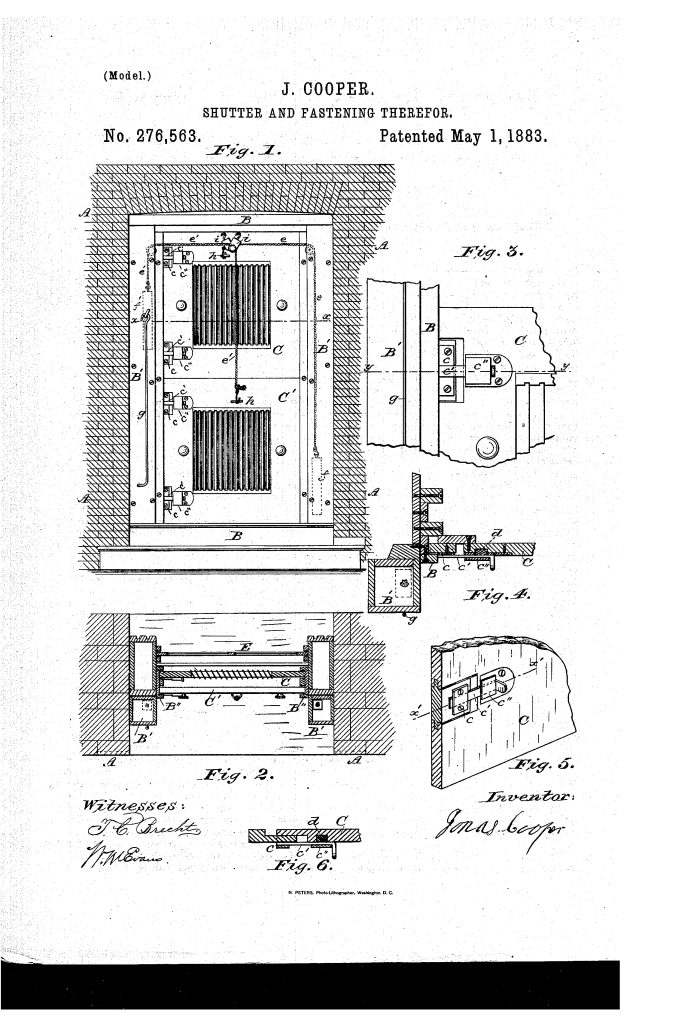
Shutter and Fastening Therefor (Jonas Cooper, No. 276,563)
The patent by Jonas Cooper of Washington, D.C., describes certain new and useful Improvements in Inside Shutters for Windows and Means for Operating and Fastening the Same (Patent No. 276,563, 1883). The object is to provide shutters for large or small windows that run smoothly in fixed grooves, yet are independently removable without disturbance to those remaining, and offer a simple way to achieve a perfect, vibration-free fit.
Inventor Background: Jonas Cooper
Jonas Cooper was an inventor focused on utility and architectural hardware. His invention addressed common flaws in commercial and public building shutters: they were often too heavy to move manually, required complex hidden mechanisms (which were costly to repair), or rattled when closed. Cooper’s solution simplified the installation, operation, and fit of large shutters.
Invention and Mechanism (Simplified)
The core of the invention is a shutter with an adjustable edge section that uses a springy rubber pad to lock the shutter into the frame’s groove at any point, providing a perfect, tight fit.
1. Shutter Structure and Fit
- Sliding Shutters (C, C): Two or more shutters slide in parallel grooves within the window-frame (E).
- The Problem: The shutter body is slightly too narrow to perfectly fill the space between its vertical grooves, allowing for play or vibration.
2. The Adjustable Edge Section (Key Innovation)
- Extensible Section ($C’$): A division or portion of the shutter edge is made as a separate piece ($C’$) that is slidable or extensible from the main body of the shutter (C).
- Rubber Disk/Cushion (D): Located inside the shutter body, directly in the path of the sliding section’s shank. This is a plane-surfaced disk of india-rubber.
- Bridge/Yoke ($c^{2}$): A yoke holds the shank of the sliding section ($C’$) against the rubber disk (D).
- Operation: After the shutter is placed in the grooves:
- The operator slides the section ($C’$) forward, pushing it snugly against the groove wall.
- The tension of the rubber cushion (D) grips the metal shank of the sliding section, holding it securely at that exact position.
3. Benefits
- Adjustable Tightness: The rubber cushion allows the shutter to be set to an infinite number of adjustments—firmly (no shake or rattle) or loosely (for easy movement).
- Vibration Removal: The “close engagement with the groove of the frame along the entire length,” secured by the broad grip of the rubber disk, prevents all vibration and shake.
- Easy Maintenance: Because each shutter slides in its own groove, any single shutter can be removed or inserted quickly without disturbing the others.
Concepts Influenced by This Invention
Cooper’s shutter influenced subsequent designs for adjustable hardware by pioneering the rubber friction lock for continuous adjustment and vibration damping.
- Friction Lock with Elastic Medium: The core concept of using a broad, plane-surfaced rubber cushion or disk (D) to provide a continuous, high-friction, non-positive lock on a sliding metal piece influenced the design of:
- Adjustable Fixtures: Any rod or panel mounting that uses friction pads or rubber collars to hold a position against slippage or vibration (e.g., telescopic stands, articulated mounts).
- Integrated Vibration Damping: The invention demonstrates the principle of using a flexible, elastic material to actively damp vibration by filling the gap between the functional component (shutter) and its structural housing (frame groove). This is used in automotive interiors, appliance mounting, and architectural fixtures.
- Continuous Adjustment vs. Indexed Lock: The design’s successful use of friction to secure the component at an “infinite number of adjustments” (avoiding fixed teeth or notches) influenced hardware where high precision and variability are required.
- Retrofit Architecture: The design of using external boxes (B) for the counterweights, which attach to the existing window frame, influenced the design philosophy of architectural retrofitting where new functions are added without structural alteration.
