
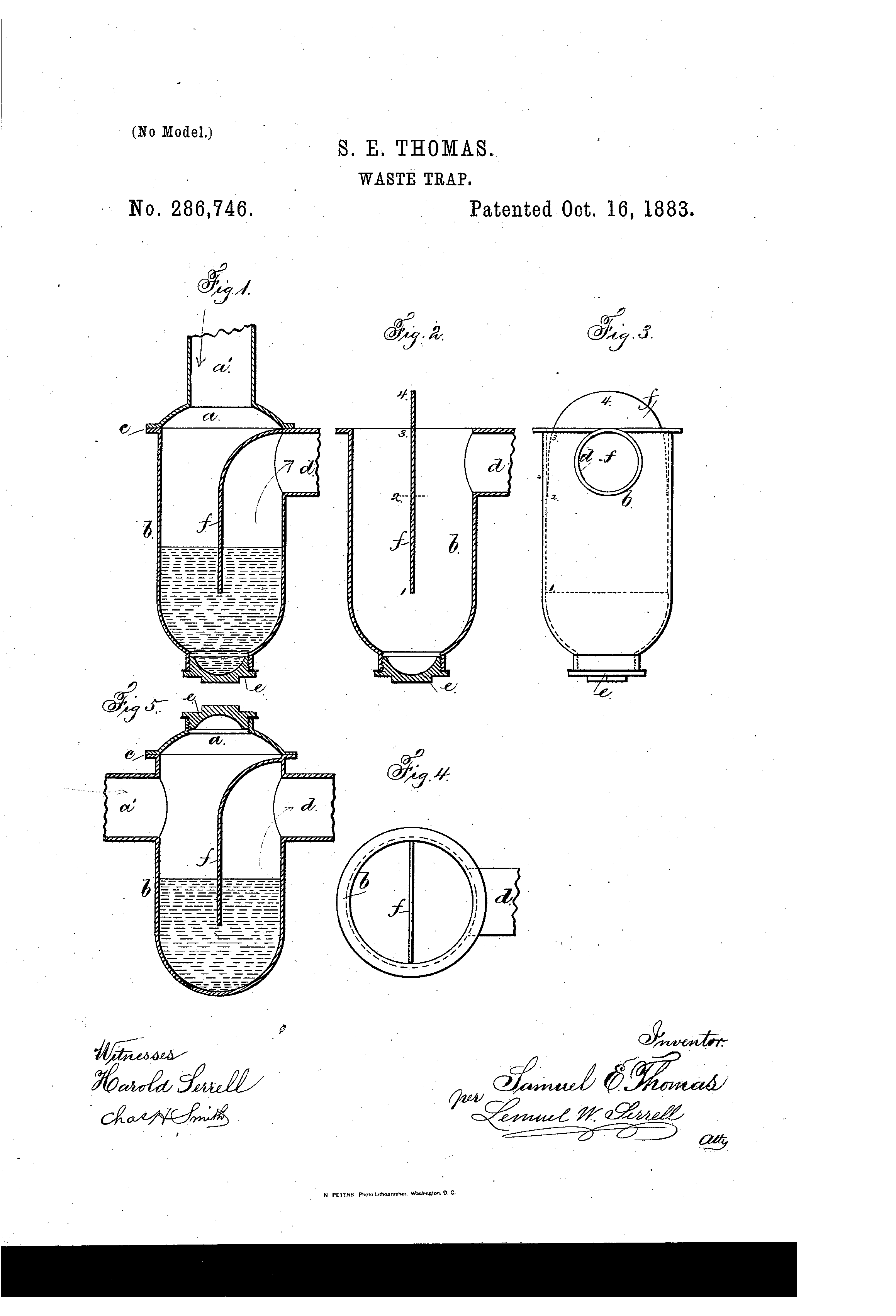
Inventor: Samuel E. Thomas
Patent Number: 286,746 (US-0286746-A)
Date of Patent: October 16, 1883
Invention: Waste-Trap
Description of the Invention (from the Patent Document): Samuel E. Thomas’s 1883 patent for a “Waste-Trap” aimed to create a more efficient, reliable, and cost-effective waste-trap, particularly addressing common issues in the manufacture and performance of cast-lead traps used by plumbers.
His invention’s main objective was to address problems like:
- Seams in the lower portion: Existing cast-lead traps often had seams in the lower, water-retaining part, which could catch debris, interfere with proper washing, and were prone to opening or leaking due to expansion and contraction.
- Difficulty in core removal: The complex shapes of traditional traps made it difficult to remove the casting cores, complicating manufacturing.
Thomas’s improvements focused on:
- Eliminating the lower seam: His trap design ensures that the seam is in the upper portion, where it does not come into contact with the waste water, thereby preventing debris accumulation and leaks.
- Facilitating core removal: The “cup portion” of his trap is shaped specifically to allow cores to be easily and quickly removed after casting.
- Novel Partition Design (Main Feature): The central partition is the key innovation. The lower part of this partition is cast solid with the trap’s walls and exit-pipe. The upper part of the partition is initially free from the side walls and is elliptical. After casting, this upper, free end is bent over into a curved form until its edges touch the side walls, and then it is soldered to the cup, forming a “perfect dam to exclude sewer-gas.” This bending and soldering process was crucial to create an effective seal.
The trap is constructed of an upper inlet portion and a bottom “cup” portion, with the exit-pipe and cleaning-plug as usual.
Personal Significance (Samuel E. Thomas): Samuel E. Thomas was an African American inventor from Brooklyn, New York. His patent for an “Improvement in Waste-Traps” demonstrates his expertise in plumbing technology and his ability to solve practical problems related to sanitation and public health. Waste traps were (and still are) essential for preventing noxious sewer gases from entering homes and buildings, which was a significant health concern in the 19th century.
Thomas was a prolific inventor, holding several patents beyond this waste trap, including another waste trap design in 1887, a process for casting in 1888, and a pipe connection in 1888. His multiple contributions to plumbing and casting technologies highlight his sustained ingenuity and specialized knowledge. As an African American inventor during a period of widespread racial discrimination, Thomas’s success in securing and developing multiple patents underscores his remarkable perseverance and inventive spirit in a field critical to urban development and public welfare.
Historical Significance: Samuel E. Thomas’s “Waste Trap” holds significant historical importance within the context of plumbing, public health, and African American innovation:
- Advancement in Sanitation and Public Health: The 19th century saw growing awareness of the link between sanitation and disease. Waste traps played a critical role in preventing the entry of sewer gases (believed to carry disease-causing “miasma”) into homes. Thomas’s invention, by creating a more reliable seal and easier manufacturing, contributed directly to the improvement of urban sanitation systems and, consequently, public health.
- Innovation in Plumbing Manufacturing: The patent specifically addresses improvements in the casting of lead traps and the removal of cores. This indicates a focus on making plumbing components easier and more efficient to produce, which was important for the expanding infrastructure of cities.
- African American Contribution to Essential Infrastructure: Thomas’s work on waste traps is a vital example of an African American inventor contributing to fundamental urban infrastructure and public health. It showcases how Black ingenuity addressed critical challenges that benefited all citizens, despite the racial barriers of the era.
- Evolution of Trap Design: While other trap designs like the S-trap and P-trap were also evolving (e.g., Alexander Cumming’s P-trap in 1775, and later improvements by Thomas Crapper), Thomas’s invention represents a specific refinement in the construction and sealing mechanism of lead traps, contributing to the ongoing development of safer and more effective plumbing systems.
His patent is a testament to the continuous drive for innovation in essential everyday technologies.
