
Globe-Supporter for Electric Lamps (John Tregoning & Lewis H. Latimer, No. 255,212) 💡
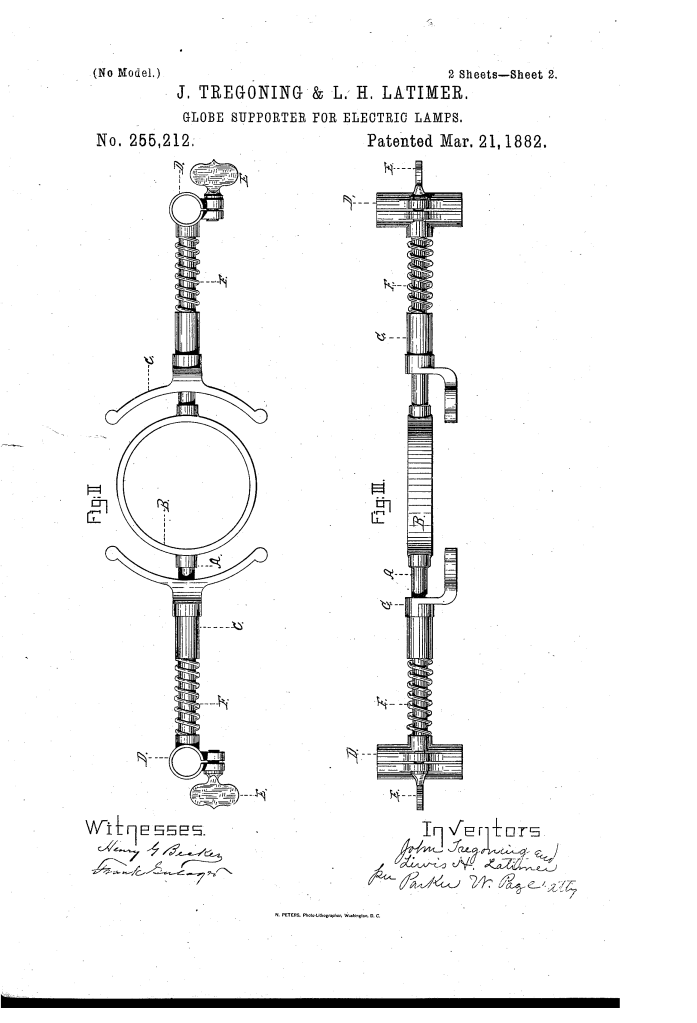
The patent by John Tregoning and Lewis H. Latimer describes certain new and useful Improvements in Globe or Shade Supporters for Electric Lamps (Patent No. 255,212, 1882). The invention provides a superior method for suspending the glass globe (or shade) on arc lamps, addressing the issues of fragility and inconvenience associated with older bottom-support methods.
Inventor Background: John Tregoning & Lewis H. Latimer
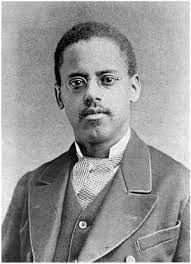
This invention is a collaboration involving Lewis H. Latimer (1848–1928), the pioneering African-American inventor and draftsman. Latimer was centrally involved in advancing electric light technology during this critical period. This patent focuses on the external mechanics necessary for the practical installation and maintenance of arc lamps, complementing his work on the internal filament structure.
Patent Details (No. 255,212 – March 21, 1882)
This patent focuses on a practical, but crucial, component for electric lamps, addressing issues of convenience and safety in installation and maintenance.
- Purpose: The invention aimed to provide an improved device for supporting the glass “globe” or bulb of an electric lamp, particularly those large lamps used for arc lighting (though the principles could extend to incandescent bulbs). The primary goals were to make it easier to install and remove the globe for cleaning, maintenance, or bulb replacement, and to do so without requiring the electrical connection to be broken or the entire lamp fixture to be dismantled.
- Core Mechanism (Key Innovations):
- “Jaw” or Clamp System: The support consists of a collar or ring that clamps onto the neck of the lamp globe. This collar has a series of “jaws” or clamping pieces that are moved inwards or outwards by screws or a similar mechanism.
- Supporting Rods/Arms: From this clamping collar, several supporting rods or arms extend downwards.
- Base/Socket Attachment: These rods attach to a base piece that is connected to the lamp’s main fixture or socket.
- Adjustability and Easy Release: The crucial innovation was the ability to quickly and easily release the globe from its support by manipulating the jaws, allowing the globe to be lowered or removed without disturbing the electrical connections to the lamp’s carbon electrodes (in an arc lamp) or the filament (in an incandescent bulb).
- Protection: The design likely also aimed to protect the delicate globe from undue stress or accidental breakage during handling.
- Advantages Claimed (Inferred from purpose):
- Ease of Maintenance: Simplified the process of cleaning globes or replacing carbons/filaments.
- Reduced Labor/Time: Less time and effort required for lamp servicing.
- Improved Safety: Less handling of electrical components during maintenance, potentially reducing risk.
- Durability of Globes: Better support could reduce breakage.
- Cost Savings: Faster maintenance translated to lower operational costs for electric lighting systems.
Essentially, Latimer’s “Globe Supporter” was a clever mechanical solution to a common problem in the practical application of electric lighting, making the maintenance of lamps more efficient and user-friendly.
Personal Perspectives: Lewis Howard Latimer (1848-1928)
This patent further underscores several key aspects of Latimer’s inventive character:
- Comprehensive Understanding of Lighting Systems: This invention demonstrates that Latimer’s expertise wasn’t limited to the core element of the filament. He understood the entire ecosystem of electric lighting, from the generation of light (filament) to its practical deployment, installation, and maintenance. This holistic view was invaluable in an emerging industry.
- Practicality and Problem-Solving: Like his filament patent, the “Globe Supporter” solved a very real, everyday problem for those installing and maintaining electric lamps. It shows his ability to identify bottlenecks or inefficiencies and devise elegant mechanical solutions.
- Continual Innovation: This patent, coming shortly after his groundbreaking carbon filament patent (1882), indicates his continuous engagement with improving electric lighting technology. He wasn’t just a one-off inventor; he was consistently looking for ways to refine and optimize.
- Drafting and Engineering Prowess: The detailed mechanical design evident in this patent’s concept would have relied heavily on his exceptional skills as a mechanical draftsman and engineer.
Historical Perspectives: Electric Lighting Deployment in the 1880s
Latimer’s “Globe Supporter” patent fits into the exciting and challenging historical context of the widespread adoption of electric lighting in the 1880s:
- The “War of the Currents” and Commercialization: The 1880s were a period of intense competition in the electric lighting industry (the “War of the Currents” between Edison’s DC and Westinghouse/Tesla’s AC). Companies were not just focused on inventing the light bulb but on building entire electrical systems – power stations, wiring, and reliable fixtures.
- Arc Lamps vs. Incandescent Lamps: While we primarily associate Latimer with incandescent bulbs, arc lamps were prevalent for street lighting and large interior spaces in the early 1880s due to their higher brightness. These lamps often had large, heavy glass globes that needed frequent cleaning and servicing to replace the carbon electrodes. Latimer’s patent would have been highly relevant for these arc lamps.
- Installation and Maintenance Challenges: Installing and maintaining early electric lighting systems was labor-intensive and often dangerous. Any device that could simplify these tasks, reduce the need for highly skilled electricians, or make them safer was immensely valuable.
- The Rise of Electrical Infrastructure: Inventions like Latimer’s, while seemingly small, were crucial components that facilitated the efficient and practical rollout of electrical infrastructure in cities and eventually homes. They represent the “nuts and bolts” improvements that made grand visions of electrification a reality.
- African American Contributions to Industrialization: This patent further solidifies Lewis Latimer’s place as a foundational figure in American industrial development and a prominent example of African American ingenuity. His contributions, often behind the scenes, were indispensable to one of the most transformative technologies of the late 19th century. His string of patents in this field demonstrates sustained expertise and impact.
In essence, Lewis Howard Latimer’s Patent No. 255,212 for a “Globe Supporter for Electric Lamps” is another testament to his inventive genius and his crucial role in making electric lighting a practical, maintainable, and ultimately ubiquitous technology.
