
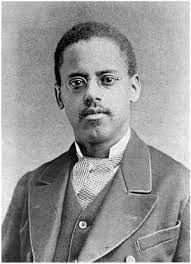

Lewis Howard Latimer was a pivotal figure in the development of practical electric lighting, making crucial improvements that helped pave the way for its widespread adoption. While Thomas Edison is often credited with inventing the incandescent light bulb, it was Latimer’s work on the filament that made it truly viable for commercial and domestic use.
Let’s break down his contributions:
Electric Lamp (co-inventor Joseph V. Nichols) – Patent No. 247,097
- Issued: September 13, 1881
- Inventors: Joseph V. Nichols and Lewis H. Latimer
- Purpose: This patent focused on improving the method of attaching carbon filaments to the metallic conducting wires within an electric lamp.
- Details of the Invention:
- The patent describes a method for securing a carbon “conducting-strip” (filament) to the metallic wires that supply electricity to the bulb.
- It uses “widened ends” on the carbon strip with “rectangular perforations” cut into them before carbonization.
- Flattened ends of the conducting wires are passed through these perforations and then bent over with pincers to firmly clamp the carbon.
- To ensure better electrical contact, the ends of the carbon could be pre-coated with copper or platinum.
- This design aimed to eliminate the need for “nuts, screws, or pins” found in other methods, simplifying the connection and reducing manufacturing cost.
- Crucially, by making contact with the carbon at a distance from the incandescent (glowing) portion, the wires were better protected from heat, allowing the use of less expensive copper wires, thereby significantly reducing the overall cost of the lamps.
- Joseph V. Nichols’ Role: Joseph V. Nichols was Latimer’s colleague and chief electrician at the U.S. Electric Lighting Company, where Latimer worked as a draftsman and engineer under Hiram Maxim (an Edison rival). Their collaboration on this patent highlights the team effort often involved in major technological advancements. Nichols, as the lead engineer, likely guided the overall lamp design, while Latimer’s expertise in drafting and material properties was critical to solving the practical problem of filament attachment.
Personal and Historical Perspectives: Lewis Howard Latimer (1848-1928)
Lewis Howard Latimer was an extraordinary African American inventor, draftsman, and engineer whose contributions to electric lighting are often overshadowed but were absolutely essential to its success.
- Early Life and Self-Education: Born in Chelsea, Massachusetts, in 1848, to parents who had escaped slavery, Latimer had limited formal schooling. He served in the U.S. Navy during the Civil War. After his honorable discharge, he taught himself mechanical drawing and drafting while working at a patent law firm. His immense talent for technical drawing quickly became evident.
- Work with Giants of Invention:
- Alexander Graham Bell: Latimer’s drafting skills were so exceptional that he was hired by Alexander Graham Bell to draft the patent drawings for Bell’s telephone in 1876.
- Hiram Maxim: He then joined the U.S. Electric Lighting Company in 1880, working for Hiram Maxim, a competitor to Edison. It was here that he made his crucial improvements to the carbon filament and collaborated with Joseph V. Nichols. He also traveled to London to help establish a lamp factory for Maxim’s company.
- Thomas Edison: In 1884, recognizing his indispensable expertise, Thomas Edison hired Latimer for the Edison Electric Light Company (later part of General Electric). Latimer became a vital member of Edison’s “Edison Pioneers,” a group of elite researchers. He served as an expert witness in patent infringement lawsuits, leveraging his deep knowledge of electrical lighting and his drafting skills to defend Edison’s patents.
- Wider Impact on Electric Lighting:
- Commercialization: Latimer’s durable carbon filament made electric lighting practical for mass production and adoption. Before his improvements, the high cost of frequent bulb replacement limited electric lighting to a luxury.
- Accessibility: By making bulbs longer-lasting and cheaper to produce, Latimer’s work transformed electric light from an experimental novelty into an accessible utility for the general public. This facilitated the electrification of cities and homes across the globe.
- Literary Contribution: In 1890, Latimer authored “Incandescent Electric Lighting: A Practical Description of the Edison System,” one of the first books on electric lighting, which became an important resource in the burgeoning industry.
- Installation Expertise: He oversaw the installation of electric lighting systems in major cities worldwide, including New York, Philadelphia, Montreal, and London.
- Other Inventions: Beyond lighting, Latimer was a prolific inventor. His other patents include an improved water closet for railroad cars (1874), a “Supporter for Electric Lamps” (1882, with John Tregoning), and an “Apparatus for Cooling and Disinfecting” (an early air conditioning system, 1886).
- Legacy: Lewis Latimer’s life and work are a testament to his immense intellect, perseverance, and dedication to innovation in the face of significant racial barriers. He played an instrumental, though often overlooked, role in bringing light to the world, and his contributions continue to inspire. He was the only African American member of the “Edison Pioneers,” a prestigious group of inventors and scientists.
