
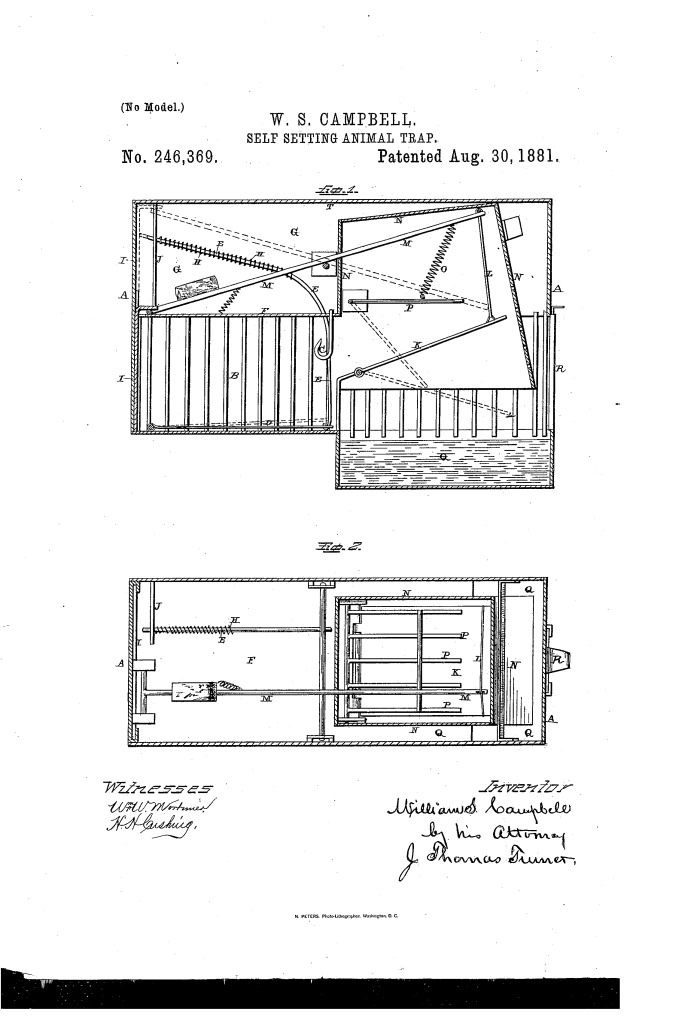
🪤 Self-Setting Animal-Trap (William S. Campbell, No. 246,369)
The patent by William S. Campbell of Columbus, Nebraska, describes a novel Self-Setting Animal-Trap (Patent No. 246,369, 1881) designed to automatically reset after a capture, and, crucially, to kill the animal by drowning. The object is to create a durable, all-purpose trap that is efficient and eliminates the need for the user to be present to reset it or dispatch the captured animal.
👤 Inventor Background: William S. Campbell
William S. Campbell was an inventor from Columbus, Nebraska, focused on practical devices for agriculture and pest control. His invention addresses the problem inherent in many live-catch traps of the time: the user had to manually reset the trap and then deal with the live (or killed) animal, which was often a time-consuming and messy task. Campbell’s design innovates by combining a continuous-action mechanical capture system with a drowning mechanism.
⚙️ Simplified Mechanism: The Two-Step Drowning Trap
The Self-Setting Animal-Trap is essentially a two-room trap that uses the animal’s weight to first lock the entrance and then reset the lock while dumping the animal into a water tank.
Step 1: Entry and Lock 🚪 (The First Room)
- The Bait: The animal enters the front chamber (B), attracted by bait on a hook (C). The front door (I) is held open by a simple, curved stick (E) propped against it, which is pulled tight by a spring (H).
- The Trip: As the animal walks inside, it steps on the first platform (D), which is like a hidden floor trigger.
- The Lock: The animal’s weight pulls the supporting stick (E) out of the way. The front door (I), no longer propped open, immediately slams shut. The animal is now trapped inside the first room.
Step 2: Drowning and Reset 🌊 (The Second Room)
- Seeking Escape: Trapped, the animal looks for a way out and heads toward the back of the trap. It steps up onto the second platform (K).
- The Point of No Return: After passing under a small, one-way door (P), the animal is standing on the back half of Platform K.
- The Drop: When the animal’s weight tips the second platform (K), it acts like a seesaw, overcoming a counterbalance spring or weight. The platform suddenly flips or tilts, and the animal slides down into the water tank (Q) below, where it drowns.
- The Self-Set: Crucially, the same flipping action that drops the animal also makes the opposite end of the platform’s support arm (Lever M) rise up and push the front door (I) open again. It pushes the door just high enough so that the small curved stick (E) from Step 1 can automatically catch and prop the door open.
Result: The animal is captured and disposed of, and the trap is instantly ready to catch the next animal without any human interaction.
💡 Core Concepts Utilized Today
Campbell’s trap is an early and complex example of an efficient, automated pest control system, integrating several mechanical concepts foundational to modern designs:
- Continuous-Action/Self-Setting Mechanism: The core idea of using the animal’s weight in one part of the trap (Platform K) to trigger the reset of the entrance (Door I) for the next capture is a blueprint for modern multi-catch and continuous-use traps.
- Two-Stage Capture System: Separating the initial trigger/capture chamber (B) from the final killing/holding chamber (Q) is a standard design principle in large-scale animal control devices to maximize capture rates.
- Counterbalanced Lever and Gravity Drop: The use of the pivoted lever (M) and counterforce (spring/weight) to create an instantaneous drop for dispatching the animal—a critical and humane feature of a killing trap—is still utilized in various trap and delivery systems today.
