
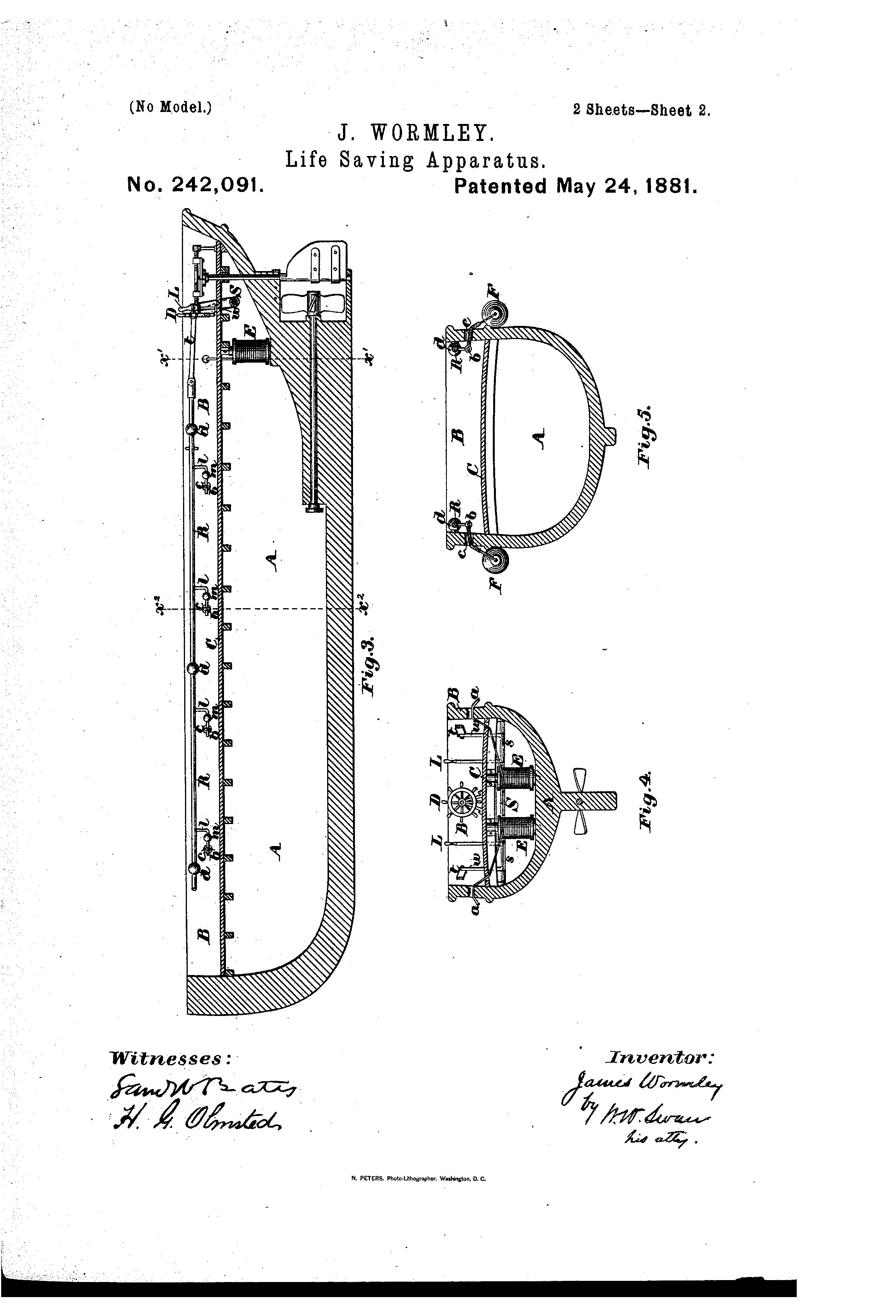
James Wormley’s patent for a “Life-Saving Apparatus,” Patent No. 242,091, issued on May 24, 1881, is a fascinating example of ingenuity applied to a critical safety concern of the era: maritime safety. What makes this patent even more compelling is that James Wormley was a prominent African American businessman and hotelier, known for the famous Wormley Hotel in Washington, D.C. His foray into invention showcases a broad range of talents and interests.
Let’s explore the details of his patent and its personal and historical context.
Patent Details (No. 242,091 – May 24, 1881)
Wormley’s “Life-Saving Apparatus” was designed to quickly deploy a string of floats from a ship, providing a means of rescue for those who had fallen overboard. This was particularly relevant in a time before sophisticated lifeboats or widespread personal flotation devices.
- Purpose: To provide an immediate and easily deployable means of saving lives at sea, specifically by delivering floats to a person or people who have fallen from a ship.
- Core Invention: The invention consists of:
- Floats: A series of floats (presumably buoyant objects) attached to a rope.
- Rope System: The rope, with its attached floats, is designed to run out from the ship as it moves through the water. It has eyes (loops) at its free end.
- Lock and Cast-off Mechanism: This is the key innovative part. It features a sliding rod located along the ship’s side, equipped with projecting arms or hooks.
- Deployment Mechanism: In its normal position, these hooks pass through the eyes of the rope, holding the floats in place. When activated by a hand-lever (located near the ship’s wheel or in a constantly watched area), the sliding rod moves, causing the hooks to disengage from the rope’s eyes, thus releasing the string of floats.
- Duplication for Efficiency: The patent notes that the apparatus is duplicated, allowing a string of floats to be detached from either or both sides of the vessel, enhancing its efficiency and readiness.
- Advantages Claimed: The primary advantage was the rapid and controlled deployment of life-saving floats, which would be crucial in a man-overboard scenario, where every second counts. The ability to deploy from either side of the ship also provided flexibility.
Essentially, Wormley’s invention was an early form of a rapid-deployment lifeline, aimed at quickly providing buoyancy to individuals in the water until further rescue could be attempted.
Personal Perspectives: James Wormley (1819-1884)
James Wormley was a remarkable figure in 19th-century American history, whose success extended far beyond invention:
- Prominent Entrepreneur: Wormley was born free in Washington, D.C., in 1819. He rose from humble beginnings, working in his family’s hackney carriage business, to become one of the most successful African American entrepreneurs of his time. He was renowned for his culinary skills and eventually opened the famous Wormley Hotel in Washington, D.C., in 1869. The hotel was a prominent establishment, attracting politicians, diplomats, and other elites, and even hosted the secret meetings that led to the “Wormley Agreement” to resolve the disputed 1876 presidential election.
- Community Leader and Activist: Beyond his business ventures, Wormley was a dedicated community leader. He played a crucial role in campaigning for and securing funding for the city’s first public elementary school for Black students, the Sumner School.
- Diverse Interests and Ingenuity: His invention of a life-saving apparatus demonstrates that his intellect and interests extended beyond the hospitality industry. It suggests he may have had personal experience with maritime travel (he worked as a steward on a Mississippi riverboat and other vessels) or simply a keen awareness of critical societal needs. That a successful hotelier would turn his mind to nautical safety speaks to his broad inventive spirit.
- Role Model: As an African American patent holder and successful businessman in a racially segregated society, Wormley served as an inspiration and proof of Black excellence and capability during a challenging period.
Historical Perspectives: Maritime Safety in the 1880s
Wormley’s invention fits into a broader historical context of increasing attention to safety, particularly in maritime travel:
- Growing Maritime Commerce and Passenger Travel: The late 19th century was a period of significant growth in international trade and passenger travel by sea. This led to more ships on the water and, unfortunately, more accidents.
- Rudimentary Safety Measures: Life-saving equipment on ships in the 1880s was far less sophisticated than today. Lifeboats were often difficult to launch quickly, and personal flotation devices were not universally required or highly effective. Any innovation that could rapidly aid someone in the water was valuable.
- Focus on Immediate Rescue: Wormley’s apparatus was designed for immediate response to a “man overboard” situation, a common and dangerous occurrence. Getting buoyancy to the person quickly could mean the difference between life and death, especially in rough seas or cold water.
- Evolution of Life-Saving Technology: Inventions like Wormley’s contributed to the gradual evolution of maritime safety technology. While simpler than later inventions, they represented a step towards more comprehensive and automated safety systems. The idea of a deployable line with floats would evolve into modern rescue lines and systems.
- African American Innovation: James Wormley’s patent is another powerful example of the significant contributions of African American inventors during the post-Reconstruction era. Despite facing immense systemic barriers, Black inventors like Wormley applied their ingenuity to a wide range of fields, from domestic goods to industrial equipment and, in this case, public safety. His patent contributes to the rich, yet often overlooked, history of Black innovation in America.
James Wormley’s “Life-Saving Apparatus” is not just a testament to his inventive mind but also a reflection of his multifaceted contributions as a businessman, community leader, and innovator during a pivotal time in American history.
