
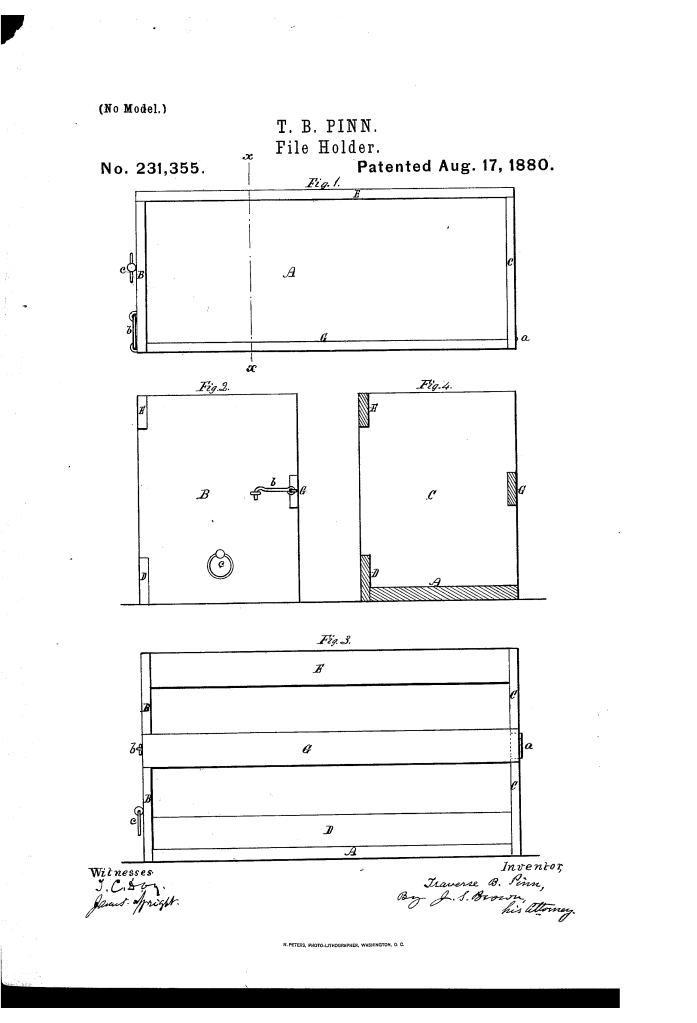
T. B. PINN’S FILE-HOLDER (Patent No. 231,355, 1880) 📁
The patent by Traverse B. Pinn of Alexandria, Virginia, describes a new and useful Improved File-Holder (Patent No. 231,355, 1880). The invention provides a low-cost, convenient case for holding and protecting files and documents, specifically designed for use in public offices where large numbers are required.
Inventor Background: Traverse B. Pinn
Traverse B. Pinn was an inventor from Alexandria, Virginia. His work, as evidenced by the File-Holder, focused on creating simple, durable, and highly economical solutions for organizational needs. His design prioritizes cost-effectiveness and ease of access, directly addressing the needs of government and administrative offices for practical, large-scale storage that minimizes wear and tear on documents.
Invention and Mechanism
The File-Holder is a simple rectangular case made primarily of thin board strips joined by nails or screws. Its key innovation lies in the specific arrangement of fixed and movable guard strips on its sides to provide protection while ensuring quick access.
1. Core Structure and Protection
- Bottom (A) and Permanent Ends (B, C): Form the foundational structure.
- Protection (Fixed Side): This side is protected by two permanently secured strips:
- Bottom Guard-Strip (D): Holds the lower ends of the files in position.
- Top Guard-Strip (E): Serves as a guard and support against displacement.
- Function: The large open space between the strips (D and E) allows easy visual access to the files without sacrificing edge protection.
2. Access Mechanism (Key Innovation)
- Movable Bar (G): A single guard-bar is placed at about the middle height on the opposite side of the holder.
- Hinge (a): The bar (G) is attached to one end of the holder by a simple hinge.
- Catch (b): The bar is secured at the other end by a simple fastener, such as a hook and eye or sliding bolt.
- Function: This hinged bar allows the user to swing the bar out after unfastening the catch, providing an unobstructed opening to take out or replace files quickly.
3. Operation and Handling
- Cost-Effectiveness: The holder’s construction using simple wood strips, a cheap hinge, and a basic catch ensures its cost is “only a few cents,” making it suitable for bulk use.
- Handling: A ring or knob (c) is provided at one end to allow the user to easily draw the holder out from a shelf or receptacle.
Concepts Influenced by This Invention
Pinn’s File-Holder is a foundational example of a Minimalist Protective Case designed for administrative efficiency.
- Selective Guarding: The core concept of using spaced guard-strips (D, E) to protect the edges of contents (especially during sliding) while leaving the center open for viewing and access influenced subsequent designs for:
- Shelf Files and Bankers Boxes: Modern file storage often uses reinforced corners and edges while maintaining an open top or side for identification and handling.
- Simple Hinged Access: The use of a single, hinged, mid-level bar (G) for quick, one-handed opening and closing is a principle adapted in:
- Toolbox/Kit Latches: Quick-release buckles and latches on simple containers that serve as both a fastener and a temporary handle.
- Designed-in Economical Construction: The patent’s explicit focus on extreme simplicity and cheapness set an early standard for Government and Office Supply Design, where low production cost per unit is a critical requirement for mass deployment.
