
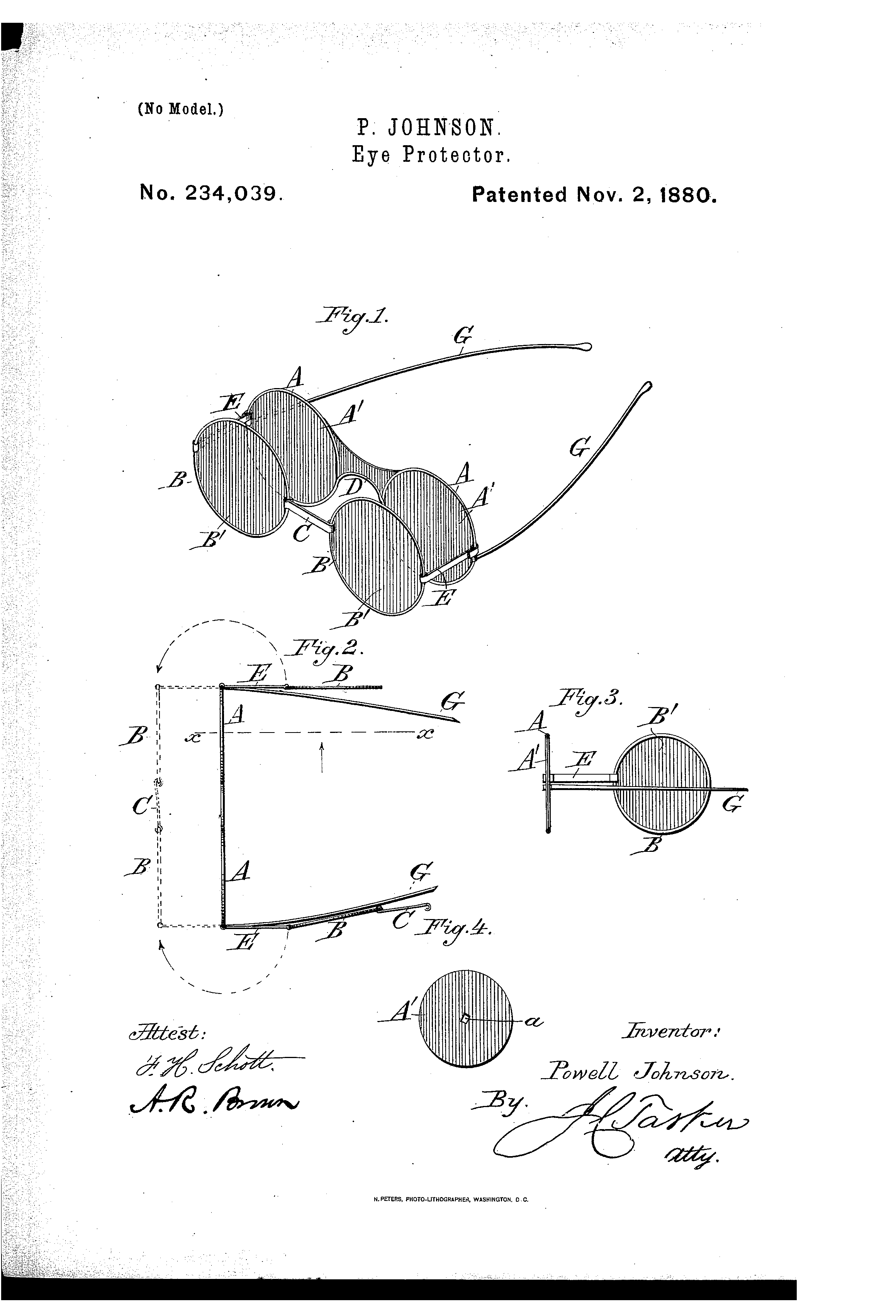
Eye-Protector (Powell Johnson, No. 234,039)
The patent by Powell Johnson of Barton, Alabama, describes an Eye-Protector (Patent No. 234,039, 1880). The device is designed for use by furnace-men, puddlers, firemen, and others exposed to the glare of strong light, as well as for people with weak sight.
Inventor Background: Powell Johnson
Powell Johnson was an African-American inventor whose work focused on safety and utility in demanding industrial environments. His invention directly addresses the need for specialized eye protection in intense heat and light settings common in the steel, rail, and heavy manufacturing industries of the late 19th century.
Invention and Mechanism
The eye-protector is essentially a pair of safety spectacles using layers of cloth instead of colored glass, with a unique feature allowing the user to quickly adjust the level of light intensity.
1. Primary Protection Layer
- Hoops/Frames (A, A): Two wire frames or hoops, similar to spectacle hoops, connected by a wire nose-bridge (D).
- Cloth Disks ($A’, A’$): Disks of cloth of any desired color, description, or thickness are fastened within or around these frames.
- Weak Sight Feature: For persons of weak sight, a small hole ($a$) or slit can be made through the cloth disks, allowing them to see through the hole while the rest of the eye is shaded.
2. Secondary/Adjustable Protection Layer (Key Innovation)
- Second Pair of Hoops (B, B): A second pair of hoops or frames, also filled with cloth disks ($B’, B’$), is positioned in front of the primary layer (A, A).
- Connection: The two pairs of hoops are connected by side pieces (E, E), which are hinged to the frames. A clasp (C) connects the front of the outer frames (B, B).
- Function: This outer layer provides greater protection from light of very great intensity. When the high-intensity light source is removed (or a task requiring better vision is needed), the clasp (C) can be unhooked, and the outer hoops (B, B) can be thrown back and to the side, out of the way (Fig. 2).
Concepts Influenced by This Invention
Johnson’s eye protector influenced subsequent designs for safety equipment by pioneering layered and quick-release adjustable filtration systems.
- Layered Filtration/Protection: The core concept of using multiple layers of protection (A, A and B, B) to filter intense light and allow the user to subtract layers as needed influenced the design of:
- Welding Helmets: Early passive welding helmets that used layered dark glass, allowing the user to flip up the outer layer to view the work without removing the entire apparatus.
- Industrial Goggles: Safety eyewear designed with removable side shields or secondary lenses.
- Hinged/Quick-Release Filtration: The use of hinges (E) and a clasp (C) to allow the outer protection layer to be quickly swung away and stored on the side influenced the design of modern flip-up shields, visors, and lens systems used in grinding, metalworking, and other industrial settings.
- Pin-Hole Vision: The inclusion of a small central aperture ($a$) or slit to allow vision while maintaining maximum shading influenced the design of specialized visual aids and optical instruments requiring controlled light access.
