
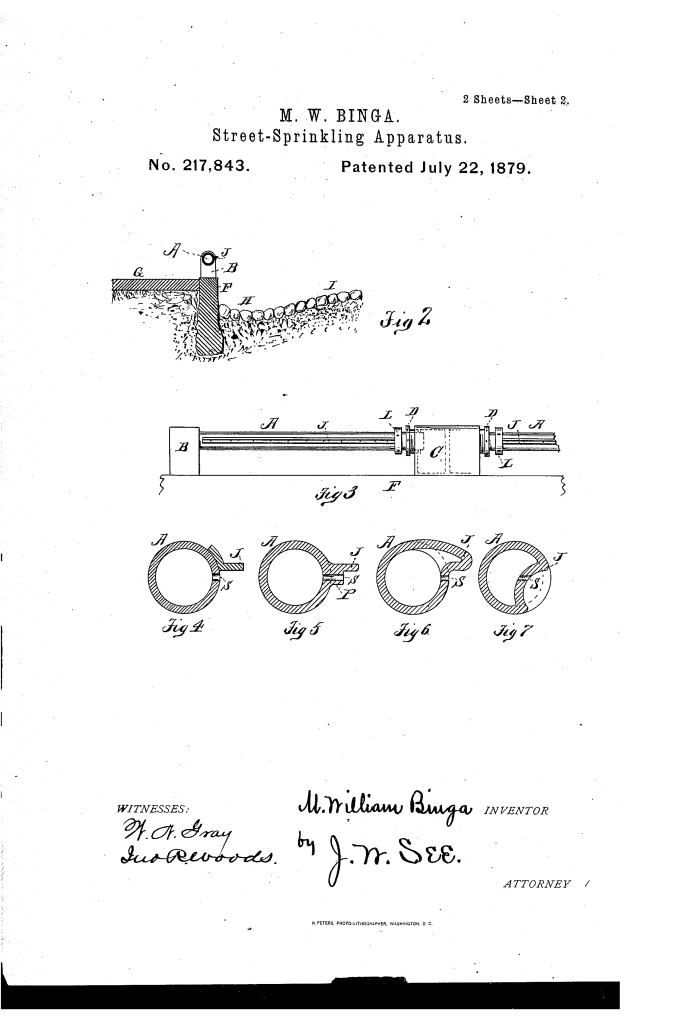
The patent by M. William Binga of Cincinnati, Ohio, describes an Improvement in Street-Sprinkling Apparatus (Patent No. 217,843, 1879). The invention is a stationary, permanent system for sprinkling streets, sidewalks, and lawns, designed to allow the water jets to be directed to any part of the street’s width and to prevent the jet-holes from becoming clogged.
Inventor Background: M. William Binga
M. William Binga was an African-American inventor whose work focused on municipal infrastructure and utility systems. His invention addressed the inefficiency and maintenance issues of manual or traditional mobile street-sprinkling apparatus, which was a critical service for dust control in late 19th-century cities. The assignment of one-half interest to H.L. Morey suggests a partnership for commercial development.
Invention and Mechanism
The apparatus is a permanent system of rotating, perforated pipes with protective guards that allow jets to be aimed in any direction.
1. Permanent Installation and Rotation (Key Innovation)
- Perforated Tube (A): A metal pipe with a longitudinal row of small jet-holes is installed along the curb-stone (F).
- Bearings (B, C): The tube (A) is journaled in stationary bearings (B, B, C) securely attached to the curb-stone.
- Central Bearing (C): The central bearing is hollow and connected to the street-main or other water source. The tube (A) is open in the central bearing but sealed at the ends.
- Function: Water enters the tube (A) from the central bearing. The tube can be rotated (using capstan collars L or a wrench) to direct the jets vertically, horizontally, or at any angle. This allows the water to sprinkle the roadway or the sidewalk, or be directed nearly downward to wash the gutters.
- Sectional Control: The central hollow bearing (C) may have a partition to allow water to be admitted to only one tube section at a time.
2. Anti-Clogging Guard (Secondary Innovation)
- Protecting Shed/Guard (J): A longitudinal guard (J) is attached above the row of issue-holes (S). This guard may be brazed, riveted, or drawn as part of the pipe section.
- Function: This shed prevents the small issue-holes from becoming clogged by dirt and mud being thrown into them by vehicles and animals, solving a major maintenance problem with fixed jets.
- Thickening Rib (P): The preferred pipe section (Fig. 5) includes an extra thickness or rib (P) under the guard, which gives superior length to the issue-orifices.
Concepts Influenced by This Invention
Binga’s apparatus influenced subsequent municipal infrastructure and fluid control systems by pioneering the concept of rotating, directional ground-level fluid discharge.
- Permanent/Ground-Level Sprinkler Systems: The concept of permanently installing a pipe with rotational control at street level influenced the design of modern retractable or fixed irrigation systems for public spaces, lawns, and golf courses, which rely on precise jet direction control.
- Rotational Nozzle Control: The method of achieving directional aiming by rotating the entire perforated pipe (tube A) influenced the engineering of various rotary nozzles and spray heads that use mechanical rotation to sweep a fixed jet over a wide area.
- Integrated Guarding for Apertures: The use of a longitudinal projecting shed or guard (J) over the jet-holes to prevent external debris from entering and clogging the orifices influenced the design of all subsequent industrial and commercial piping components that terminate in small openings, such as drains, vents, and spray nozzles used near the ground or in dirty environments.
- Systemic Cleaning Utility: The design feature allowing the pipes to be rotated downward for drainage after use influenced the development of modern pipeline systems that utilize gravity-assist or rotational features for self-cleaning and preventing freezing.
