
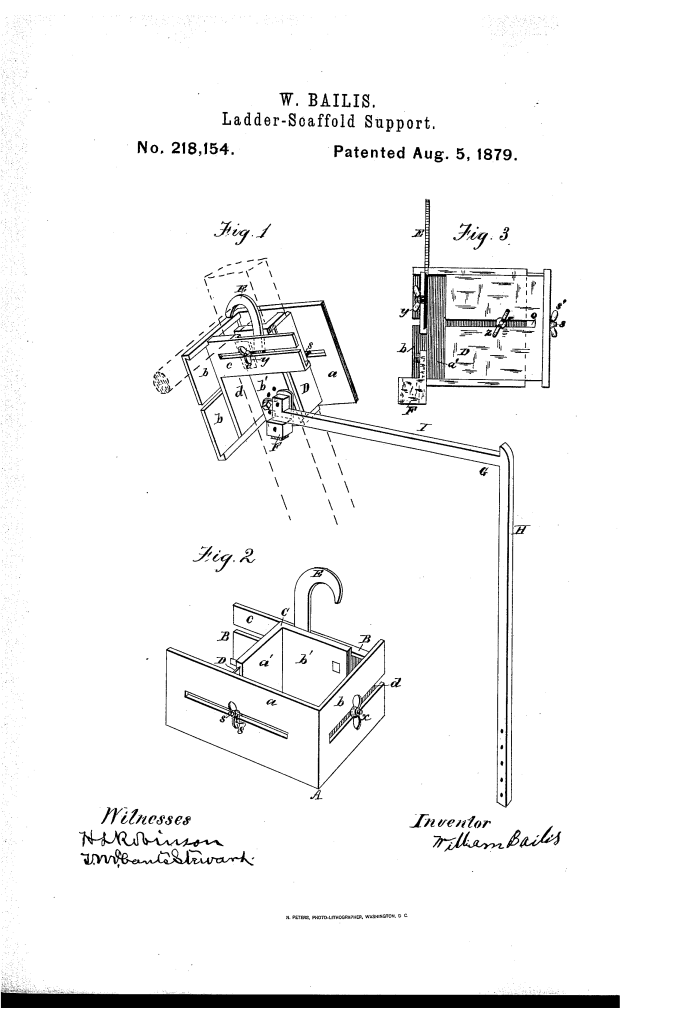
Improvement in Ladder-Scaffold Supports (William Bailis, No. 218,154)
The patent by William Bailis of Princeton, New Jersey, describes a new and useful Improvement in Adjustable Supports for Ladder-scaffolds (Patent No. 218,154, 1879). The primary object is to create a scaffold clamp and bracket that offers rapid and secure adjustment while being easily portable.
Inventor Background: William Bailis
William Bailis was an inventor focused on improving safety and efficiency in construction and industrial work. His invention, patented in 1879, targeted a specific problem in the building trades: the instability and difficulty of setting up temporary ladder-based scaffolds. The co-assignment of one-half interest to Hugh M. Browne suggests a partnership for the commercialization of the scaffolding equipment.
Invention and Mechanism
The device is a complex, multi-sided adjustable box clamp that secures firmly to a ladder and holds a detachable, adjustable bracket.
1. The Clamping Box (Key Innovation: Multi-Sided Slide Adjustment)
- Structure: The clamping-box consists of three main sides (A, B, C) that are designed to slide upon one another to adjust for varying widths of ladder standards.
- Guideways and Slots: Sides A and C have slots and dovetailed ways (on wing $b$ of side A, and wing $a$ of side C) that guide the sliding movement.
- Sliding Piece (D): Side C guides a sliding piece (D) which is secured by a stationary screw ($s$) and a wing-nut ($s’$).
- Function: By loosening wing-nuts on the screws ($m, s, z$), the multiple sliding sides (A, B, C) can be adjusted over each other until they are clamped securely around the ladder standard, regardless of its thickness. This feature ensures a secure and rapid fit.
2. Ladder Retention
- Pivoted Hook (E): A hook pivoted to the outside of side C.
- Function: This hook is hooked over the round next above the box, securing the box against any tendency to slide down the standard.
- Friction and Angle: The clamp’s design ensures the weight on the box creates a strain that forms an acute angle with the slide direction, aiding in frictional security.
3. Bracket and Radial Adjustment
- Bracket (G): A right-angled bracket with two perforated arms (H, I) that forms the support for the scaffold plank.
- Swinging Box-Eye (F): A box-eye pivoted to the side C of the clamping-box. This eye is radially adjustable (secured by a pin through a series of circular holes).
- Function: This radial adjustment allows the scaffold bracket (G) to be mounted so that its support arm (I) is always level, regardless of the inclination at which the ladder is placed against the wall.
Concepts Influenced by This Invention
Bailis’s ladder support influenced subsequent clamping and scaffolding hardware by pioneering complex, quick-adjust, multi-axis stabilization systems.
- Multi-Axis Adjustable Clamping: The most significant influence is the use of multiple sliding sections (A, B, C) guided by dovetailed ways to achieve a rapid, yet ultra-secure, adjustment over a variable thickness (the ladder standard). This concept is fundamental to modern heavy-duty clamps and workholding vices that must conform precisely to irregular or large workpieces.
- Integrated Safety Hook: The simple but effective idea of integrating a fixed, round-engaging safety hook (E) directly onto the clamp itself influenced the design of modern ladder accessories and stabilizers, where the safety mechanism is built into the primary support, not added separately.
- Radial/Angular Leveling Adjustment: The provision of a radially adjustable box-eye (F) to ensure the work platform (bracket G) is always perfectly level regardless of the angle of the main support (ladder) influenced the design of adjustable work platforms, camera mounts, and tripod heads used in construction and surveying.
- Modular Assembly for Versatility: The device is constructed as separate, adjustable clamping box and bracket components, allowing the system to be configured for scaffolds placed either next to or away from the wall.
