

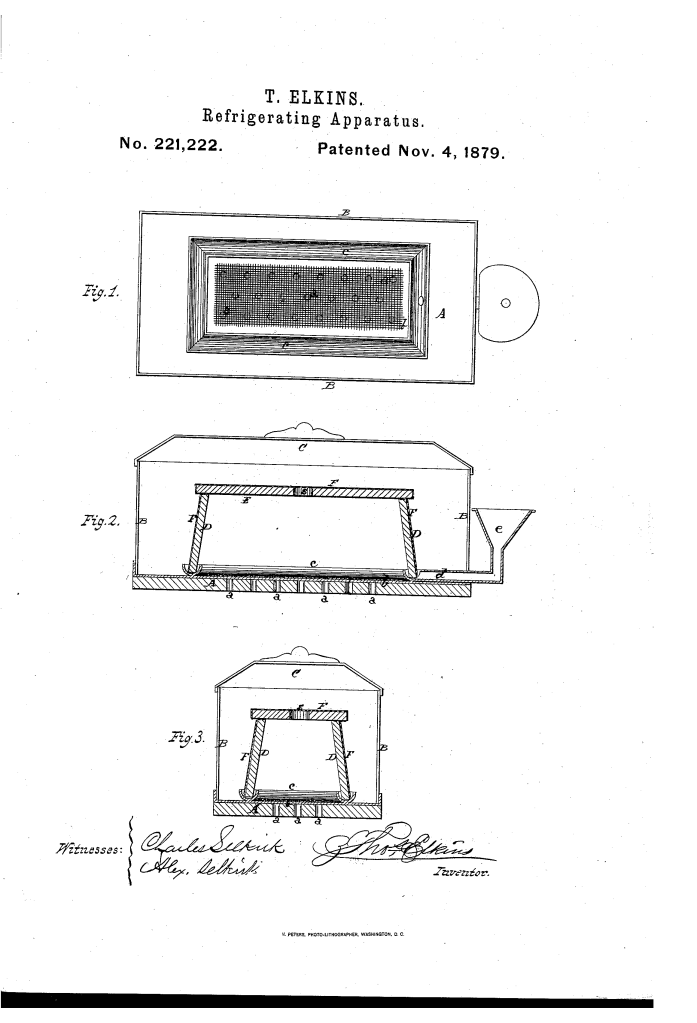
Inventor: Thomas Elkins
Patent Number: 221,222 (US-0221222-A)
Date of Patent: November 4, 1879
Invention: Improvement in Refrigerating Apparatus
Description of the Invention: Thomas Elkins’ 1879 patent addressed the problem of preserving perishable food and even human corpses in a time before widespread mechanical refrigeration. His “Improvement in Refrigerating Apparatus” was not a mechanical refrigerator in the modern sense, but rather an improved insulated container that utilized the cooling effect of water evaporation.
Key features of his design included:
- Trough for Water: The apparatus had a trough or canal to hold water or another refrigerating fluid.
- Cooling Chamber: A box made of detachable sections, lined externally with a bibulous (absorbent) material, sat within this trough. This material extended down into the water.
- Porous Box: The chilling box itself was made of a porous material like earthenware, allowing water to percolate through it.
- External Shell: An external shell enclosed the entire apparatus, preventing the surrounding air from affecting the cooling process.
- Perforated Bottom and Grating: The bottom of the apparatus had a perforated section with a wire netting or grating, allowing for some air circulation within the chilling chamber.
- Cover: The chilling box was covered to further insulate it.
The device worked by filling the trough with water, which was then drawn up by the bibulous lining of the inner box. As the water evaporated from the porous walls of the chilling box, it drew heat from the interior, thus cooling the contents.
Personal Significance (Thomas Elkins): Thomas Elkins (1818 – August 10, 1900) was an African American inventor, dentist, pharmacist, and abolitionist from Albany, New York. Beyond his work as an inventor, Elkins was a respected member of his community and an active participant in the fight against slavery, serving as the secretary of the Vigilance Committee in Albany, which aided fugitive slaves. He also served as a medical examiner for the 54th and 55th Massachusetts Infantries.
His patent for a refrigerating apparatus, along with his other inventions, including an improved chamber commode and a combined dining, ironing table, and quilting frame, demonstrates his inventive spirit and his commitment to improving everyday life. Despite facing the pervasive racial discrimination of the time, Elkins made significant contributions to technology and public health.
Historical Significance: Thomas Elkins’ “Improvement in Refrigerating Apparatus” holds historical significance for several reasons:
- Early Refrigeration Technology: While not a mechanical refrigerator, Elkins’ invention represented an advancement in food preservation techniques before the widespread adoption of mechanical refrigeration. It provided a means of keeping food and other perishable items cool for longer periods.
- Preservation of Corpses: Unusually, Elkins’ apparatus was also designed to preserve human corpses, addressing a significant public health concern in the 19th century. Keeping bodies cool helped to prevent the spread of disease and reduce odors.
- African American Contribution to Science and Technology: Elkins’ invention is a powerful example of an African American inventor contributing to the development of technology that had a direct impact on public health and daily life. His work challenges the common narrative of invention in this era and highlights the ingenuity and resourcefulness of Black inventors.
- Precursor to Modern Refrigeration: Although Elkins’ device relied on evaporative cooling, it represents an early step in the development of more sophisticated refrigeration technologies that would eventually revolutionize food preservation and public health.
- Multi-Functional Design: Elkins’ approach to design, as seen in his other inventions, often combined multiple functionalities into a single device, reflecting a practical and efficient approach to problem-solving.
