
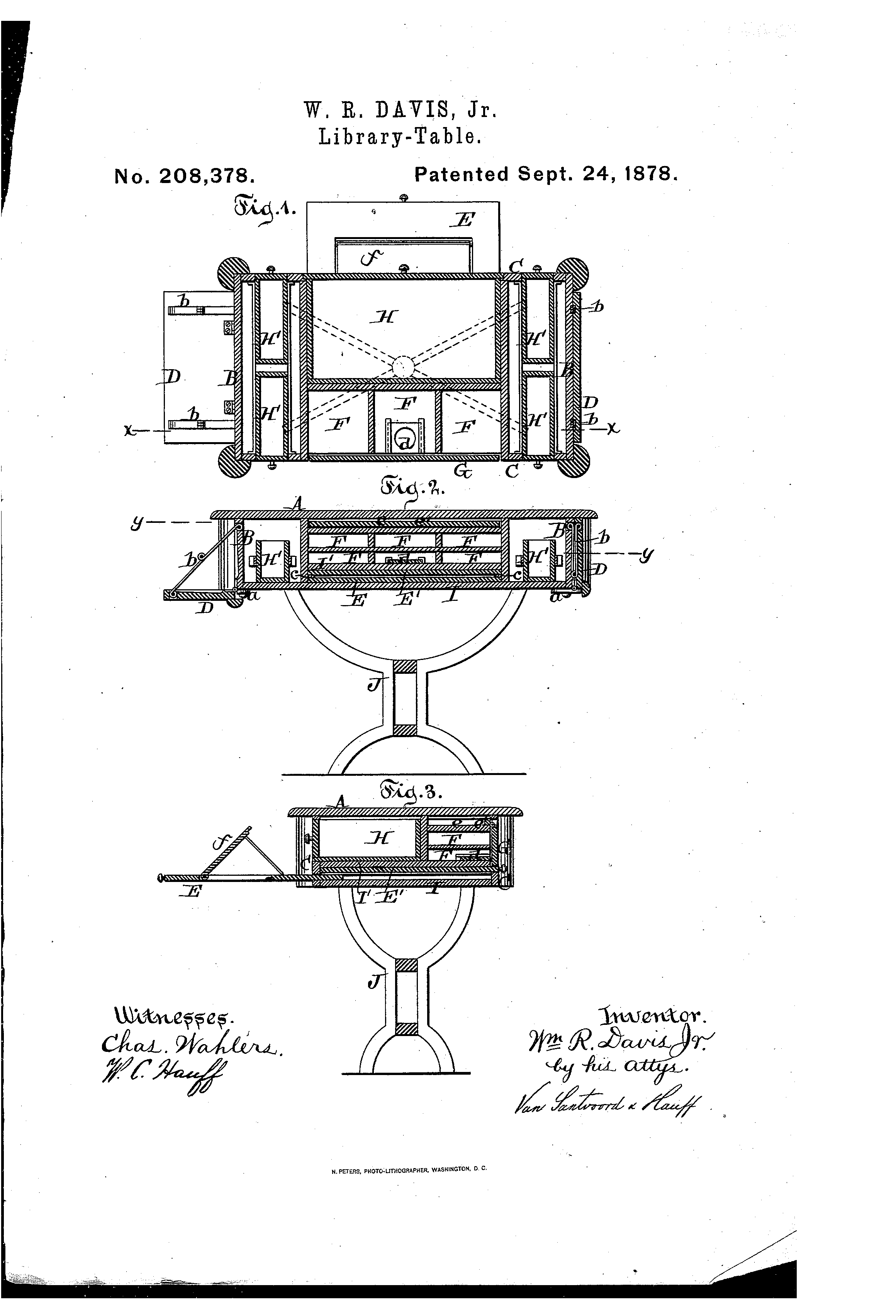
Improvement in Library-Tables (William R. Davis, Jr., No. 208,378)
The patent by William R. Davis, Jr., of New York, N.Y., describes an Improvement in Library-Tables (Patent No. 208,378, 1878). The object is to provide a compact and convenient table that can be used on either or all sides for writing, supporting books, and filing papers, and which can be completely enclosed to exclude dust when not in use.
Inventor Background: William R. Davis, Jr.
William R. Davis, Jr., was an inventor focusing on furniture design and domestic utility. His table is a classic example of late 19th-century cabinetmaking ingenuity, addressing the need for specialized, multi-functional furniture required by professionals and scholars in a private study or library.
Invention and Mechanism
The table is a box-style piece of furniture that integrates multiple hidden features for writing, storage, and reading.
1. Multi-Functional Work Surfaces
- Box Top (A, B, C): The table has a box-like structure with depending ends (B) and sides (C).
- Sliding Leaves ($E, E’$): Leaves arranged to be drawn out on opposite sides of the table for reading or writing.
- Tiered Design: Leaf $E’$ slides on cleats ($c$) above leaf E, creating a tiered effect.
- Hinged Section ($f$): Leaf E is provided with a hinged section ($f$) that can be lifted and held at an inclined position (and sometimes a book-rest rail) for reading.
- Hinged Ledges (D): Ledges hinged to the ends (B).
- Function: They can be folded up against the ends (to enclose the table) or swung down to a horizontal position where they form a convenient support for books. They are held in the down position by jointed arms ($b$).
2. Integrated Storage and Enclosure (Key Innovation)
- Pigeon-Holes (F): Storage compartments formed above a false bottom ($I’$), facing one side of the table (D). They include a slide ($d$) to support an inkstand.
- Drawers (H, $H’$): Multiple drawers, some facing the side opposite the pigeon-holes (H), and others arranged in pairs pulling out on opposite sides ($H’$).
- Concealed Door (G): A door arranged above the pigeon-holes (F) that, when pulled out, covers the pigeon-holes. It retracts into a recess ($c$) in the table top when not needed.
- Function: The hinged ledges (D), when folded up, and the door (G), when drawn out, allow the table to be completely enclosed to exclude dust, protecting papers and books stored inside.
Concepts Influenced by This Invention
Davis’s library table influenced subsequent furniture and fixture design by pioneering multi-sided utility and integrated, concealed modularity in storage and work surfaces.
- Multi-Sided Utility Furniture: The design philosophy of creating a central piece of furniture that is accessible and functional from all sides (with drawers and work leaves pulling out on opposite faces) influenced the design of modern office desks, library reference tables, and modular central workstations.
- Integrated Concealable Features: The use of sliding leaves (E), hinged ledges (D), and retracting doors (G) to quickly convert the table from an open, multi-functional piece to a completely enclosed, dust-proof box influenced the design of:
- Concealed Kitchen or Appliance Storage: Cabinets that use sliding or hinged mechanisms to hide utility items.
- Retracting Drawers/Shelves: Modern desks and work surfaces where auxiliary surfaces slide out only when needed.
- Ergonomic Reading Surfaces: The inclusion of the hinged, inclined section ($f$) for supporting a book influenced the design of modern adjustable reading stands, ergonomic drafting tables, and laptop stands.
