
Improvement in Fire-Escape Ladders (Joseph R. Winters, No. 203,517)
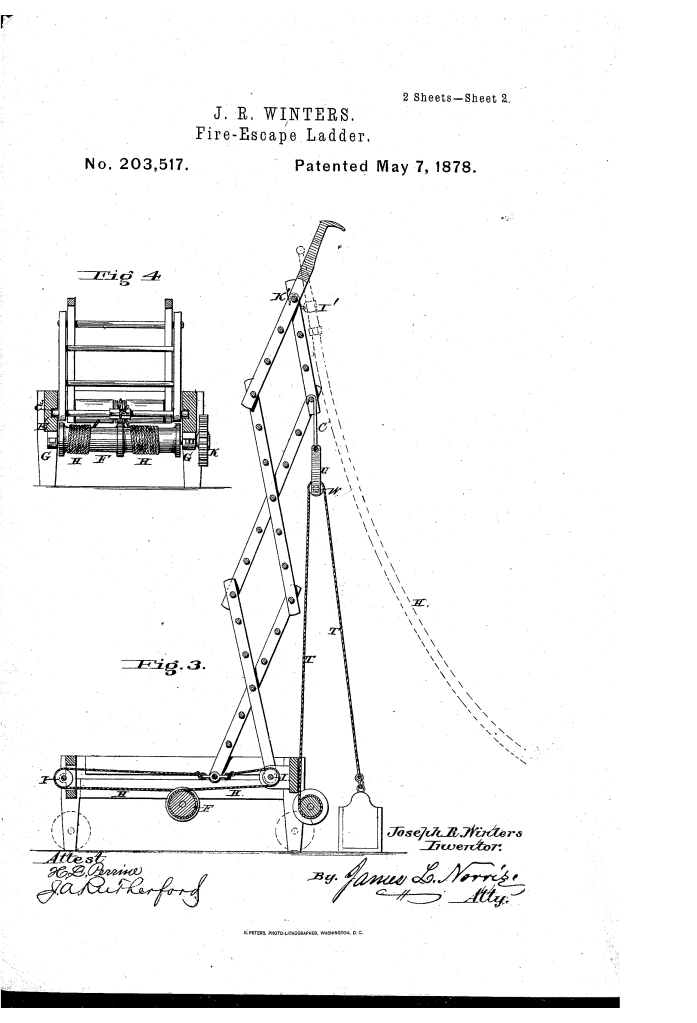
The patent by Joseph R. Winters of Chambersburg, Pennsylvania, describes an Improvement in Fire-Escape Ladders (Patent No. 203,517, 1878). The invention is a ladder-truck and fire-escape apparatus designed to expeditiously raise a series of ladders to the upper stories of a burning building without dismounting them from the truck.
Inventor Background: Joseph R. Winters
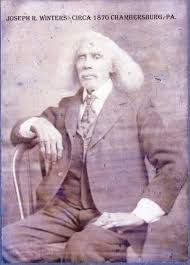
Joseph R. Winters (1840-1916) was an African-American inventor and firefighter from Chambersburg, Pennsylvania.
- Focus on Fire Safety: Winters was deeply involved in fire service, which directly informed his invention. He is most famous for patenting a wagon-mounted fire-escape ladder (his first patent in 1878, which this document refers to) and later inventing a railway signaling device (1881).
- Solving the Firefighting Problem: In the 1870s, reaching upper stories was a major challenge for fire departments. Winters’s design provided a mobile, rapidly deployable, and multi-functional apparatus, addressing the critical safety needs of both firemen and trapped occupants.
Invention and Mechanism
The apparatus is a wheeled truck that carries a vertically extensible, folding ladder driven by a central windlass.
1. Folding and Extensible Ladder
- Ladder Sections (C): A series of ladder-sections are pivoted together at their ends (
), forming a folding ladder.
- Fixed/Movable Base: The end of one lower section is pivoted fast to one end of the truck-frame (A) at (
).
- Traveling Base (Key Innovation): The end of the other lower section is provided with pins/projections (
) that travel in horizontal ways or grooves (E) formed in the truck-frame (A).
2. Windlass and Deployment System
- Windlass (F): A central windlass with a double drum is journaled transversely across the truck frame.
- Ropes/Chains (H): Two reversely-wound ropes are secured to the drum. They pass over pulleys (I) at each end of the truck frame and are connected to the round of the lower movable ladder-section.
- Function: As the windlass (F) is rotated, the reversely-wound ropes cause the movable ladder-section to travel in the ways (E). This action extends or folds the entire series of ladder sections, quickly raising the ladder to the desired height.
- Lock: A dog or pawl (P) engages a pinion (L) on the windlass shaft to lock the ladder at any desired elevation.
3. Auxiliary Functions
- Bucket/Elevator: A second windlass (R) is provided with ropes (T) to operate a bucket or elevator (
). A detachable frame (U) with a hooked link (
) allows this elevator to be secured to any round of the main ladder for carrying up water or lowering “persons too helpless to make their escape.”
- Hose Attachment: The hose-pipe (I) is provided with a hooked link (K) so it can be attached to a round of the main ladder and elevated with the ladder.
Concepts Influenced by This Invention
Winters’s invention is a fundamental precursor to modern aerial firefighting and rescue equipment, influencing the design of modular, quick-deploy systems.
- Telescoping/Folding Ladder Systems: The core concept of a series of hinged, folding sections that extend and retract via a controlled base movement (the movable section traveling in grooves E) influenced the design of modern articulating and telescoping fire truck ladders and mobile work platforms .
- Reversely-Wound Winch Actuation: The mechanism using two reversely-wound ropes/cables on a single drum to control the movement of a multi-stage articulated structure is a critical principle in cable-driven actuation systems, ensuring smooth, controlled, and synchronized deployment and retraction of long booms or stages.
- Integrated Rescue/Utility Platform: The inclusion of auxiliary functions (a separate windlass for a bucket/elevator and hose attachment points) influenced the modern design philosophy of multi-functional aerial rescue platforms that integrate water delivery, lighting, and personnel access.
- Track-and-Roller Guidance: The use of grooves (ways E) and projections () on the truck bed to guide the moving ladder section is a simple, robust linear guidance system that is the conceptual ancestor of the tracks and rollers used for large, heavy sliding components.
