
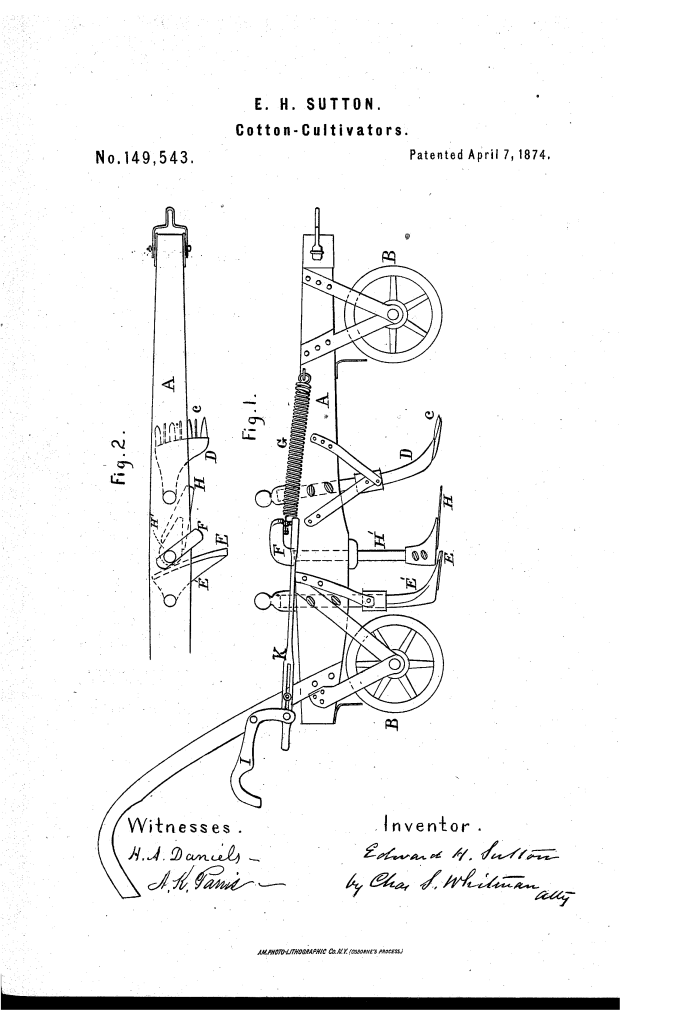
Inventor: Edward H. Sutton
Patent Number: 149,543 (US-0149543-A)
Date of Patent: April 7, 1874
Invention: Improvement in Cotton-Cultivators
Description of the Invention: Edward H. Sutton’s “Improvement in Cotton-Cultivators” aimed to enhance the efficiency and precision of cultivating cotton crops, specifically in loosening soil and removing weeds. His invention focused on improvements to the construction of existing cotton cultivators, which were vital tools for farmers in the Southern United States.
Key aspects of his design included:
- Combination of Teeth and Blades: The cultivator featured teeth (c) for loosening and pulverizing the soil, similar to a plow, and blades (E and H) specifically designed to cut weeds.
- Rotatable Blade for Precision Weeding/Thinning: A significant innovation was the rotatable blade (H). This blade was secured to a standard (H’) that could be rotated. This rotation allowed the blade to effectively cut weeds or thin out growing cotton plants that were beyond the reach of the stationary blade (E).
- Lever Mechanism for Control: The rotation of the blade (H) was controlled by a lever (I), which was pivoted to a handle of the implement. This lever was connected via a slotted rod (K) to an arm (F) on top of the standard (H’). A spiral spring (G) assisted in the operation of the standard. This mechanism allowed the operator to adjust the blade’s position precisely while working in the field.
Sutton’s invention was designed to make the cultivation process more effective, allowing farmers to better manage weeds and selectively thin their cotton plants, which was crucial for optimal growth and yield.
Personal Significance (Edward H. Sutton): Edward H. Sutton was an African American inventor, author, and state legislator from Edenton, North Carolina. His patent for a cotton cultivator is a testament to his practical ingenuity and his understanding of the agricultural needs of the South, particularly concerning the dominant crop of cotton.
Sutton’s life and achievements are particularly noteworthy given the historical context of the post-Reconstruction South. As an African American, he navigated a society fraught with racial discrimination and limited opportunities. Despite these challenges, he not only pursued invention but also engaged in civic life, serving in the North Carolina state legislature in 1883. This dual role as an inventor and a public servant highlights his commitment to improving the lives of his community and contributing to the economic and political progress of his state. His work stands as an important example of African American intellectual and entrepreneurial activity in the late 19th century.
Historical Significance: Edward H. Sutton’s “Improvement in Cotton-Cultivators” played a role in the ongoing mechanization of agriculture in the United States, especially in the crucial cotton-producing regions.
- Impact on Cotton Agriculture: Cotton was king in the post-Civil War South, and its cultivation was incredibly labor-intensive. Innovations in farming implements like cultivators were vital for improving efficiency, reducing manual labor, and increasing yields. Sutton’s cultivator, with its specific improvements for weeding and thinning, contributed to making cotton farming more productive and less arduous.
- Advancements in Agricultural Technology: This patent is part of a broader trend of agricultural innovation in the 19th century. As inventors sought to apply mechanical principles to farming, tools became more specialized and efficient, allowing farmers to cultivate larger areas with less manual effort. Such advancements were critical for feeding a growing nation and for supporting the textile industry.
- African American Contribution to Agriculture: Sutton’s invention underscores the often-unrecognized contributions of African American inventors to American agriculture. Despite being disproportionately employed in agricultural labor, Black inventors often brought their practical knowledge and ingenuity to bear on developing tools and techniques that benefited the entire industry. His patent is a valuable historical record of this vital contribution.
- Economic Development of the South: Improved agricultural efficiency, especially in cotton production, had a direct impact on the economic recovery and development of the Southern states after the Civil War. Inventions that boosted farm productivity were essential for economic growth and stability in the region.
Relation to Current Items
Sutton’s design principle—combining a broad mechanical function with a precise, manually controlled element—is highly relevant to modern agricultural technology:
- Tillage and Cultivation Equipment: The general structure of a wheeled beam, fixed soil-loosening teeth, and fixed blades remains the basic design of modern row-crop cultivators and tillage implements , though they are now much larger and pulled by tractors.
- Active Control Systems: Sutton’s manual lever control (I) over the blade (H) is the conceptual ancestor of modern precision agriculture and guidance systems. Today, large tractor-drawn cultivators use hydraulic actuators and GPS/optical sensors to automatically and precisely adjust the position of weeding blades and tines in real-time, moving them closer to or farther from the crop row to ensure only weeds are removed, mirroring the selective function Sutton achieved manually.
- Selective Thinning: The task of thinning (or “chopping”) cotton plants is now often done by specialized automated equipment or, increasingly, is avoided through the use of seed planters that precisely space seeds to eliminate the need for thinning altogether. However, the requirement for selectivity (saving the crop while destroying the weed) remains the core challenge that Sutton’s adjustable blade was designed to solve.
