
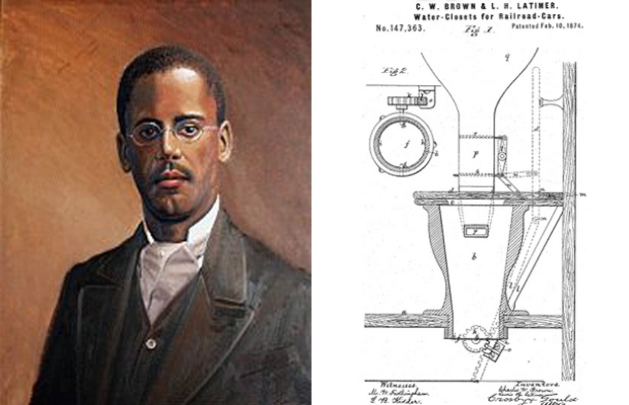
Inventors: Charles W. Brown and Lewis Howard Latimer Patent Number: 147,363 (US-0147363-A)
Date of Patent: February 10, 1874
Invention: Improvement in Water-Closets for Railway-Cars
Description of the Invention: The patent by Brown and Latimer addressed the challenges of sanitation on railway cars, particularly the common issue of open-bottomed hoppers that discharged directly onto the tracks, leading to unsanitary conditions and odors. Their invention proposed a more contained and hygienic system.
Key features of their “Improvement in Water-Closets for Railway-Cars” included:
- Pivoted Bottom Plate: The core of their invention was a pivoted bottom plate in the hopper (the bowl of the toilet). This plate was automatically closed when the seat-cover was raised and automatically opened when the seat-cover was closed. This design ensured that the bottom of the hopper was always closed, whether the seat was up or down, preventing direct exposure to the tracks and containing odors and waste.
- Rotation of the Bottom Plate: Preferably, the bottom plate was pivoted at its center and designed to rotate 180 degrees with each opening or closing movement of the seat-cover. This rotation would help to clean the plate and ensure that fresh surfaces were presented for waste.
- Earth Closet Mechanism Integration: The inventors also preferred to integrate an “earth-closet” mechanism. This involved a reservoir for “earth” (likely a deodorizing agent like ash or dry soil) and a system of valves that would deposit this material onto the waste when the seat cover was raised, further aiding in disinfection and odor control. This suggests a hybrid system that could function with or without significant water flushing, which was practical given the limited water supply on early trains.
- Odor Control: The enclosed nature of the hopper, combined with the earth-closet mechanism, was intended to “obviate the objections to the use of such closets as they are now built or applied,” primarily referring to the pervasive odors and direct discharge.
Personal Significance (C. W. Brown and L. H. Latimer):
- Charles W. Brown: While less is known about Charles W. Brown compared to his co-inventor, he was from Salem, Massachusetts, and collaborated with Latimer on this important patent. This collaboration highlights the shared intellectual pursuits and ingenuity among inventors, sometimes crossing racial lines, in the post-Civil War era.
- Lewis Howard Latimer (1848-1928): Latimer was a remarkable African American inventor, draftsman, and engineer. Born in Chelsea, Massachusetts, to escaped slaves, he became a self-taught draftsman after serving in the Union Navy during the Civil War. His extraordinary talent led him to work for patent attorneys, where he drafted the patent drawings for Alexander Graham Bell’s telephone. Later, he joined Thomas Edison’s team, becoming an “Edison Pioneer” and a key figure in the development of electric lighting. His invention of an improved carbon filament for light bulbs significantly extended the lifespan of incandescent bulbs. The “Water-Closets for Railway-Cars” patent with Brown is one of his early and lesser-known but significant contributions, showcasing his diverse range of mechanical interests and problem-solving abilities. Latimer’s achievements are particularly profound given the systemic racial discrimination he faced, demonstrating immense intellect and perseverance.
Historical Significance: The “Improvement in Water-Closets for Railway-Cars” by Brown and Latimer holds considerable historical significance in the context of public health, transportation, and African American innovation:
- Advancements in Railway Sanitation: In the 1870s, long-distance train travel was becoming more common, but sanitation on board was rudimentary. Early train toilets often consisted of a simple hole directly over the tracks, leading to unsanitary conditions, unpleasant odors within the cars, and pollution along the railway lines, particularly in station areas. This invention aimed to address these critical public health and comfort issues, representing a significant step towards more hygienic and contained waste disposal on trains.
- Passenger Comfort and Public Health: As train journeys became longer, passenger comfort, including access to sanitary facilities, became increasingly important. Improvements in water closets directly contributed to a more pleasant and healthier travel experience for the public. These types of innovations were crucial for the ongoing expansion and acceptance of railway travel as a viable mode of long-distance transportation.
- Early Environmental and Health Awareness: While comprehensive environmental regulations were still far off, inventions like this show an early awareness of the need to manage waste in public spaces and to minimize its direct impact on the environment and human health.
- African American Contribution to Everyday Life: This patent is another powerful example of how African American inventors contributed to improving various aspects of daily life and industrial infrastructure, often in practical and essential ways. Latimer’s ingenuity, in particular, was not limited to groundbreaking electrical inventions but extended to solving common problems in transportation and sanitation. Their work helped shape the evolving standards of convenience and hygiene in public conveyances.
