
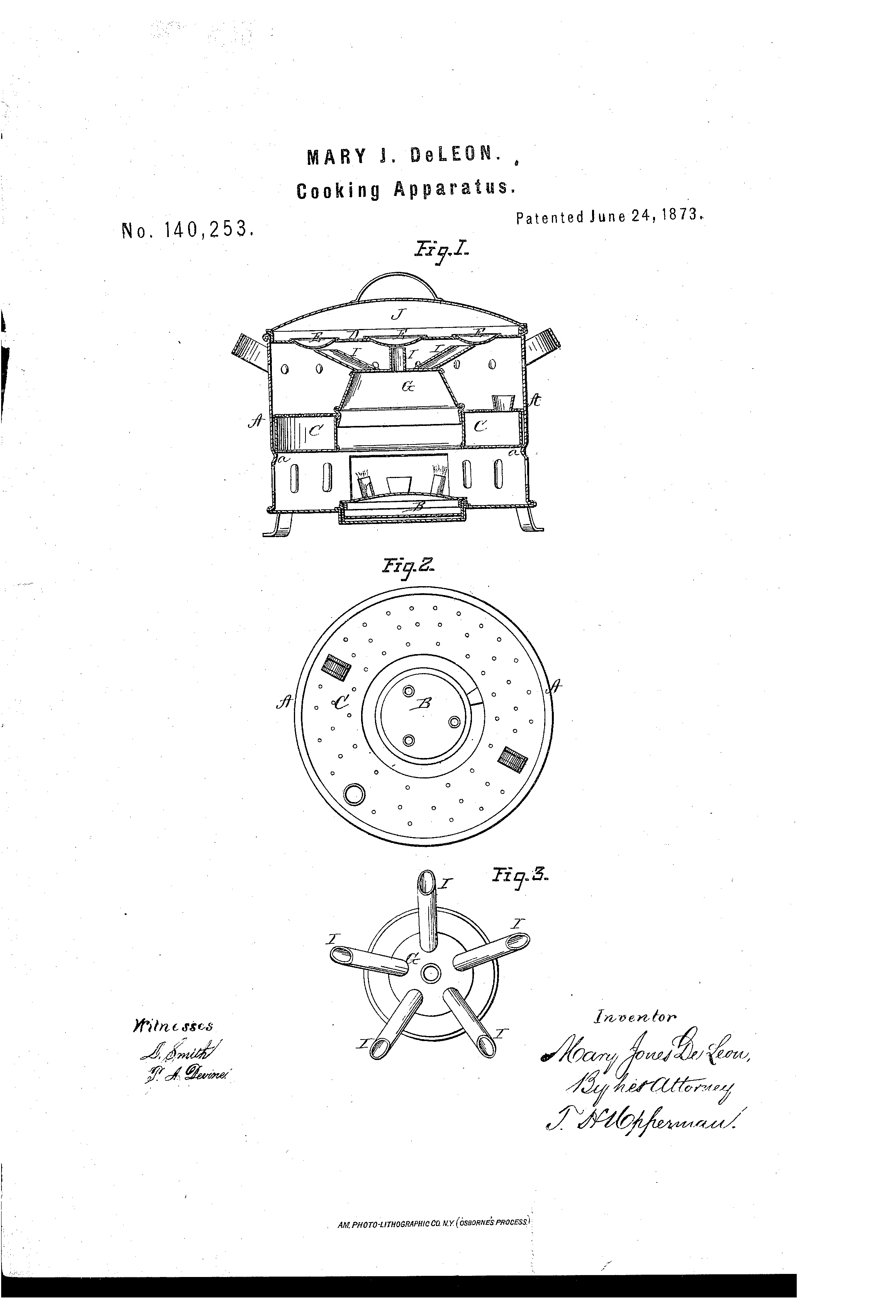
Inventor: Mary Jones DeLeon
Patent Number: 140,253
Date of Patent: June 24, 1873
Invention: Improvement in Cooking Apparatus (Early Steam Table)
Description of the Invention: Mary Jones DeLeon’s patent for an “Improvement in Cooking Apparatus” was an innovative design that served as an early precursor to the modern steam table. Her invention aimed to keep food warm and moist using a combination of dry heat and steam, and could also be adapted for cooking.
The apparatus consisted of:
- An exterior vessel (A): This could be circular or other suitable forms and contained a central recess for a lamp.
- A lamp (B): Positioned at the bottom of the vessel, it provided the primary heat source.
- An annular water-reservoir (C): Placed above the lamp on a ledge within the vessel, this reservoir was designed to hold water. Its central opening allowed the lamp to be placed inside it when desired. The top of the reservoir was perforated to allow steam to escape.
- A large plate (D) with holes: This plate rested on the top edges of the vessel and contained a series of holes to receive smaller plates (E) holding the food.
- Conical cap (G) and tubes (I I): When the lamp was used in the bottom of the vessel, a conical cap covered the central opening of the water reservoir. From the top of this cap, a series of pipes led to the underside of each food plate, directly conveying dry heat from the lamp to the food.
The key innovation was the dual action: the lamp provided dry heat to the food directly through the tubes, while the steam generated from the heated water in the reservoir surrounded the food, preventing it from drying out or scorching. By reconfiguring the lamp and using a solid plate instead of the perforated one, the apparatus could also be used for cooking.
Personal Significance (Mary Jones DeLeon): Mary Jones DeLeon, residing in Baltimore, Maryland, is historically significant as one of the earliest African American women to receive a U.S. patent. She is believed to be the second Black woman to hold a U.S. patent, following Martha Jones in 1868. This achievement is remarkable given the pervasive racial and gender discrimination of the era. Women, and especially African American women, faced immense barriers to education, professional opportunities, and recognition for their intellectual property. DeLeon’s invention demonstrates her ingenuity and resourcefulness in addressing a practical household and potentially commercial need. While specific biographical details about her life are limited beyond her patent record, her patent stands as a testament to the often-overlooked contributions of Black women to American innovation.
Historical Significance: Mary Jones DeLeon’s “Cooking Apparatus” has significant historical importance for several reasons:
- Pioneering Food Preservation/Serving Technology: Her invention was an early precursor to modern steam tables, which are ubiquitous in buffets, cafeterias, and catering services today. Before such devices, keeping food warm and palatable for extended periods, especially for large gatherings, was a considerable challenge. DeLeon’s apparatus offered a practical solution by combining dry heat with steam to maintain food quality.
- Impact on Domestic and Commercial Food Service: At a time when meal preparation was labor-intensive and time-consuming, inventions that streamlined the process or improved food serving were highly valuable. DeLeon’s apparatus would have been beneficial for homemakers, as well as in early commercial food service settings, helping to improve efficiency and the quality of served food.
- Advancements in Kitchen Technology: This patent is part of a broader trend of mechanization and innovation in kitchen and food-related technologies during the 19th century. As society industrialized, there was a growing demand for devices that could simplify domestic tasks and improve food preparation and serving on a larger scale.
- African American Contributions to Innovation: DeLeon’s patent highlights the vital, though often marginalized, role of African American inventors in shaping technological progress. Her invention adds to the growing body of evidence demonstrating that Black individuals contributed significantly to American innovation despite facing systemic disadvantages.
- Empowerment through Invention: For women, and particularly for African American women, obtaining a patent represented a form of economic and intellectual empowerment, challenging prevailing social norms and demonstrating their capacity for ingenuity.

Generate Audio Overview
