
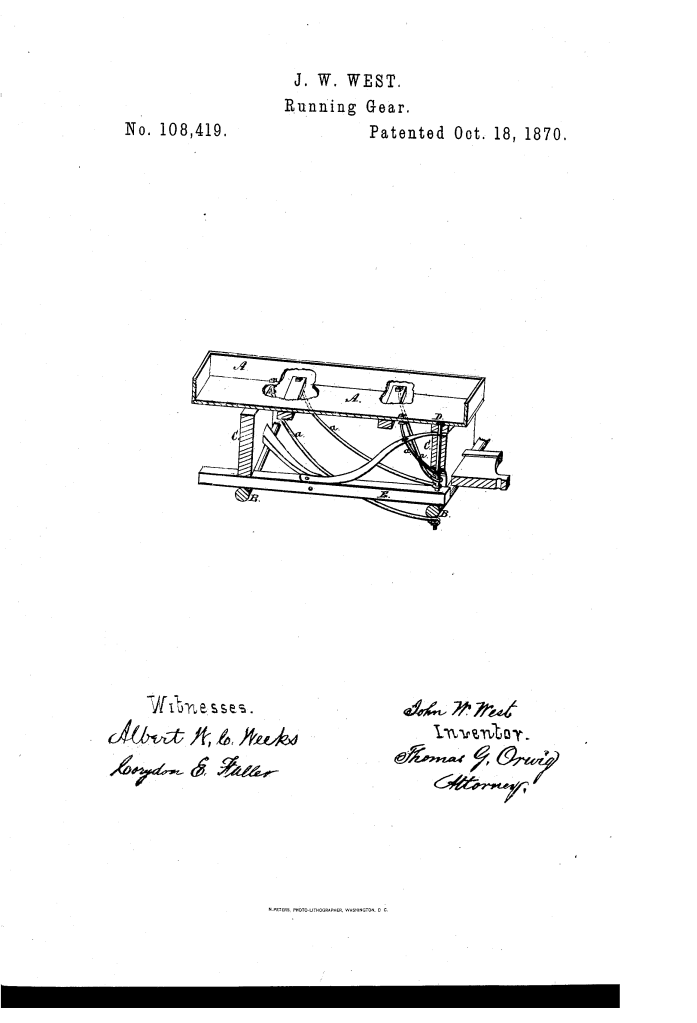
John W. West, from Saylorville, Iowa, was granted U.S. Patent No. 108,419 for an “Improvement in Wagons” on October 18, 1870. The patent was antedated to October 8, 1870.
What was innovative about West’s Improvement in Wagons?
West’s invention focused on a novel way to suspend the body or box of a wagon (or indeed, any kind of carriage) to improve its performance, particularly its ability to assist the propelling power.
Key features and the core innovation of his design included:
- Concentrated Forward Pressure: The central idea was to suspend the wagon box in such a manner that the weight or load placed upon it would be concentrated to press forward, thereby assisting the power used to move the wagon.
- Radiating Rods from the King-Bolt: This was achieved by a series of rods that radiated from the king-bolt (the main pivot connecting the front axle and steering mechanism to the wagon body). These rods connected with various points on the wagon box.
- Leverage for Propulsion: By bringing the force from the weight on the box to bear on the front axle through this system of rods, West aimed to create a leverage effect. This leverage would effectively convert some of the downward pressure of the load into a forward-assisting force, making the wagon easier to pull, especially when heavily laden.
- Larger Rear Wheels: While not the main patented feature, the patent abstract also notes that the hind wheels of his wagon were larger than the front wheels, implying a design intended to optimize pulling efficiency and possibly stability over uneven terrain.
- Versatility: West stated that the invention could be adapted for “all the common uses of carriages,” indicating its broad applicability beyond just freight wagons.
Personal and Historical Significance:
- Post-Civil War Economic Expansion: The 1870s were a period of rapid industrialization and westward expansion in the United States. Efficient transportation, particularly by wagons and carriages, was crucial for moving goods, people, and resources across the country, especially before the full build-out of the railroad network. West’s invention contributed to making this vital mode of transport more efficient.
- African American Contribution to Foundational Technology: Wagons were a fundamental technology of the era. West’s patent demonstrates that African American inventors were not just focused on niche products but were also contributing to improvements in core infrastructure and transportation.
- Assertion of Inventive Capability: Coming just five years after the 13th Amendment abolished slavery, West’s patent is a powerful testament to the intellectual capacity and ingenuity of African Americans who, for centuries, had been denied the right to their own inventions. His ability to secure a patent after the Dred Scott decision had temporarily halted such rights underscored the new, though still challenging, opportunities.
- Practical Problem-Solving: West’s invention addresses a very practical problem for anyone involved in hauling goods: making a heavy load easier to move. This kind of pragmatic innovation was common among African American inventors, who often focused on solutions that had a direct impact on daily life and productivity.
- Role in Agricultural Development (Iowa Context): Given his residence in Iowa, a state heavily reliant on agriculture, improvements in wagons would have been particularly valuable for farmers transporting crops, supplies, and equipment.
John W. West’s “Improvement in Wagons” stands as an example of how African American inventors contributed to the technological advancements of the nation during a critical period of growth and change, making fundamental improvements to the tools that drove America’s economy.
