
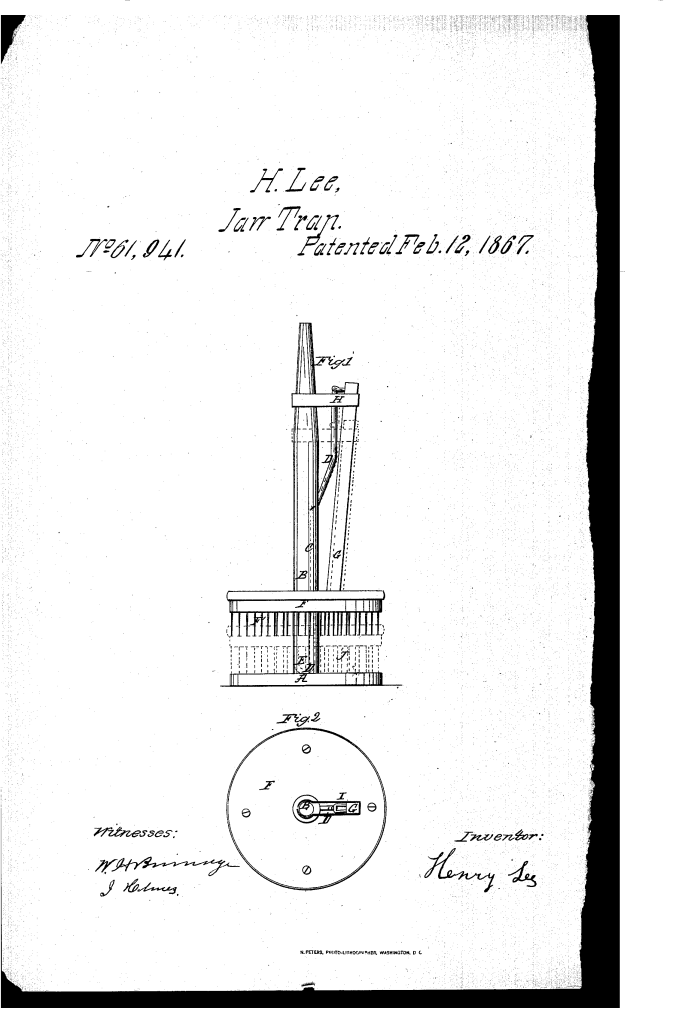
Henry Lee of Oberlin, Ohio, was an inventor who patented an “Improvement in Animal Traps.” He received U.S. Patent No. 61,941 on February 12, 1867.
His invention focused on a trap designed to quickly and effectively capture or impale an animal.
Here are the key aspects of Henry Lee’s improved animal trap:
- Design Principle: The trap operates on a spring-release mechanism triggered by the animal interacting with bait.
- Central Post and Bait Hook: The trap has a floor with a central standard or post. A curved rod, pivoted within a groove in this standard, has a hook at its loose end where the bait is attached. This rod is designed to be easily dislodged.
- Impaling Fall/Disk: The most distinctive feature is a large disk or “fall” of the same size and shape as the trap’s floor. The underside of this fall is studded with long, sharp points or teeth.
- Setting Mechanism: The fall is raised and held in an elevated position by a staple on the top of the central standard, which engages with the upper end of the curved bait rod. A yoke structure connects the fall to a supplementary standard on its upper side, ensuring it falls straight down.
- Trigger and Action: When an animal works at the bait or pulls the string attached to the bait hook, the curved rod is dislodged from the staple. This causes the heavy fall to drop instantly and forcefully down upon the animal, impaling it with the sharp points.
- Versatility: The patent also mentions that, instead of the impaling teeth, the fall could be fitted with a “bane or rim,” which would then merely imprison the animal rather than killing it. This suggests a potential for both lethal and non-lethal versions of the trap.
- Concealment: The floor of the trap could be covered with materials like meal or straw to hide the string and partially conceal the bait, making it less obvious to the animal.
Personal and Historical Significance:
- Early Post-Civil War Patent: Henry Lee’s patent from 1867 is incredibly significant because it falls within the very early years of the Reconstruction era, immediately following the end of slavery and the passage of the 13th Amendment (1865). This was a period when African Americans were just beginning to legally exercise their rights as citizens, including the right to obtain patents.
- Re-establishment of Patent Rights: After the Dred Scott v. Sandford decision of 1857 effectively barred all Black Americans (enslaved or free) from obtaining patents, the ability of men like Henry Lee to secure patents in 1867 demonstrated the profound impact of emancipation and the 14th Amendment (which confirmed Black citizenship, though ratified later in 1868). Lee’s patent is a tangible marker of this restored legal right and recognition of African American intellectual property.
- Everyday Problem Solving: Like many inventions by African Americans of this era, Lee’s trap addressed a practical, everyday problem (pest control, hunting) that had direct relevance to farming, household management, and survival. It shows ingenuity applied to common challenges.
- Symbol of Resilience and Ingenuity: For newly freed people and the broader African American community, each patent granted was a powerful symbol of their capabilities and contributions to the nation, directly challenging racist stereotypes that had been used to justify slavery and segregation. It affirmed their place as intelligent and contributing members of society.
Henry Lee’s “Improvements in Animal Traps” stands as an important, albeit often overlooked, marker in the history of African American innovation, showcasing the immediate impact of newfound freedoms on creativity and entrepreneurship.
