
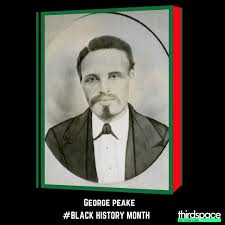
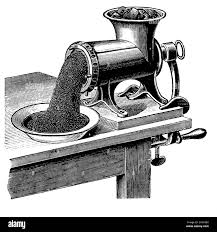
George Peake (c. 1722-1827) was an African-American inventor, Revolutionary War veteran, and an early settler in what would become Cleveland, Ohio. He is credited with inventing an improved hand mill for grinding corn.
Here’s what makes George Peake’s hand mill noteworthy:
- Necessity in Frontier Life: In the early 19th century, especially in frontier settlements like the one Peake helped establish in Ohio, access to large-scale milling operations was limited. Grinding grain, particularly corn, for food was a fundamental and laborious task. The traditional method involved a mortar and pestle, which was slow and produced coarse meal.
- Peake’s Innovation: Peake’s hand mill was a significant improvement over the rudimentary mortar and pestle. While the exact details of its mechanism are not available through a patent (as he did not receive one), historical accounts describe it as being made of two round stones, approximately 19 inches (about 48 cm) wide.
- Improved Efficiency and Quality: This design made the process of grinding corn much easier to use and produced a smoother, better quality of ground meal compared to the traditional methods. This was a valuable contribution to his community, as it simplified a vital daily chore and improved the quality of their staple food.
- Community Recognition, Not Patent: Like many inventors, particularly African Americans in that era, Peake did not file for or receive a formal U.S. patent for his invention. However, his contribution was recognized and celebrated by his neighbors. The Cleveland Leader newspaper credited him with the invention in a November 8, 1858, article, decades after his death. This public acknowledgment is a testament to the impact his invention had on his community.
- Historical Context: George Peake’s story is also significant because he was among the first African Americans to settle permanently in the Cleveland area. He was a free man and a landowner, which was unusual for African Americans at that time. His invention, and the positive reception it received, further endeared him to his fellow settlers.
George Peake’s hand mill for grinding corn is a testament to the practical ingenuity of early American settlers and inventors, especially those who, despite facing systemic barriers, made valuable contributions to their communities.
