
Improved Gridiron for Broiling (1845)
U.S. Patent No. 3,973, granted on March 26, 1845, to Joseph Hawkins, introduces a clever mechanical solution to a perennial culinary problem: the loss of flavorful juices and the creation of acrid smoke during the broiling of meat. Hawkins, a resident of West Windsor, New Jersey, designed a specialized cooking surface that allowed heat to reach the meat while simultaneously capturing 100% of the gravy.
The invention addressed the “flare-up” problem common in 19th-century hearth cooking, where fat dripping into the coals caused smoke that would “destroy the flavor” of the meat.
The Innovation: Concavo-Convex Overlapping Bars
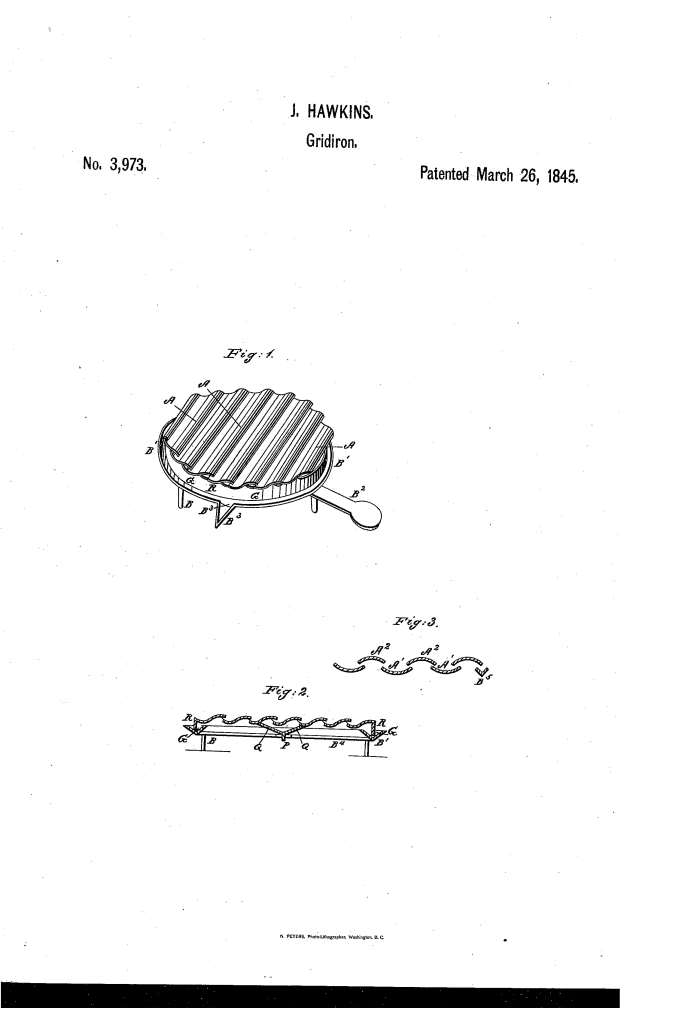
The heart of Hawkins’ invention lies in the geometry of the cooking surface. Instead of traditional flat or round bars, he utilized a “Cima Recta” (S-shaped) or concavo-convex design.
1. The Gravity-Fed Trough System
The bars were arranged parallel to one another but were strategically overlapped.
- The Convex Surface: The meat rests on the “hump” of the bar. As the meat cooks, the juices run down the sides of the convex surface.
- The Concave Surface: Because the bars overlap, the juice falling from one bar is caught by the “trough” or concave section of the bar below it.
- The Trough (G): These bars conduct the liquid to a circular trough that surrounds the entire grate.
2. The Rotating Mechanism
Unlike static gridirons of the era, the circular version of this grate was designed to move.
- The Pivot (P): The entire grate assembly turns on a central pivot and socket.
- Circular Rim (R): The ends of the bars are fastened to a rim that rotates within the stationary trough. This allowed the cook to rotate the meat over the fire for even heating without having to move the entire heavy stand.
Technical Components: Smoke Prevention
The apparatus was designed to be supported directly over an open fire or a stove hole, utilizing a specific “double-layered” approach to fluid management.
| Component | Function |
| Cima Recta Bars (A) | The S-shaped bars that catch gravy on the “inside” curve while exposing meat to heat on the “outside” curve. |
| Circular Trough (G) | The main collection ring that sits above the fire to catch all runoff from the bars. |
| Discharge Spout (B²) | A precision exit point that funnels the collected gravy into a separate receiver for use in sauces. |
| Ovolo & Cavetto Bars | An alternative “double-grate” design where an upper rounded bar (ovolo) sheds juice into a lower grooved bar (cavetto). |
Performance: Saving the Flavor
Hawkins’ gridiron provided two major advantages for the 19th-century kitchen:
- Nutrient Retention: By saving “all the liquid which falls from the meat,” the cook could preserve the most flavorful part of the meal, which was previously lost to the ashes.
- Smoke Elimination: By preventing fat from falling onto the fire, the gridiron stopped the creation of “burnt” smoke. This resulted in a cleaner broiling process and a more delicate flavor in the finished steak or chop.
About the Inventor: Joseph Hawkins
Joseph Hawkins was an inventor focused on the practicalities of domestic life in the mid-1800s.
- Engineering of the Hearth: His work reflects a transition in American history where scientific principles of fluid dynamics and heat management began to be applied to everyday household tools.
- Versatility in Design: Hawkins was practical enough to include designs for both round and square gridirons in his patent, acknowledging that farmers used various types of stoves and open hearths.
- Focus on the “Gravy”: At a time when meat was expensive, the ability to “save all the gravy” was a significant economic and culinary selling point for his invention.
Summary of Claims
The 1845 patent explicitly protects:
- The construction and arrangement of the bars specifically for the purpose of saving gravy.
- The overlapping configuration of concavo-convex bars that allows heat to pass upward while blocking liquid from falling downward.
- The combination of a revolving grate with a stationary trough and spout system.
