
Multiple Effect Evaporator (1843)
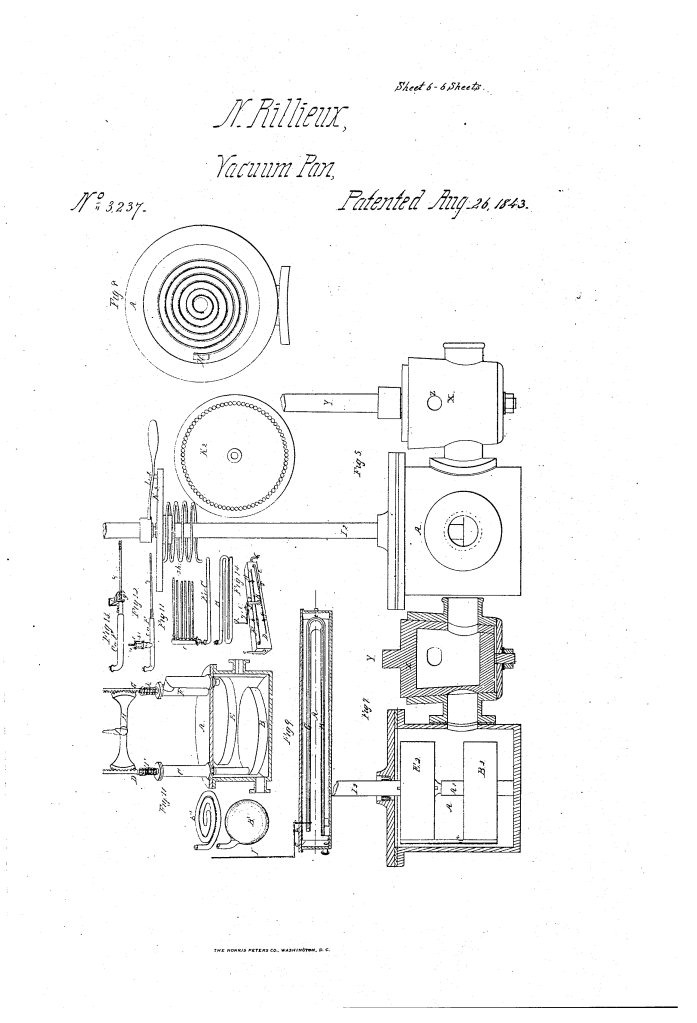
U.S. Patent No. 3,237, granted on August 25, 1843, to Norbert Rillieux, is arguably one of the most important inventions in the history of chemical engineering. Rillieux, a brilliant engineer and free person of color from New Orleans, revolutionized the sugar industry by developing a system that recycled heat, drastically reducing the fuel and labor required to refine sugar.
Before Rillieux’s invention, sugar was produced using the “Jamaica Train”—a dangerous, back-breaking process where enslaved workers ladled boiling sugarcane juice from one open kettle to another over an open fire. Rillieux replaced this with a closed, automated, and energy-efficient system.
The Innovation: The Multiple Effect Evaporator
The core of Rillieux’s invention is the principle of latent heat. He realized that the steam rising from one boiling vat of sugar juice could be used to boil the juice in a second vat, provided the second vat was under a vacuum (which lowers the boiling point of the liquid).
1. The Cascading Heat System
In Rillieux’s system, a series of pans (evaporators) are connected in a sequence.
- The First Pan: Heated by high-pressure steam from a boiler. As the juice boils, it releases vapor.
- The Second Pan: This vapor is piped into the heating chamber of the next pan. Because this second pan is under a partial vacuum, the juice inside boils at a lower temperature than the first, allowing the “waste” steam from the first pan to act as a heat source.
- The Third Pan (and so on): The process repeats, with each subsequent pan operating at a higher vacuum and a lower temperature.
2. Integration with the Steam Engine
Rillieux’s first improvement involved connecting the plantation’s steam engine directly to the evaporating pans. The engine was powered by steam on its way to the pans. A weighted throttle valve regulated the flow, ensuring the pans received steam at the exact temperature needed while the engine performed mechanical work simultaneously.
Technical Components: Automation and Control
The Rillieux apparatus was a complex “machine” that managed pressure, temperature, and fluid flow with remarkable precision for the 1840s.
| Component | Function |
| Vacuum Pan | A sealed vessel where juice is concentrated at low temperatures to prevent “burning” or discoloring the sugar. |
| Differential Thermometer | A specialized sensor that measured the difference between the temperature of the boiling sirup and its vapor to accurately gauge concentration. |
| Champenoise Column (Improved) | A vertical heating column that Rillieux enclosed in a “jacket” to allow it to function within his vacuum-cascading system. |
| Condenser & Air Pump | Used to create and maintain the vacuum necessary to lower the boiling points in the secondary pans. |
Performance: Revolutionizing the Industry
Rillieux’s system moved sugar refining from an artisanal (and dangerous) craft to a modern industrial process.
- Fuel Efficiency: By reusing steam multiple times, the system reduced fuel consumption (usually wood or “bagasse”—dried cane stalks) by up to 70%.
- Product Quality: Because the sugar was boiled at lower temperatures in a vacuum, it did not caramelize or burn, resulting in a much higher quality, whiter sugar crystal.
- Safety: By enclosing the boiling juice in pipes and vats, the risk of “flash” fires and severe burns to workers was significantly mitigated.
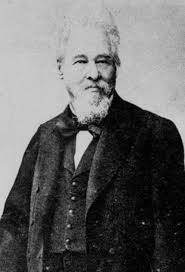
About the Inventor: Norbert Rillieux
Norbert Rillieux (1806–1894) was a figure of immense intellectual stature whose contributions to thermodynamics remain fundamental today.
- Education: Born in New Orleans to a wealthy white planter and a free woman of color, he was sent to Paris to be educated at the École Centrale, where he became an instructor in applied mechanics at age 24.
- Return to Louisiana: He returned to New Orleans to implement his designs, but as a person of color in the antebellum South, he faced increasing legal and social restrictions despite his genius.
- Legacy: Rillieux eventually returned to France, where he spent his later years studying Egyptology. His multiple-effect evaporation principle is still used today in the production of sugar, condensed milk, glue, and in seawater desalination.
Summary of Claims
The 1843 patent explicitly protected:
- The use of a weighted throttle valve to regulate steam flow between an engine and an evaporating pan.
- The combination of a vacuum pan with a standard boiler, where the vapor from the first serves as the heating element for the second.
- The use of a differential thermometer to regulate the concentration of sirup by monitoring temperature variances between the liquid and its vapor.
