
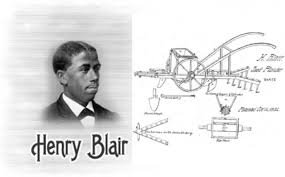
Henry Blair was a significant African-American inventor, known for his contributions to agricultural machinery. He is especially notable as the second African American to be granted a U.S. patent, following Thomas L. Jennings.
Blair received his first patent on October 14, 1834, for a corn-planting machine. The patent number for this invention is X8,447.
Here are the key details of Henry Blair’s corn-planting machine:
- Design and Functionality: While the original patent document was lost in the 1836 Patent Office fire (making it an “X-patent,” as discussed with Thomas L. Jennings), contemporary descriptions and surviving records give us a good understanding of its design.
- It was essentially a horse-drawn device, resembling a wheelbarrow.
- It featured two shovel-like blades at the front that would open a furrow in the ground.
- Behind these blades, a wheel-driven cylinder with holes on its periphery would rotate. This cylinder was connected to a hopper filled with corn seeds. As the cylinder turned, it would automatically drop a precise quantity of seeds at regular intervals into the newly opened furrow.
- Following the seed drop, rakes or other mechanisms at the back of the machine would then cover the seeds with soil and level the ground.
- Efficiency and Labor Savings: The primary benefit of Blair’s corn planter was its significant improvement in planting efficiency. It allowed farmers to plant corn much faster and with less labor than manual methods. An article in The Mechanics’ Magazine from 1836 estimated that his invention “will save the labour of eight men.”
- Weed Control: The machine was also designed to facilitate better weed control. By planting corn in straight rows or a checkerboard pattern, it made subsequent cultivation and weeding much easier.
- Impact on Agriculture: Blair’s invention was a crucial advancement in agricultural technology during a time when the United States was still largely agrarian. It contributed to increased productivity in corn farming, a staple crop.
- Personal and Historical Significance:
- Henry Blair was a free black farmer from Glen Ross, Montgomery County, Maryland. His status as a free man allowed him to apply for and receive a patent, as slaves were not permitted to do so in their own names.
- He is uniquely identified in the patent records as a “colored man,” which is the only such notation in early U.S. patent history, highlighting the racial context of the time.
- Although he signed his patent application with an “X,” suggesting he may have been illiterate, his ingenuity and mechanical aptitude were undeniable.
Two years after his corn planter, Henry Blair also patented a cotton planter on August 31, 1836 (U.S. Patent No. 15A), which was an adaptation of his corn planter design for cotton cultivation. His work on both planters solidified his legacy as a pioneering African-American inventor in the field of agriculture.
