
Celebrating Black Inventions
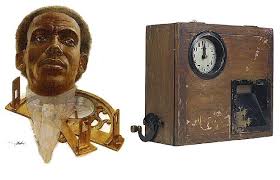
Benjamin Banneker (1731–1806) is famously known for building one of the first striking clocks entirely in America, and notably, it was made almost entirely of hand-carved wood. He was a self-taught African-American mathematician, astronomer, and almanac author who achieved fame in early America. He is also renowned for accurately predicting solar eclipses, assisting with the surveying of Washington, D.C., and publishing his widely popular almanacs. Banneker used his work to challenge racist assumptions of his time, most notably in a letter to Thomas Jefferson, and remained a lifelong advocate for civil rights.
Benjamin Banneker was born free in 1731 to a free African American mother and a former slave father who had purchased his freedom. Although he was born in a slave state and came from a lineage that included slavery, Banneker himself was never enslaved.
Benjamin Banneker did not seek or receive a patent for his wooden clock because the concept of patenting individual inventions was not as established or accessible in the early 1750s, especially for a self-taught Black man without extensive connections. While Banneker was a skilled craftsman who built America’s first all-wooden clock from scratch, his focus was on creation and accuracy rather than legal protection for his work, a process that would become more formalized later in history.
Here are the key details about Banneker’s striking wall clock:
- Year of Creation: Banneker built his clock around 1753, when he was about 22 years old.
- Inspiration: He was inspired after borrowing a pocket watch from a wealthy acquaintance. He meticulously disassembled the watch, studied its intricate components, and made detailed drawings of each part. He then reassembled the watch and returned it to its owner, fully functioning.
- Construction: Using these drawings as a blueprint, Banneker then set about creating a much larger version. He hand-carved each gear, cog, and other mechanism primarily from wood using only a pocketknife. He even calculated the proper number of teeth for each gear and the necessary relationships between them. For the “striking” mechanism, he used a metal bell.
- Accuracy and Longevity: The clock was remarkably precise and kept accurate time for over 50 years, until his death in 1806 when his home and most of his possessions were tragically destroyed in a mysterious fire.
Significance:
- Self-Taught Genius: Banneker was largely self-taught, having received very little formal schooling. His ability to reverse-engineer a complex pocket watch and then construct a fully functional, accurate striking clock from wood was a testament to his extraordinary mechanical aptitude and intellect.
- American Innovation: At a time when most clocks and watches in America were imported from Europe, Banneker’s clock was a significant feat of American ingenuity and craftsmanship. It was, by many accounts, the first striking clock built entirely in America.
- Reputation Builder: The clock garnered him significant local attention and established his reputation as a brilliant mind and skilled mechanic. This reputation later helped him gain access to scientific instruments and books, further expanding his knowledge of astronomy and mathematics, which he used to publish his renowned almanacs and contribute to the surveying of Washington D.C.
Banneker’s wooden striking clock stands as a powerful symbol of his remarkable talents and his perseverance in an era when opportunities for African Americans were severely limited.
