
Hear podcast on Spotify and Apple Podcast:
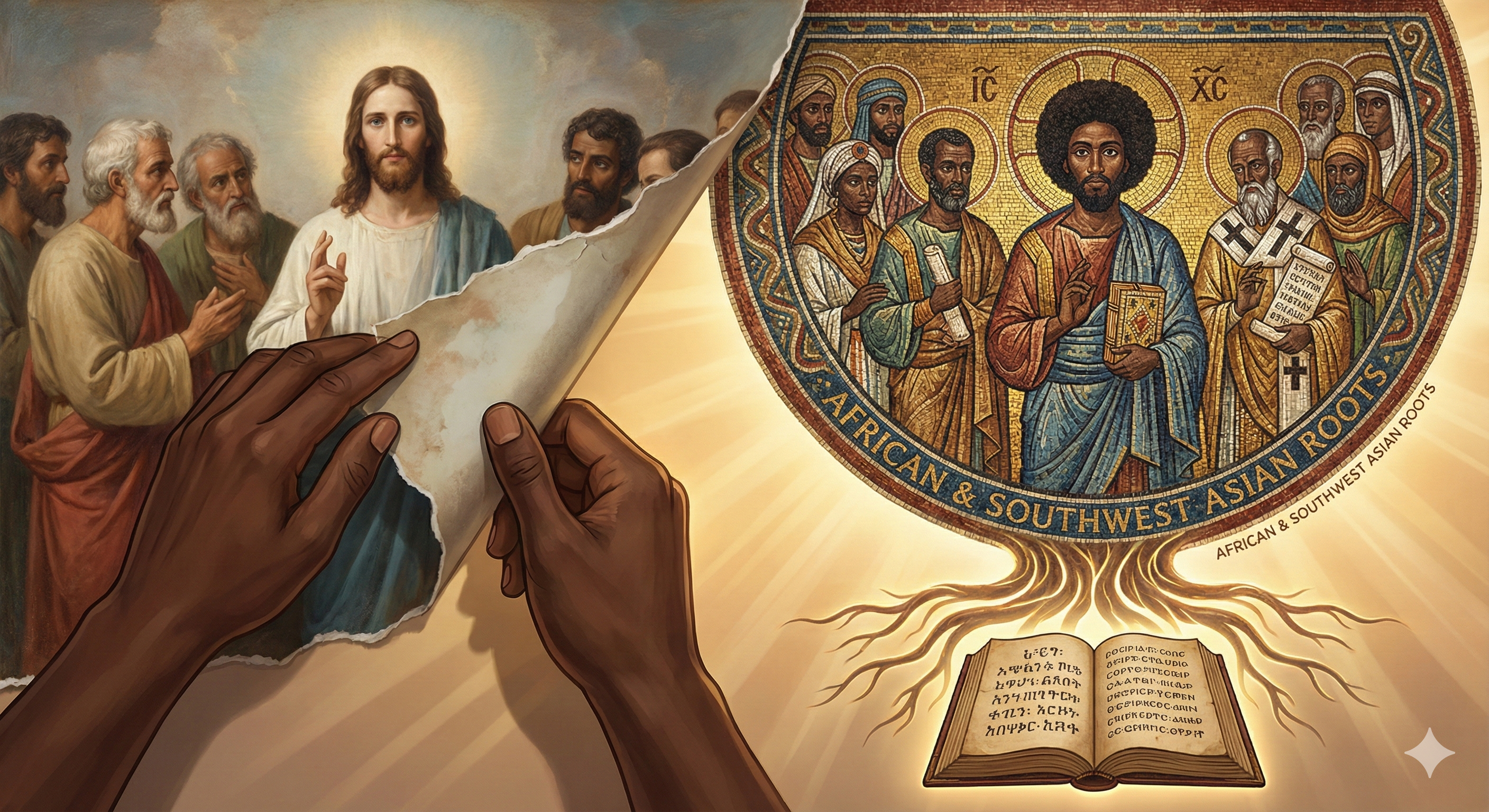
Growing up, there was a common print of Leonardo da Vinci’s The Last Supper hanging on my grandmother’s living room wall. It is a cherished image for many, yet for me, it represents a profound historical conflict.
As we celebrate the festive season of Christmas, we are routinely confronted with a visually pervasive, culturally dominant narrative: a fair-skinned, blue-eyed Jesus, surrounded by disciples and the recognized intellectual architects of Christianity—all rendered as white Europeans. For an African American Christian who loves history, the cognitive dissonance is unavoidable.
This visual distortion has fueled the assertion by some in the Black community that Christianity is merely a “white man’s religion.” This powerful claim drives some Black people away from the Church entirely. Yet, it is a rejection based on a lie: centuries of visual and historical misinformation.
The cognitive challenge of accepting this truth cannot be overstated. When I first started reading the foundational works of African American scholars like Ivan Van Sertima, Dr. John Henrik Clarke, or Chancellor Williams, I was stunned. My uncle taught me about Civil Rights heroes, but my only context for Africa came from Tarzan movies or commercials featuring starving children. I was educated on my oppression, but ignorant of my contribution.
Even after studying African history in college, the data was so contrary to the dominant narrative I grew up with that my reaction was literal unbelief. My programming was so complete that the idea that “Black people and culture contributed so much” felt impossible. This is not a testament to a lack of Black accomplishment, but rather to the effectiveness of extreme white-washing.
Methodology: Historical Accuracy over Revisionism
Let me be clear: This paper does not originate from a need to claim that Black people are the creators of everything. I am not attempting to “black-wash” history, nor do I seek to substitute one form of racial supremacy for another.
I am simply following the facts and logic that history has left for us. If the historical data indicated that these figures were European, I would be no less of a Christian. However, the data tells us what is logical: the brilliant theologians who were born, lived, and worked in Africa were African, not European.
This paper asserts a foundational truth often obscured by Eurocentrism: Christianity is a faith with its origins in Southwest Asia and its theological architecture built in Africa.
1. The Historical Identity of Biblical Figures: Southwest Asian Roots
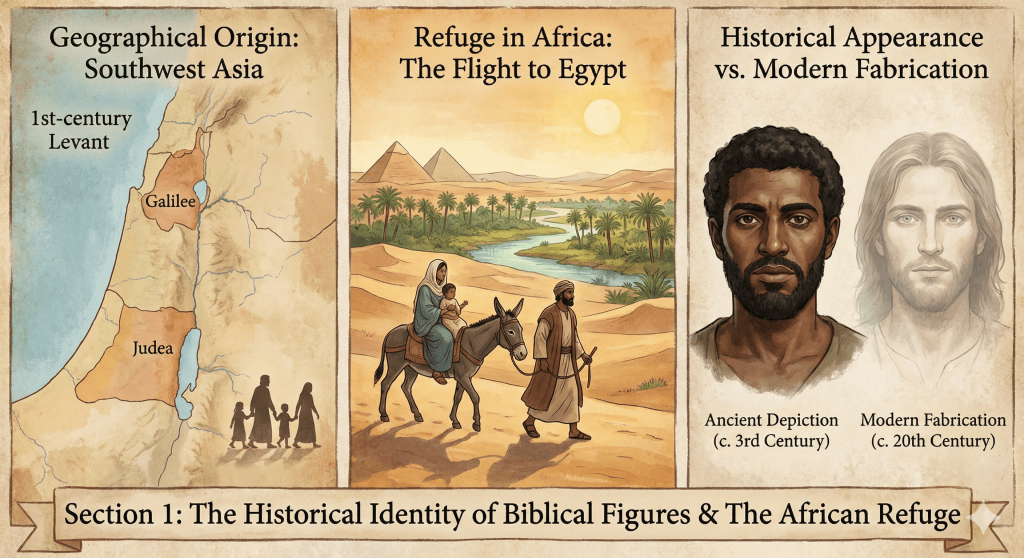
The core figures of the Christmas story—Jesus, Mary, and Joseph—and later, the disciples, are continually racialized in Western art as European. This is a historical impossibility.
- Geographical Origin: Jesus, his family, and his disciples were Jews from Galilee and Judea—regions in the Eastern Mediterranean (the Levant), geographically located in Southwest Asia.
- The Origin of the Name (Antioch): It is often assumed that the identity of the Church was formed in Rome. However, the Bible records that “the disciples were called Christians first at Antioch” (Acts 11:26). Antioch is located in ancient Syria (Southwest Asia). Furthermore, the leadership of this founding church was multi-ethnic. Acts 13:1 records that the prophets who ordained Paul included Lucius of Cyrene (from Libya, North Africa) and Simeon called Niger (a Latin term meaning “Black”). The men who sent the Gospel to Europe were African and Southwest Asian.
- The Refuge Narrative: Furthermore, Africa played a critical role in the physical survival of the faith. When King Herod sought to kill the infant Jesus, the Holy Family was not told to flee to Rome or Athens; they were told to flee to Egypt. Historically, Africa has not just been a passive recipient of the Bible; it was the cradle of refuge and preservation for the Messiah.
- Phenotype: The people of the Levant during the 1st century had a genetic and physical profile typical of the region. They would have had brown or olive-brown skin, brown eyes, and dark hair. They were Semitic people, not North European. It is crucial to clarify this term, as its modern usage is often narrowed. While the common term “anti-Semitic” refers specifically to prejudice against Jews, causing many to equate the two terms, the root historical and linguistic term “Semitic” is far broader. It refers to a diverse group of peoples across Southwest Asia and North Africa spanning many cultures and languages—including ancient Babylonians, Assyrians, Arabs, as well as Israelites—not solely adherents of the Jewish faith.
- The Rejection of “White”: The oldest known images of Christ found in the East—such as the frescoes of Dura-Europos in Syria—reflect the brown, olive-colored skin typical of the Semitic people of that region
2. The Modern Construction of Jewish Identity: A Recent Demographic Shift
A primary reason the West struggles to visualize a brown-skinned Jesus is our contemporary visual association with the Jewish people. In the modern Western imagination, the “standard” image of a Jewish person is Ashkenazi—of Central or Eastern European descent.
This European phenotype is subconsciously projected backward onto the ancient world. However, historical statistics reveal that this European-dominant Jewish identity is a relatively recent anomaly.
The Demographic Flip
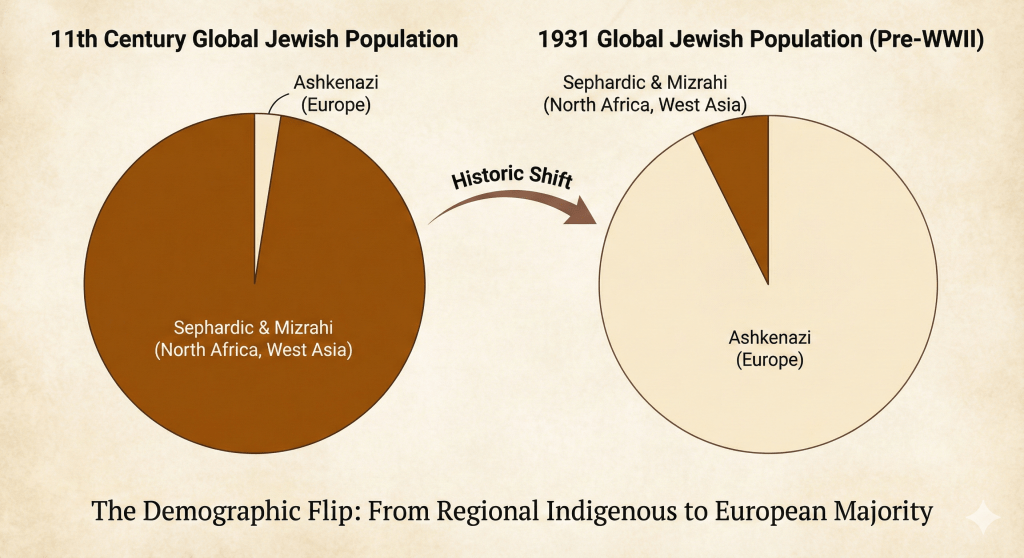
- 11th Century: Historical data indicates that approximately 97% of the world’s Jewish population was Sephardic or Mizrahi (residing in North Africa and Western Asia). Only roughly 3% were Ashkenazi (European).
- 17th Century: Even as late as the 1600s, the Sephardic/Mizrahi population still outnumbered the Ashkenazi population globally.
- 1931 (Pre-WWII): Due to massive population growth in Eastern Europe, the balance flipped. By 1931, Ashkenazi Jews accounted for approximately 92% of world Jewish population.
The “Retrospective Illusion”
This demographic shift creates a retrospective illusion. We look at the modern Ashkenazi population and incorrectly assume that the biblical population of Judea shared these same physical characteristics. History tells us the opposite: the biblical population mirrored the brown-skinned, indigenous populations of Western Asia, not the modern European diaspora.
3. The African Founders of Christian Thought
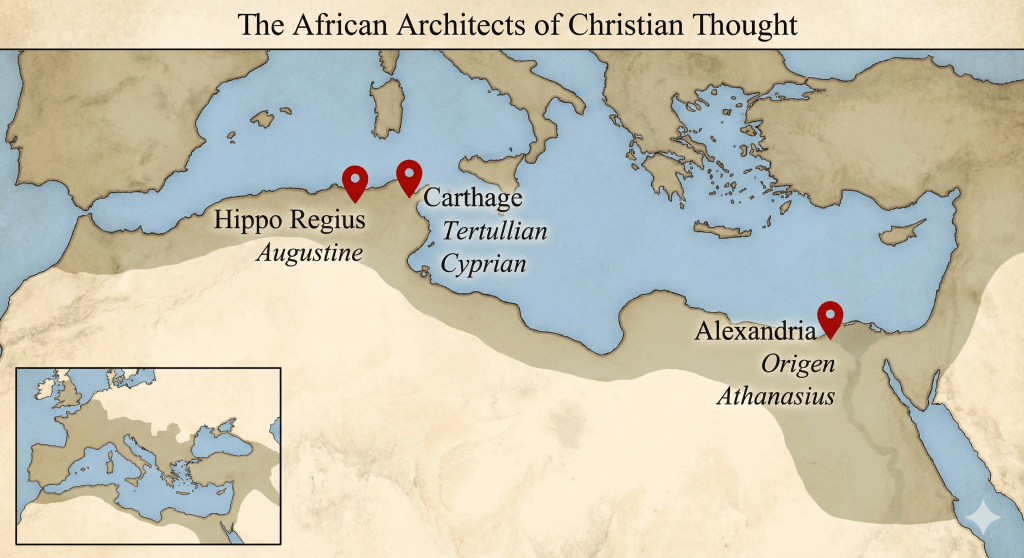
While the faith originated in Southwest Asia, the intellectual bedrock of the Christian faith—especially the Western tradition—was built by Africans. These influential figures, commonly known as the Church Fathers, were indigenous inhabitants of the Maghreb and the Nile Valley.
The Timeline: Africa Before Europe
It is vital to correct the historical timeline. According to the Book of Acts, the first recorded Gentile (non-Jewish) convert to Christianity was an Ethiopian official (Acts 8). This conversion occurred years before the Apostle Paul ever set foot in Europe. Historically, the Gospel reached the heart of Africa before it ever reached the shores of Europe.
To assert that Christianity is a “white European religion” is to erase the contributions of its most brilliant early theologians and architects:
- Tertullian (c. 160–240)
- Origin: Carthage (Tunisia)
- Indigenous Identity: Punic / Berber
- Key Contribution: Known as the “Father of Latin Christianity.” He was the first to coin the term “Trinity” (trinitas) to explain the Godhead.
- Cyprian (c. 200–258)
- Origin: Carthage (Tunisia)
- Indigenous Identity: Punic / Berber
- Key Contribution: Defined the unity and authority of the Church and its bishops.
- St. Anthony the Great (c. 251–356)
- Origin: Coma, Lower Egypt.
- Indigenous Identity: Coptic (Indigenous Egyptian)
- Key Contribution: The “Father of All Monks.” He founded Christian monasticism. The entire structure of monks, nuns, and monasteries—often associated with medieval Europe—was actually invented by Black men in the Egyptian desert.
- Origen (c. 185–254)
- Origin: Alexandria (Egypt)
- Indigenous Identity: Coptic (Indigenous Egyptian)
- Key Contribution: A pioneer of systematic theology and biblical interpretation.
- Athanasius (c. 295–373)
- Origin: Alexandria (Egypt)
- Indigenous Identity: Coptic (Indigenous Egyptian)
- Key Contribution: The principal defender of Jesus’s divinity at the Council of Nicaea. He was historically described as having a dark complexion.
- Augustine of Hippo (c. 354–430)
- Origin: Hippo Regius (Algeria)
- Indigenous Identity: Punic / Berber
- Key Contribution: Known as the “Father of Western Christianity.” His theology on sin and grace forms the basis of both Catholic and Protestant thought.
4. The Theological Necessity of Inculturation vs. Erasure
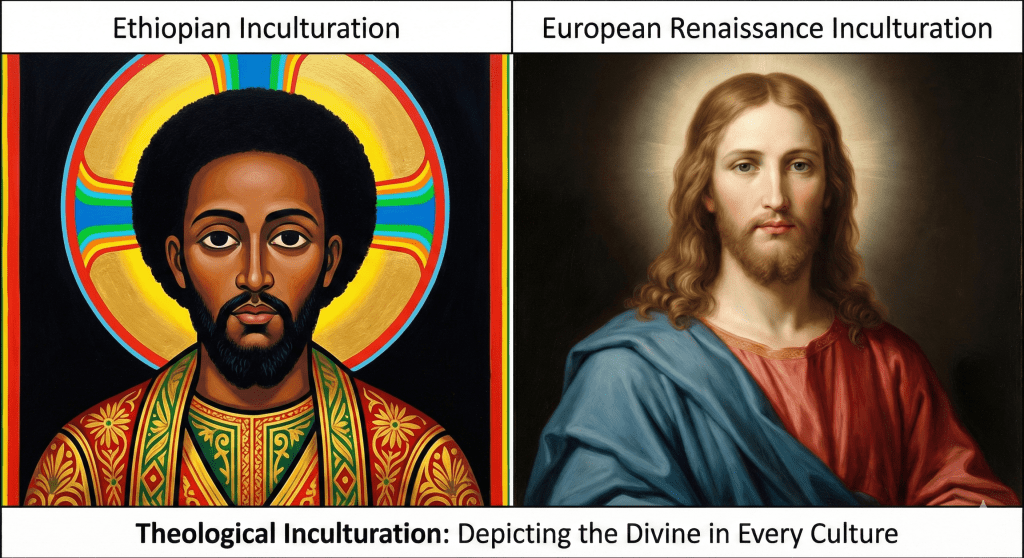
To understand how the “White Jesus” became dominant, we must first understand a standard, accepted practice in Christian theology known as Inculturation.
Inculturation is the adaptation of the Gospel and its imagery into a specific culture.
- Universal Representation: Ethiopian art depicts Jesus and the Apostles as Ethiopians. Chinese art depicts them as Chinese. This is not a lie; it is a theological statement that Christ is incarnate in every culture.
- European Inculturation: When German or Italian artists depicted Augustine or Jesus as white, they were originally practicing inculturation. They were making the holy figures relatable to their local congregations.
The Transition to Erasure
The problem arose when European Inculturation became Global Normativity. Because of European colonialism, the “White Jesus” and “White Augustine” were exported back to Africa and the Americas as the only legitimate representations.
- The Renaissance Shift: Before the Renaissance, Byzantine iconography (such as the Black Madonna icons or the mosaics of Ravenna) often depicted saints with darker, more olive complexions. However, the shift to hyper-realistic, pale-skinned depictions in the 15th century coincided with the rise of the Atlantic slave trade. Critics like Titus Kaphar have noted that this era “whitewashed” history by physically altering the visual record to center whiteness.
- The Psychological Impact: As scholar Edward J. Blum argues, the image of a white Christ became associated with the logic of empire. It justified the oppression of Native and African Americans by putting God on the side of the colonizer.
5. The Mechanism: How Christianity Was “White-Washed”
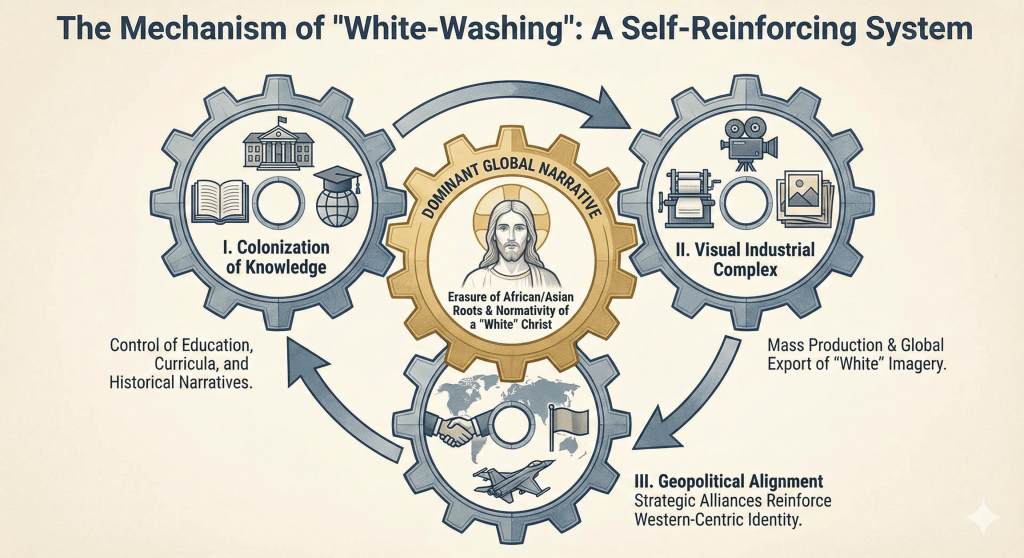
The transition from “local art” to “global erasure” was not an accident; it was a powerful tool used to solidify racial hierarchy.
I. The Colonization of Knowledge
European nations did not just colonize land; they colonized education. By controlling schools, universities, and publishing houses, they enforced curricula that prioritized European history while systematically erasing the histories of Africa and Asia. The colonizer’s truth became the mandatory, global truth.
II. The Visual Industrial Complex
The rise of European power coincided with the industrialization of art production (printing press, film, etc.). This allowed the visual white-washing of history to spread globally. While an Ethiopian icon remained in Ethiopia, European prints were mass-produced and shipped worldwide.
III. Geopolitical Alignment
This distortion is actively maintained by modern geopolitics. Following World War II, the Zionist movement (largely Ashkenazi) forged a strategic alliance with Western powers. This positioned the new state of Israel as a Western-aligned outpost in Southwest Asia. This cultural bond makes it easier for Western audiences to visually claim modern Jewish identity—and by extension, ancient biblical identity—as fundamentally European. Admitting that the original Jews were brown-skinned Southwest Asians undermines the “White Jesus” myth that has served the West so well.
6. Conclusion: Reclaiming the Narrative
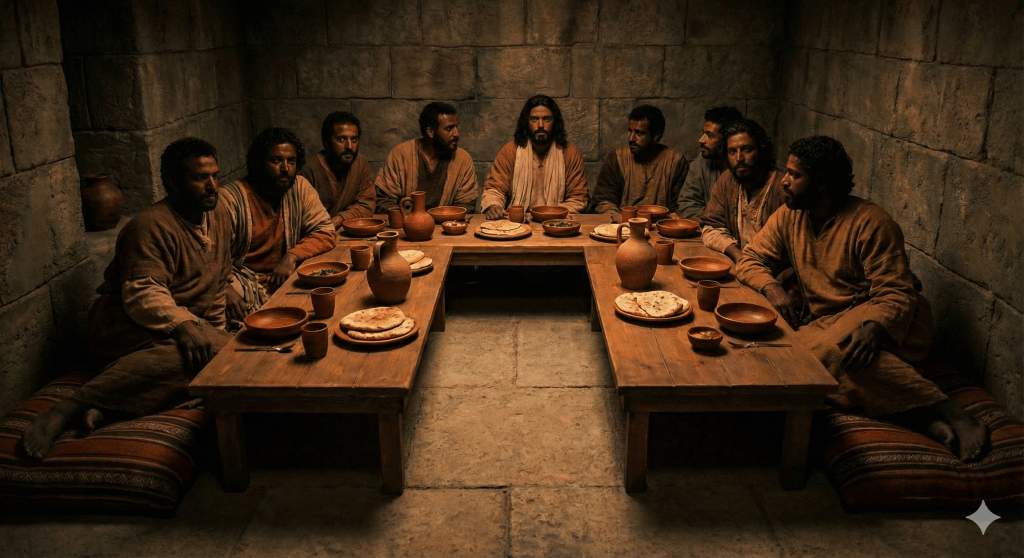
The greatest irony is that White Supremacy claims Christianity as a strictly European heritage, yet relies on images of a white Jesus created by the very distortion that expunged the faith’s African and Asian roots. The white Jesus is, at its core, a symbol of historical erasure.
When I think back to that print of The Last Supper on my grandmother’s wall, the feeling of conflict is gone; it has been replaced by clarity. I realize now that while the image she revered was a European fabrication, the faith she held was unknowingly indigenous. She was not praying to a stranger’s god. Without a history book, she was connecting with a spiritual lineage that stretches back not to Rome or London, but to the Nile Valley and the Levant.
For African American Christians, reclaiming these roots is a revolutionary act. It directly answers the critique that the faith is a “white religion.” By revealing that the people who wrote and codified the core doctrines were brown-skinned Africans and Southwest Asians, the foundational argument for rejection is dismantled.
We do not practice a white European religion. We practice a faith whose intellectual structure was built by our ancestors.
