
Table of Contents
- The Sanitized Search Engine Narrative
- The True Origin: May 1, 1865
- Why Was This Story Forgotten?
- The Same Formula: Lady Liberty’s Hidden Chains
- A Shared Legacy of Dilution
- Conclusion: Reclaiming the Foundation
- Glossary of Key Terms
- Historical Bibliography
The Sanitized Search Engine Narrative
What is Memorial Day?
When you type that question into Google, you get a clean, institutional answer:
“Memorial Day is a federal U.S. holiday held on the last Monday of May to mourn and honor the military personnel who died in service. It is distinct from Veterans Day, which celebrates all living veterans.”
The search engine goes on to lay out the official timeline. It tells us the tradition began as “Decoration Day” in the years following the Civil War, was widely established on May 30, 1868, by General John A. Logan of the Grand Army of the Republic, and became an official federal holiday in 1971.
It is a day we all observe by honoring our fallen. Their families deserve every ounce of honor we give them; those service members made the ultimate sacrifice in defense of our country.
I would be remiss, however, if I did not live up to the mission of this blog. My Two Cents is a provocative digital space dedicated to reclaiming history through the power of truth. At the heart of this platform is a commitment to unearthing the untold stories of Black history and challenging the systemic inaccuracies that have long shaped American and world narratives.
I am constantly questioned about this mission. “Why do you have to mention that they are Black?” “What you do is divisive,” people say. They fail to recognize, understand, or perhaps just admit that our history is already divisive. This country was built on legal segregation—you cannot get much more divisive than separating an entire group of citizens both physically and legally.
Historically, proponents of segregation hid behind the legal and social doctrine of “separate but equal,” arguing it preserved public peace and distinct cultural traditions. In reality, it was a system of institutional racism explicitly designed to enforce white supremacy and keep African Americans in a subordinate status.
A massive part of maintaining that system was controlling the narrative. To convince the white public that mixing with Black citizens would be destructive, it was imperative to erase Black contributions to American society. If a foundational cultural event involved Black agency, that involvement had to be scrubbed.
To make history palatable to the dominant culture, specific African American triumphs are systematically stripped away. The narrative is reframed around general freedom, commercial consumerism, or white paternalism. Historians call this process “universalization.”
What does this have to do with Memorial Day? It fits this American formula perfectly.
The True Origin: May 1, 1865
The full story of Memorial Day was largely lost to the national consciousness for generations until Yale historian Dr. David Blight discovered a misplaced archival file at Harvard containing 1865 newspaper clippings detailing the actual first observance.
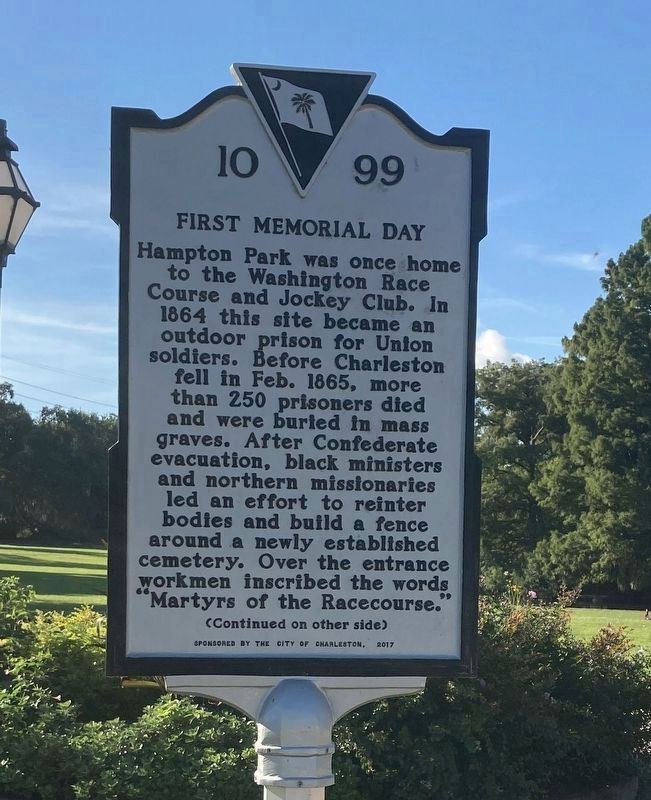
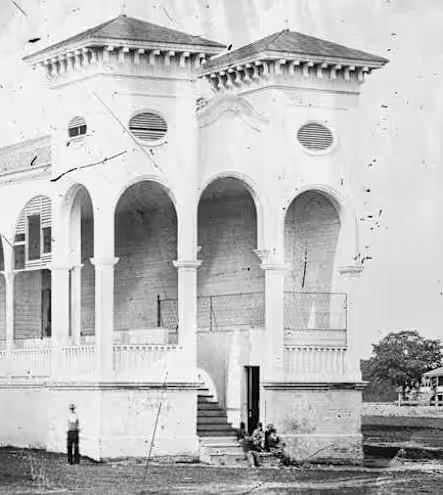
During the final year of the Civil War, the Confederate military turned the Washington Race Course and Jockey Club—a playground for wealthy South Carolina planters—into an open-air prison camp for Union soldiers. Due to disease and horrific exposure, at least 257 Union prisoners died there, buried hastily in a chaotic mass grave behind the grandstand. When Charleston fell to the Union in early 1865, the white population largely fled, leaving behind thousands of newly freed Black citizens.
In April 1865, a group of 28 Black workmen from local churches took it upon themselves to give those Union dead a proper, honorable resting place. Over ten days, they exhumed the bodies, reburied them in respectful rows, and landscaped the grounds. They built a 10-foot-tall wooden fence around the cemetery, whitewashed it, and over the arched entryway painted the words: “Martyrs of the Race Course.”
On May 1, 1865, a massive crowd of 10,000 people—predominantly Black former slaves, alongside white missionaries, teachers, and Union troops—gathered to dedicate the cemetery.
- The Children: The procession was led by 3,000 Black schoolchildren from the newly established freedmen’s schools, marching with armloads of fresh roses and singing “John Brown’s Body.”
- The Citizens: Hundreds of Black women followed with baskets of flowers and wreaths, followed by Black men marching in cadence.
- The Troops: Famous Union regiments, including the historic 54th Massachusetts and the 35th and 104th U.S. Colored Troops, performed drills around the graves.
When the ceremony concluded, the graves were buried under a sea of flowers. Black ministers led prayers, choirs sang spirituals, and the crowds broke out into picnics on the infield—creating the exact blueprint of how Americans celebrate Memorial Day today.
Why Was This Story Forgotten?
When Reconstruction ended and white Democrats regained political control of the South, the narrative of the war’s origin was heavily rewritten. The rich history of Black citizens founding a holiday dedicated to emancipation and the Union dead was actively suppressed in favor of a narrative focused on white reconciliation between the North and South.
Over the last 150 years, the core message shifted away from the specific political achievements of the Civil War—like ending slavery—and was streamlined into a universal, non-political tribute to military sacrifice built on three comfortable pillars:
- The Core Modern Message: Differentiating Memorial Day (those who died) from Veterans Day (those who lived) to keep the focus strictly on a somber, nationwide tribute.
- The Commercial Message: The Uniform Monday Holiday Act of 1968 shifted the day to a guaranteed three-day weekend, transforming it into “the unofficial start of summer” dominated by backyard barbecues, beach trips, and mattress sales.
- National Unity: Shifting the rhetoric to the shared bravery of soldiers rather than the contentious causes they fought for, institutionalized by the National Moment of Remembrance at 3:00 p.m.
The old racetrack is now Hampton Park in Charleston. While the soldiers’ bodies were moved to the National Cemetery in Beaufort in the 1880s, a lone bronze plaque was finally placed at Hampton Park in 2010. But the national memory remains scrubbed.
The Same Formula: Lady Liberty’s Hidden Chains
This follows a distinct American historical pattern. The true impetus behind the Statue of Liberty was also deeply rooted in the abolition of slavery and the triumph of the Union—a narrative systematically replaced by a completely different concept. Most people today look at Lady Liberty and see a beacon welcoming immigrants. While beautiful, that was not why she was built.
The idea was conceived in 1865 by Édouard René de Laboulaye, president of the French Anti-Slavery Society. Ecstatic over the ratification of the 13th Amendment, Laboulaye and his circle of French liberals wanted to present a gift to the United States to celebrate the destruction of human chattel slavery.
The sculptor, Frédéric-Auguste Bartholdi, embedded the message of emancipation directly into the bronze. The most undeniable evidence is right at her feet—hidden from the view of millions of tourists who visit every year.
Bartholdi originally designed the statue holding broken chains in her hand. Concerned that the imagery was too politically polarizing for white American donors, he moved the chains to her feet, partially obscured by her toga, and placed the July 4, 1776 tablet in her hand instead. Lady Liberty is literally stepping forward out of the chains of bondage.
When American committees raised money for the pedestal, the wealthy elite deliberately downplayed the anti-slavery theme to avoid disrupting post-Reconstruction national reconciliation. In 1883, Emma Lazarus wrote “The New Colossus” to raise funds, centering the immigrant experience. When her poem was attached to the pedestal in 1903, the transformation was complete: the monument shifted from celebrating the liberation of Black Americans to celebrating the arrival of European immigrants.
A Shared Legacy of Dilution
We see this exact dilution across our cultural landscape:
- Labor Day: Signed into law in 1894, the modern imagery of the holiday heavily appropriated the fierce, dangerous civil rights battles of Black labor organizers like A. Philip Randolph and the Brotherhood of Sleeping Car Porters. Their radical fight for basic human dignity against post-slavery exploitation was repackaged into a generic celebration of the mid-century industrial worker and a backyard barbecue.
- The Freedman’s Memorial (1876): Funded entirely by the pennies and dollars of formerly enslaved Black Americans and Union veterans, this Washington D.C. monument was completely co-opted by a white-run commission. They hired a white sculptor who depicted a shirtless, kneeling Black man at the feet of a paternalistic Abraham Lincoln. Even when Black people paid for their own monument, the visual narrative stripped away their agency, prompting Frederick Douglass to openly protest at its dedication.
Conclusion: Reclaiming the Foundation
What do we lose when we universalize history?
When we look at the Google snippet for Memorial Day, the plaque inside the Statue of Liberty, or the commercialized weekends of our modern holidays, we are looking at the final products of historical amnesia. Universalization is often framed as a noble effort toward unity—a way to make a narrative include everyone. But in the American context, “including everyone” has historically required erasing the specific triumphs, sacrifices, and agency of Black citizens.
When you strip the Black schoolchildren of Charleston out of Memorial Day, you turn a radical celebration of emancipation into a generic marker for summer. When you hide the chains at Lady Liberty’s feet, you substitute a celebration of broken bondage for a comfortable myth of immediate inclusion.
This Memorial Day weekend, as we rightfully honor those who gave their lives for this country, we must also honor the truth of how we began remembering them. True unity cannot be built on the quiet erasure of Black liberation. It requires us to look past the sanitized search results, dig up the buried archives, and boldly reclaim our foundational place in the American story.
Glossary of Key Terms
- Universalization: The historical and sociopolitical process by which a specific, radical narrative belonging to a marginalized group is stripped of its original context and reframed into a generalized, non-contentious concept acceptable to the dominant culture.
- Emancipationist Legacy: The historical perspective of the Civil War centered on the destruction of slavery, the liberation of Black Americans, and the political enforcement of racial equality.
- Reconciliationist Narrative: The post-Reconstruction historical focus that prioritized national healing and political unity between white Northerners and white Southerners by deliberately ignoring the causes of the war (slavery) and downplaying the contributions of African Americans.
- Grand Army of the Republic (GAR): A powerful fraternal organization founded in 1866 composed of veterans of the Union Army, Navy, Marine Corps, and Revenue Cutter Service who served during the Civil War.
- United States Colored Troops (USCT): Military regiments in the United States Army during the American Civil War composed primarily of African American soldiers, making up roughly 10% of the total Union forces.
Historical Bibliography
- Blight, David W. Race and Reunion: The Civil War in American Memory. Cambridge, Mass: Harvard University Press, 2001. (This text provides the foundational archival discovery of the May 1, 1865 event in Charleston).
- Blight, David W. “The First Decoration Day.” The New York Times, May 29, 2011, Editorial Section.
- Douglass, Frederick. “Oration Delivered on the Occasion of the Unveiling of the Freedmen’s Monument in Memory of Abraham Lincoln.” Lincoln Park, Washington, D.C., April 14, 1876.
- Logan, Mary S. The Part Taken by Women in American History. Wilmington, Del: The Perry-Nalle Publishing Co., 1912. (Contains the primary source accounts of General John A. Logan’s observations of Southern decoration rituals).
- The New York Tribune. “The Martyrs of the Racecourse: Solemn Celebration by the Freedmen of Charleston.” May 2, 1865, Front Page Dispatch.
- The Charleston Daily Courier. “The May Day Procession and Decoration of Union Graves.” May 2, 1865.

