
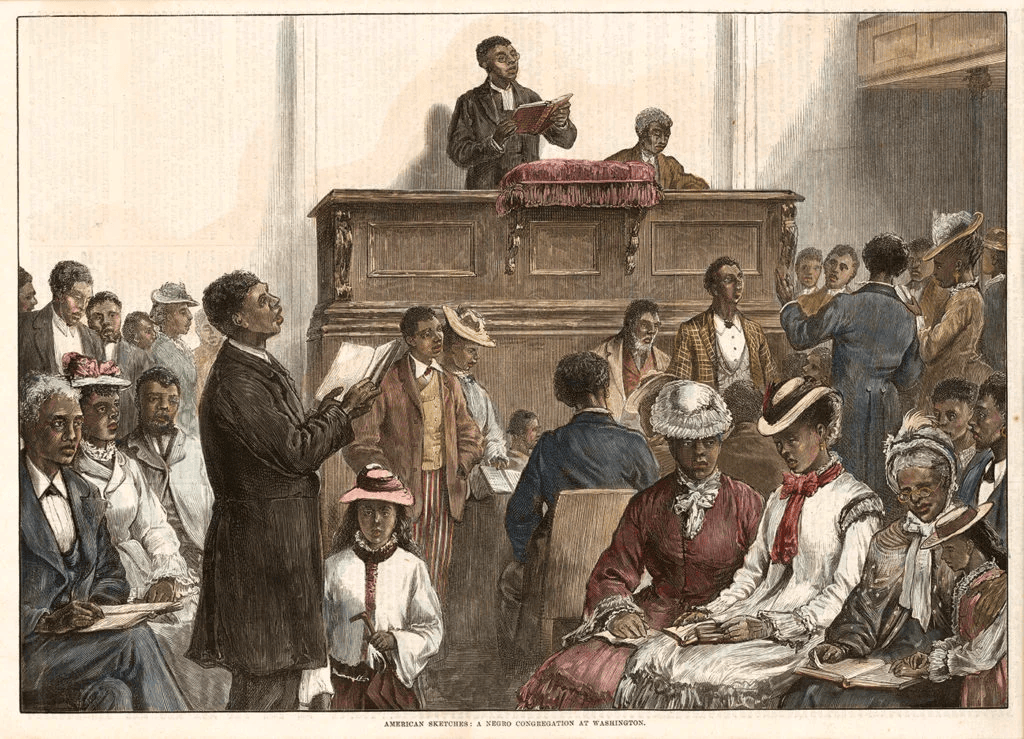
Table of Contents
- I. The Impossibility of the Timeline: The Drawn Bow of 1860–1870
- From Chattel Property to the Halls of Congress
- The Physics of Repression and Ascension
- II. The Second Founding: Writing the Blueprint of the South
- Dismantling the Plantation Order
- The South Carolina and Mississippi Conventions of 1868
- III. Profiles in Statesmanship: The Men Who Built the Floor
- Robert Smalls: The Strategic Disruptor
- Francis Louis Cardozo: The Fiscal Guardian
- John Roy Lynch: The Parliamentary Master
- IV. The Physical Blueprint: Independent Towns and Financial Sovereignty
- Parallel Sovereignty: Mitchelville, Princeville, and Mound Bayou
- The Financial Shadow Treasury: Fraternal Lodges, Churches, and Land Collectives
- V. The Universal Engine: How Black Liberation Expanded All American Freedom
- Overhauling the Constitutional Architecture (13th, 14th, and 15th Amendments)
- The Direct Beneficiaries: Due Process, Women’s Suffrage, and Immigrant Rights
- VI. The Engineered Sabotage: The Mechanics of “Redemption”
- Paramilitary Terror: The Mississippi Plan and Red Shirts
- Judicial Nullification (Cruikshank, Slaughter-House, Civil Rights Cases)
- The Betrayal of 1877 and the Re-enslavement of Labor
- VII. The Detractor’s Trap: 1865 vs. 1965
- 1. The Demographic Math: Geopolitical Majorities vs. Dispersed Minorities
- 2. The Economic Floor: Agrarian Leverage vs. Deindustrialization and Redlining
- 3. The Evolution of Sabotage: Paramilitary Terror vs. Bureaucratic Systems
- VIII. The Next Frontier: Facing the Third Backlash and Answering with Law
- The Modern Counter-Revolution Against the 21st Century
- The Legislative Mandate: Voting Rights, Education, Capital, and Local Governance
The Impossibility of the Timeline: The Drawn Bow of 1860–1870
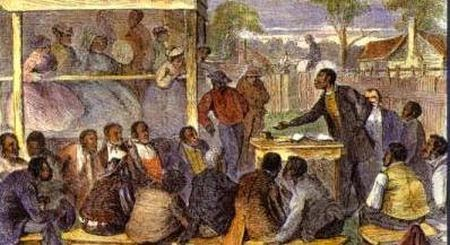
In the autumn of 1860, four million human beings living within the borders of the United States had no legal name, no claim to their own labor, no custodial right over their children, and zero constitutional standing. Under the authoritative doctrine of the Supreme Court’s Dred Scott decision three years earlier, they were legally defined as beings who possessed “no rights which the white man was bound to respect.” They were inventoried alongside livestock, timber, and farm implements on tax ledgers across eleven states. To teach them the alphabet was a crime against the state; to assemble without white oversight was treated as an act of insurrection.
Fast-forward ten years.
By February 1870, Hiram Rhodes Revels—an ordained minister who had organized two regiments of the United States Colored Troops and served as a wartime chaplain—walked down the center aisle of the United States Senate chamber. He took the oath of office to represent the State of Mississippi, filling an unexpired Senate term alongside Adelbert Ames, who assumed the seat formerly occupied by Confederate President Jefferson Davis.
That same year, Joseph Rainey, born into slavery but whose freedom had been purchased by his father prior to the war, was sworn into the United States House of Representatives representing South Carolina. Rainey had escaped Confederate forced labor in 1862 aboard a blockade runner to Bermuda before returning to champion the civic rights of his people.
That same year, Joseph Rainey, who had escaped chattel slavery aboard a blockade runner, was sworn into the United States House of Representatives representing South Carolina. Across the South, formerly enslaved men sat as lieutenant governors, secretaries of state, state treasurers, superintendents of education, and municipal judges. In South Carolina, Black legislators held an outright majority in the state House of Representatives.
History provides no parallel for this velocity of civic ascension. Historians often marvel at the speed of this transformation, treating it as an inexplicable anomaly of American politics or a patronizing gift granted by federal decree. But human nature operates under the laws of mechanics: when you artificially compress a people for two and a half centuries—clamping down on their literacy, their commerce, their inventions, and their civic assembly—you do not destroy their capacity; you store it under immense tension.
Enslavement was a drawn bowstring pulled back for 250 years. The preparation had been running in the shadows for generations—in hush harbors where parliamentary order and mutual aid were practiced, in the fields and workshops where Black hands managed the complex logistics and trades of the southern economy, and in secret schools where literacy was acquired at the risk of the lash.
The moment the Reconstruction Acts of 1867 released the bowstring, the newly freed did not stumble out of bondage waiting to be taught how to walk. They fired forward like an arrow released, covering decades of civic, municipal, and political ground in a matter of months. They did not wait for tutorials in republican governance. Given an inch of constitutional daylight, they broke through the barricades of the American social contract and immediately set about redesigning the entire apparatus.
The Second Founding: Writing the Blueprint of the South
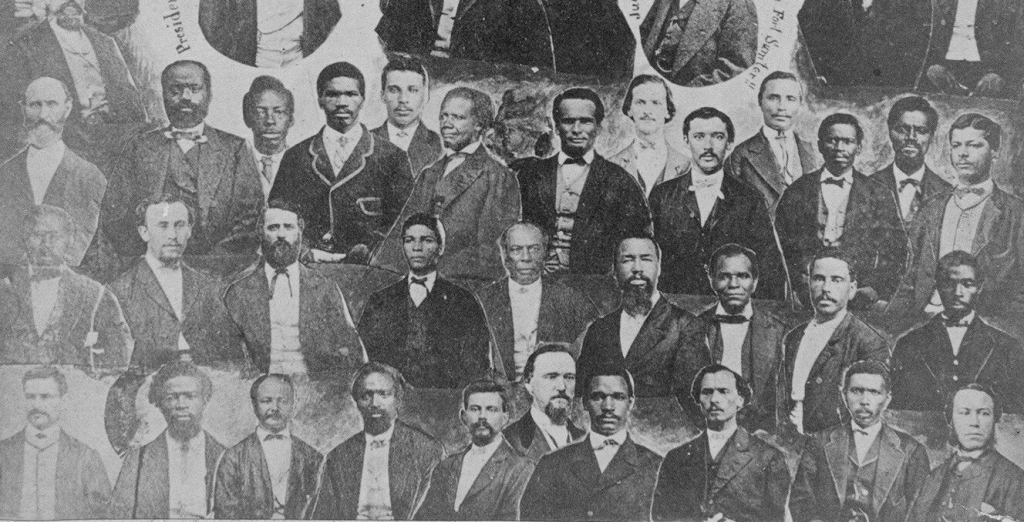
The prevailing mythology of Reconstruction treats the era as an exercise in federal martial law imposed from above by northern Radical Republicans. In truth, the democratic rebirth of the South was forged at the state level during the constitutional conventions of 1868, conceived and codified by Black delegates who constructed the most egalitarian frameworks the American South had ever witnessed.
Prior to 1868, public schooling in the American South was essentially non-existent. Wealthy planters hired private tutors or sent their children abroad, leaving poor white children and enslaved populations uniformly illiterate. At the South Carolina Constitutional Convention of 1868—the only convention in American history where Black delegates constituted an outright majority (holding 73 of the 124 seats)—delegates systematically dismantled the antebellum plantation order.
Led by figures like Francis Louis Cardozo, educated at the University of Glasgow and London’s Presbyterian seminary, the convention drafted the state’s first mandate for a free, taxpayer-funded public school system open to all children regardless of race. They abolished property qualifications for voting and holding public office, enfranchising poor white men who had been kept politically voiceless by the planter oligarchy for generations. They eliminated debtor prisons, which had served as engines of permanent indentured servitude, and codified the legal right of married women to hold and manage property independently of their husbands—a legal standard far ahead of most northern states.
In Mississippi’s 1868 “Black and Tan” convention, formerly enslaved leaders like Thomas W. Stringer and John R. Lynch struck directly at the post-war “Black Codes,” which had attempted to criminalize Black autonomy through vagrancy statutes. They rewrote the state’s organic law to guarantee universal male suffrage, outlaw racial discrimination on public transit, and democratize the judiciary by replacing appointed planter-controlled magistrate boards with locally elected judges.
These delegates did not seek vengeance or punitive carve-outs. Instead, they designed an open, modern commonwealth from the ashes of a collapsed slaveocracy.
Profiles in Statesmanship: The Men Who Built the Floor
Reconstruction was propelled by men who paired intellectual power with immense physical bravery.
Robert Smalls: The Strategic Disruptor
In May 1862, while still enslaved, Robert Smalls commandeered the Confederate armed transport steamer CSS Planter out of Charleston Harbor. Disguising himself in the captain’s wide-brimmed straw hat and copying his mannerisms, Smalls slipped past five Confederate harbor checkpoints, navigated the ship to freedom, and delivered the vessel, its heavy artillery, and its Confederate codebooks to the Union naval blockade.
Elected to the South Carolina Constitutional Convention of 1868 and subsequently to five terms in the U.S. House of Representatives, Smalls drafted the resolution that introduced the first compulsory, free public school system in the American South. In 1895, when Governor “Pitchfork” Ben Tillman convened a constitutional convention with the explicit, unabashed mission of stripping Black citizens of the ballot without technically violating the Fifteenth Amendment, Smalls stood on the convention floor as one of only six Black delegates. Directly confronting Tillman’s white supremacist cadre, Smalls delivered a fearless defense of his people’s civic and economic record:
“Since Reconstruction, times have changed… We have learned to read and write. We have acquired property. We have paid our taxes… Why then should you disenfranchise us?”
Francis Louis Cardozo: The Fiscal Guardian
Serving first as South Carolina’s Secretary of State and later as State Treasurer from 1872 to 1877, Cardozo was an uncompromising institutionalist. In an era fraught with financial chaos, he rejected fraudulent bond issues pushed by speculators, balanced state ledgers, and drove the creation of the South Carolina Land Commission. Through this program, the state purchased plantation acreage and resold small tracts to over 14,000 independent farming families—Black and white—providing the tangible bedrock of economic freedom: land ownership.
John Roy Lynch: The Parliamentary Master
Born into slavery in Louisiana and working as a teenage photographer’s assistant in Natchez when the war ended, Lynch taught himself law and parliamentary procedure through voracious night study. By age 25, he was elected Speaker of the Mississippi House of Representatives, presiding over a chamber split between former masters and former slaves with such even-handed authority that he won praise from across the political spectrum.
After serving in Congress, where he championed the landmark Civil Rights Act of 1875, Lynch took up the pen. Recognizing that revisionist historians were fabricating an image of Reconstruction as a period of “ignorant misrule,” he authored The Facts of Reconstruction in 1913—a rigorous, primary-source corrective that preserved the factual truth of Black legislative competence for future generations.
The Physical Blueprint: Independent Towns and Financial Sovereignty
Political power without economic insulation was precarious. In response to white hostility, freed communities initiated a sweeping movement in municipal self-determination, building and financing their own independent towns, credit networks, and commercial pipelines.
| Core Pillar | Operational Mechanics | Strategic Impact |
| Independent Municipalities | • Self-policing & municipal marshals • Local magistrates & civic courts • Sovereign Black town councils | Created physical safe havens beyond white eviction, terror, and jurisdictional reach. |
| Communal Capital | • Fraternal societies & mutual aid lodges • Grassroots credit unions & burial pools • Land syndicates buying plantation acreage | Replaced predatory merchant credit with self-funded community equity. |
| Insulated Economic Life | • Black-owned cotton gins & sawmills • Direct agricultural trade channels • Uncensored press & literacy pipelines | Guaranteed full retention of crop value and unmonitored civic organizing. |
- Mitchelville, South Carolina (1862): Founded on Hilton Head Island during the Civil War as part of the Port Royal Experiment, Mitchelville was the first self-governing Black municipality in the United States. Its citizens drew up their own municipal charter, established an elective council, organized an independent police force, and enacted the South’s first compulsory school attendance law.
- Princeville, North Carolina (1885): Formed in 1865 on a swampy, flood-prone ridge of the Tar River known as Freedom Hill, formerly enslaved families transformed a malarial wilderness into one of the earliest independent, all-Black chartered towns in the South and the first incorporated in North Carolina. When state legislators pressured residents to name the town after President James A. Garfield, the community refused, officially incorporating as Princeville in honor of Turner Prince, a formerly enslaved carpenter who helped construct the settlement.
- Mound Bayou, Mississippi (1887): Founded in the Mississippi Delta by Isaiah T. Montgomery and Benjamin T. Green, both formerly enslaved on Joseph Davis’s plantation at Davis Bend, Mound Bayou was designed as an unassailable bastion of Black enterprise. The founders carved 840 acres out of dense bottomland forest, ultimately establishing the Bank of Mound Bayou, a cottonseed oil mill, an independent telephone exchange, and an all-Black constabulary. Because white authorities held zero jurisdiction within its borders, the town served for decades as a secure haven from racial violence and later as an operational staging ground for leaders like Medgar Evers.
Underpinning these physical towns was an independent financial network. After the catastrophic collapse of the white-managed Freedmen’s Savings Bank in June 1874—which wiped out roughly $3 million in hard-earned deposits (equivalent to over $85 million today) across 61,000 accounts—the community turned inward. Fraternal orders like the Grand United Order of Odd Fellows and the Independent Order of St. Luke stepped into the breach, pooling weekly nickel and dime dues to finance land trusts, issue home loans, underwrite funeral expenses, and seed Black-owned enterprises. The independent Black church became a town hall, union hall, and credit union rolled into one.
The Universal Engine: How Black Liberation Expanded All American Freedom
The constitutional protections forged during Reconstruction were not narrow, race-specific statutes. They overhauled the operating system of the United States Constitution, establishing the statutory and moral foundation for nearly every major civil rights advance of the next 150 years.
The Constitutional Engine (1865–1870)
- 13th Amendment: Abolished chattel slavery and involuntary servitude across the entire nation.
- 14th Amendment: Enacted Equal Protection, Due Process, and Birthright Citizenship into Section 1.
- 15th Amendment: Prohibited federal and state governments from denying the franchise based on race, color, or previous condition of servitude.
The Universal Inheritors
- Universal Due Process: The interpretation of the 14th Amendment’s Due Process Clause as protecting fundamental, unenumerated rights formed the constitutional foundation for striking down bans on interracial marriage (Loving v. Virginia), establishing privacy rights (Griswold v. Connecticut), and securing marriage equality (Obergefell v. Hodges).
- Women’s Rights: The 15th Amendment provided the exact textual template for the 19th Amendment in 1920, substituting the word “sex” for “race, color, or previous condition of servitude.” Decades later, Ruth Bader Ginsburg systematically dismantled state-sanctioned sex discrimination by arguing before the Supreme Court under the 14th Amendment’s Equal Protection Clause (Reed v. Reed).
- Immigrant Protections: Codified to ensure children of freed slaves could never be stripped of their nationality, the 14th Amendment’s Citizenship Clause became the legal bulwark for immigrant families. In United States v. Wong Kim Ark (1898), the Supreme Court affirmed that a child born on U.S. soil to Chinese immigrant parents was an American citizen by birthright.
- The Modern Civil Rights Acts: When Black activists compelled the passage of the Civil Rights Act of 1964, Title VII—designed to halt racial employment discrimination—became the primary statutory weapon against workplace sex discrimination and the basis for LGBTQ+ workplace protections (Bostock v. Clayton County, 2020). The moral momentum also forced the Immigration and Nationality Act of 1965 (Hart-Celler Act), dismantling discriminatory European origin quotas and opening immigration to Asia, Africa, and Latin America.
The Engineered Sabotage: The Mechanics of “Redemption”
For decades, the standard textbook narrative asserted that Reconstruction collapsed because newly freed people were unready to handle self-governance. The empirical reality is the exact reverse: Reconstruction did not collapse—it was systematically overthrown by coordinated paramilitary terror, executive abandonment, and judicial nullification.
Stage 1: Structural Democracy (1868–1876)
Black legislative majorities established the South’s first universal public school systems, secured civil rights statutes, modernized the judiciary, and advanced economic independence through land commissions and agricultural cooperatives.
Stage 2: Paramilitary Counter-Revolution (1870–1876)
Failing at the ballot box, reactionary elites organized paramilitary arms—the White League in Louisiana and the Red Shirts in Mississippi and South Carolina. Under the “Mississippi Plan” of 1875, militias openly patrolled polling sites with rifles, broke up meetings, and assassinated Black officials. In South Carolina, the 1876 Hamburg Massacre saw armed Red Shirts surround a Black state militia company, force their surrender, and systematically murder captive officers.
Stage 3: The Judicial Gavel and Federal Retreat (1873–1883)
The political coup was sanctioned and legalized from the highest bench in Washington. Long before federal troops withdrew, the Supreme Court systematically dismantled the constitutional teeth of Reconstruction:
- In the Slaughter-House Cases (1873), the Court gutted the Fourteenth Amendment’s Privileges or Immunities Clause, rendering it virtually meaningless against state-level tyranny.
- In United States v. Cruikshank (1876)—arising from the Colfax Massacre, where over 100 Black men were murdered defending a courthouse—the Court ruled that the Fourteenth Amendment applied only to state actions, stripping the federal government of authority to prosecute private paramilitary terror under the Enforcement Acts.
- In the Civil Rights Cases (1883), the Court struck down Charles Sumner and John Roy Lynch’s landmark Civil Rights Act of 1875, declaring that Congress had no constitutional power to outlaw racial discrimination in public accommodations.
The political abandonment was formalized by the Compromise of 1877. Following the disputed 1876 presidential election, northern Republicans traded southern civil rights for the executive mansion, withdrawing the remaining federal garrisons. With the federal courts hostile and federal enforcement abandoned, “Redeemer” statehouses dismantled multiracial governance, instituted convict leasing and vagrancy statutes to re-enslave Black labor, and systematically altered state organic law through poll taxes and literacy tests. In Louisiana alone, following the disenfranchising constitution of 1898, registered Black voters plummeted from over 130,000 in 1896 to under 1,400 by 1904.
This rollback was not a response to incompetence. It was an organized, multi-branch counter-revolution executed because Black citizens were succeeding too quickly, too thoroughly, and too visibly.
The Detractor’s Trap: 1865 vs. 1965
I’ve been discussing African American history long enough to anticipate the question from detractors of our history, asking, “If the newly freed African American population without training or education could accomplish all that we discussed, why couldn’t African Americans duplicate the same success after the civil rights movement freed them of Jim Crow segregation?”
The question sounds clever on the surface, but it is built on a willful misreading of economics, demographics, and political power. It treats 1865 and 1965 as identical starting lines, ignoring the radically different board on which both games were played.
The reality is that African Americans did achieve massive, unprecedented institutional progress after 1965—rising from disenfranchised second-class status to mayors of global commercial centers, heads of Fortune 500 boardrooms, congressional powerhouses, and the presidency within a single generation. But where the trajectories diverged, the cause was not a sudden deficit of Black resolve. It was driven by three structural realities: the math of geographic concentration, the evaporation of the economic floor, and the transition of state sabotage from overt terror into institutional bureaucracy.
1. The Demographic Math: Geopolitical Majorities vs. Dispersed Minorities
In 1867, Black political ascension was propelled by raw, inescapable geographic concentration:
- The Black Belt: Because the domestic slave trade had concentrated enslaved labor in rich agricultural soils, Black Americans constituted outright demographic majorities across South Carolina and Mississippi, and overwhelming majorities across dozens of contiguous rural counties throughout Georgia, Alabama, Louisiana, and Florida. In a first-past-the-post democratic republic, a 60% demographic majority voting as an organized bloc does not simply elect a representative; it captures the state legislature, the sheriff’s office, the tax assessor, and the county courthouse.
- The Great Migration Dispersion (1916–1970): By the end of Jim Crow, six million Black Americans had fled the rural South, pushed out by lynchings and pulled by factory wages into northern and western cities. By 1965, Black America was no longer geographically consolidated into vast statewide majorities; it was a structural minority nationwide (rarely exceeding 12% to 15% of the total population). While this concentration created potent municipal voting blocs in select urban centers like Detroit, Atlanta, Chicago, Newark, and Gary, it meant Black political progress could no longer capture statewide apparatuses through demographic weight alone. It required building fragile, complex coalitions across predominantly white or multiracial electorates.
2. The Economic Floor: An Agrarian Canvas vs. Post-Industrial Deindustrialization
Reconstruction occurred within an expanding, agrarian economy that was completely paralyzed without Black hands. The South after the war was land-rich but cash-poor; planters held millions of acres that were economically inert without the organizational, agricultural, and mechanical expertise of the formerly enslaved. By contrast, the Civil Rights Movement broke through the door in 1965 at the exact historical moment the industrial floor dropped out beneath American cities—entering an economy that was capital-rich but aggressively labor-shedding:
| Dimension | 1865: The Agrarian Rebuild | 1965: The Post-Industrial Shift |
| Primary Economic Asset | Arable land, manual trades, and essential field labor. | Industrial seniority, corporate capital, and suburban real estate equity. |
| Labor Leverage | Monopolistic: Land-rich but cash-poor planters were paralyzed; acreage was useless without Black agricultural and artisanal skills. | Vulnerable: Black workers won legal standing just as automation, plant closures, and global offshoring eliminated blue-collar jobs. |
| Structural Landscape | Expanding regional and national agrarian growth desperately requiring physical labor. | Deindustrializing urban centers drained of commercial tax bases via federally subsidized white flight. |
- The 1865 Leverage of Essential Labor: In 1865, Black Southerners held an effective monopoly on the essential physical skills required to run the region: they were the blacksmiths, carpenters, bricklayers, teamsters, and farmers. The South could not produce a single bale of cotton, cut a board of timber, or lay a mile of rail without Black labor. If Black workers walked off a plantation or organized an independent township, the local white planter economy faced immediate, existential peril.
- The 1965 Industrial Evaporation: When Black Americans finally won legal access to union factories, corporate offices, and municipal payrolls through the Civil Rights Act of 1964, the American economy was beginning its massive pivot toward automation, outsourcing, and globalization. Between 1967 and 1987, major industrial engines like Philadelphia, Chicago, Detroit, and Cleveland lost hundreds of thousands of manufacturing jobs. The reliable blue-collar ladder into the middle class was pulled up right as Black workers legally reached the first rung.
- The Subsidized Suburban Wealth Divide: During the eight decades of Jim Crow, the federal government had financed the greatest transfer of wealth in global history through the New Deal, the Home Owners’ Loan Corporation, and the post-WWII GI Bill—underwriting low-interest, federally guaranteed mortgages that built the white middle-class suburbs while systematically redlining Black neighborhoods out of existence. When the Fair Housing Act finally passed in 1968, white families had already accumulated a thirty-year head start of subsidized home equity. Black Americans were legally invited to enter a housing market where the cheapest, most lucrative generational equity had already been captured.
3. The Evolution of Sabotage: Violent Terror vs. Institutional Bureaucracy
Detractors assume that because white sheets and “Whites Only” signs disappeared, structural resistance vanished. In truth, the mechanics of suppression simply modernized, trading crude paramilitary violence for sophisticated, colorblind bureaucratic engineering:
- Suburbanization and Tax Cannibalization: When federal courts mandated school integration following Brown v. Board of Education and the 1964 Act, the counter-offensive was not the Klan on horseback; it was White Flight. White capital fled across municipal boundaries into newly incorporated suburbs. Through exclusionary zoning laws and local tax jurisdictions, these suburbs barred lower-income Black families while taking the regional commercial tax base with them. The school systems and municipal treasuries that Black mayors inherited in the 1970s and 1980s were systematically hollowed out.
- The War on Drugs and Mass Incarceration: The post-1965 state response to urban Black political awakening was the hyper-militarization of law enforcement. Initiated under the Nixon administration and codified during the 1980s and 1990s, the justice system weaponized drug laws through mandatory minimums, militarized policing, and disparate sentencing guidelines. Millions of Black citizens—disproportionately young men during their peak earning and civic participation years—were swept into prisons, stripped of their wages, and permanently disenfranchised. Mass incarceration was the bureaucratic, industrialized successor to the 1870s convict leasing system.
- The Attack on the Public Sector: In the 1970s, as Black Americans successfully organized and mobilized into municipal civil service, education, and public transit, national politics immediately orchestrated the “taxpayer revolt,” austerity politics, deregulation, and the stigmatization of the public sector. The public payrolls that had lifted previous European immigrant generations into economic stability were defunded and privatized the moment Black hands took the wheel.
In both 1865 and 1965, the Black community delivered an explosion of civic vitality and progress that defied historical precedent. And in both eras, the American power structure immediately restructured its machinery to contain that success. Reconstruction proved what Black Americans could build when given constitutional latitude; the post-Civil Rights era proved how resilient that genius remained, even within an economic and judicial landscape engineered to siphon away its gains.
The Next Frontier: Facing the Third Backlash and Answering with Law
History does not move in a straight line; it moves in a cycle of democratic expansion met by calculated panic.
The pattern is as dependable as it is brutal. When the formerly enslaved rebuilt the South between 1865 and 1877, the reaction was the bloody restoration of Jim Crow. When the Civil Rights Movement tore down legal segregation in the 1960s, the counter-revolution arrived as the War on Drugs, mass incarceration, and suburban tax flight.
Today, we are living through the inevitable third wave.
The rapid cultural and political strides that marked the dawn of the twenty-first century—culminating in the symbolic watershed of electing a Black president—sent shockwaves through an establishment unaccustomed to sharing the helm of the republic. The retaliation was swift, systematic, and targeted at the very pillars won over a century and a half of struggle.
We see it in the aggressive revisionism that seeks to outlaw the teaching of our own history, scrubbing textbooks of the very truths that prove Black institutional competence. We see it in the judicial evisceration of the Voting Rights Act, the targeted assault on affirmative action and corporate diversity initiatives, and an economic landscape engineered to concentrate wealth upward while hollowing out the working and lower classes.
Yet if our history proves anything, it is that Black Americans have never met reactionary sabotage with passive endurance. We have never simply weathered the storm; we have rewritten the legal atmospheric conditions of the nation. When chattel slavery ended, we did not ask for polite tolerance; we extracted the 13th, 14th, and 15th Amendments. When Jim Crow choked the South, we did not merely protest; we forced the passage of the Civil Rights Act of 1964 and the Voting Rights Act of 1965.
Every genuine expansion of American liberty has required Black hands to carve the mandate into federal statute. Now, we are called to the drafting board once again.
To meet this third counter-revolution, moral persuasion is insufficient. We must counter institutional reaction with institutional power, anchoring the next era of resistance in structural, non-negotiable law:
- A Modern Federal Voting Rights Mandate: State-level gerrymandering and surgical voter suppression cannot be out-organized forever. We must enact comprehensive federal legislation—codifying the tenets of the Freedom to Vote Act and the John Lewis Voting Rights Advancement Act. Restoring federal preclearance is not an unprecedented federal overreach; it is the modern heir to the Enforcement Acts of 1870 and 1871, which recognized that local voting rights cannot survive without an active federal enforcement shield. This mandate must include automatic voter registration and the permanent dismantling of felony disenfranchisement, closing the loop on carceral political purges.
- Constitutional Defense of History and Free Speech: The current campaign to censor classroom history and penalize institutional diversity is a direct violation of First and Fourteenth Amendment protections. We must launch aggressive, systematic litigation and advance state and federal educational statutes that classify truthful, inclusive public education as a protected civil right—honoring the legacy of delegates like Francis Cardozo and Robert Smalls, who wrote universal public education into Southern law as the primary prerequisite of a free commonwealth.
- Closing the Post-Industrial Wealth Divide Through Structural Precedent: Political enfranchisement without economic insulation remains as vulnerable today as it was in 1877. Combating the modern backlash requires concrete economic architecture: federal investments in Black maternal and public health infrastructure, baby bonds to bridge the generational asset gap cemented by decades of redlining, and strict enforcement against algorithmic housing discrimination. Such initiatives find their direct historic precedent in the South Carolina Land Commission of 1869, which demonstrated that state-backed pathways to independent land and capital ownership are foundational to true republican self-rule.
- Local Institutional Consolidation: Just as our ancestors built Mitchelville, Princeville, and Mound Bayou from raw wilderness, today’s fight requires local consolidation. We must run for school boards, county commissions, municipal judgeships, and water authorities. The reactionaries understood decades ago that local governance dictates the ground rules; reclaiming those levers ensures our communities cannot be gerrymandered out of basic civic resources or economic autonomy.
The opposition has never feared Black failure; it has always been terrified of Black capability. The architects of Reconstruction proved that given a fraction of a chance, we will build a society fairer than the one we were handed. The champions of the Civil Rights era proved that no fortress of state-sanctioned bigotry could withstand organized, strategic resolve.
We are not victims wandering in the wilderness of a new crisis. We are the inheritors of an unbroken legacy of master builders. The tools have already been tested, the legal precedents have already been set, and the blueprint remains in our hands. The backlash is here—and our answer, as it has always been, must be written in the law.
Glossary of Historical Terms, Concepts & Precedents
- Black Codes (1865–1866): Restrictive statutes passed by southern states immediately following the Civil War to compel freedmen to return to low-wage agricultural labor. They criminalized vagrancy, restricted land acquisition, and established strict labor contracts enforced through penal punishment.
- Black and Tan Conventions (1867–1868): The state constitutional conventions organized across the former Confederacy under the Reconstruction Acts, distinguished by the unprecedented joint participation of Black delegates and radical white Republicans who drafted egalitarian state constitutions.
- Compromise of 1877: An unwritten political arrangement resolving the disputed 1876 presidential election between Rutherford B. Hayes and Samuel J. Tilden. Republicans secured the presidency in exchange for withdrawing federal garrisons from the South, marking the formal collapse of federal enforcement during Reconstruction.
- Convict Leasing: A post-Reconstruction penal system wherein southern states leased incarcerated individuals—overwhelmingly Black men arrested under arbitrary vagrancy statutes—to private plantations, railroads, and mines, restoring a brutal form of involuntary servitude.
- Dunning School: A 20th-century historiographical school, originating from Columbia University historian William Archibald Dunning, that framed Reconstruction as a tragic era of corruption and “Black misrule.” This revisionist narrative was widely used in academia and school textbooks to legitimize Jim Crow disenfranchisement.
- Enforcement Acts (1870–1871): Criminal codes passed by Congress under Ulysses S. Grant to protect Black voting rights and dismantle the Ku Klux Klan. The legislation authorized federal military intervention, suspended habeas corpus in rebellious counties, and established federal oversight over state elections.
- Grandfather Clause: A statutory carve-out enacted by southern states during the late 19th and early 20th centuries exempting citizens from literacy tests and poll taxes if their ancestors possessed voting rights prior to 1867, systematically disenfranchising Black citizens while shielding poor white voters.
- Hamburg Massacre (1876): An armed assault by white paramilitary “Red Shirts” against an all-Black state militia unit in Aiken County, South Carolina. The incident resulted in the capture and extrajudicial execution of Black militiamen, serving as a template for violent political intimidation during the 1876 election.
- Hart-Celler Act (Immigration and Nationality Act of 1965): Comprehensive federal legislation that repealed the 1924 national origins formula, replacing discriminatory European preference quotas with a preference system based on family reunification and skilled employment.
- Mississippi Plan (1875): An orchestrated strategy developed by the Mississippi Democratic Party combining armed paramilitary terror, voter suppression, and targeted assassinations against Republican and Black officials to recapture state government control.
- Port Royal Experiment (1861–1865): A wartime pilot project conducted on the Sea Islands of South Carolina, where thousands of formerly enslaved people managed abandoned cotton plantations, founded independent communities (such as Mitchelville), and established schools prior to the formal end of the Civil War.
- Redeemers: Reactionary white political and planter coalitions in the post-Reconstruction South who sought to overthrow Republican coalitions, purge Black political officials, and re-establish white supremacy under the mantle of state autonomy.
- South Carolina Land Commission (1869): A Reconstruction-era state initiative that purchased large tracts of plantation land, divided them into small family parcels, and sold them on affordable credit terms to freedmen and poor white families to promote independent landownership.
- Supreme Court Cases Cited:
- Dred Scott v. Sandford (1857): Ruled that people of African descent, whether enslaved or free, were not citizens under the U.S. Constitution and had no legal standing in federal court.
- Slaughter-House Cases (1873): Constrained the scope of the Fourteenth Amendment’s Privileges or Immunities Clause, sharply limiting federal power to protect civil rights against state infringement.
- United States v. Cruikshank (1876): Arising from the Colfax Massacre, ruled that the Fourteenth Amendment applied only to state actions rather than private individuals, severely undermining federal prosecution of racial terrorism.
- Civil Rights Cases (1883): Invalidated the Civil Rights Act of 1875, holding that the Fourteenth Amendment did not authorize Congress to ban racial discrimination in privately owned public accommodations.
- United States v. Wong Kim Ark (1898): Affirmed that individuals born within the territorial borders of the United States are citizens under the Citizenship Clause of the Fourteenth Amendment, regardless of their parents’ foreign nationality.
- Reed v. Reed (1971): Landmark ruling that applied the Fourteenth Amendment’s Equal Protection Clause to invalidate laws that treated men and women differently without sufficient justification.
Bibliography
Primary Historical Sources, Memoirs & Proceedings
- Cardozo, Francis L. Speeches and Reports of the Secretary of State and State Treasurer of South Carolina (1868–1877). Columbia: State Printer, 1877.
- Lynch, John R. The Facts of Reconstruction. New York: The Neale Publishing Company, 1913.
- Lynch, John R. Reminiscences of an Active Life: The Autobiography of John Roy Lynch. Edited by John Hope Franklin. Chicago: University of Chicago Press, 1970.
- Revels, Hiram R. The Autobiographical Script of Hiram R. Revels. Library of Congress, Manuscript Division, Washington, D.C.
- Smalls, Robert. Speech of Hon. Robert Smalls of South Carolina in the House of Representatives. Washington, D.C.: Government Printing Office, 1876.
- South Carolina Constitutional Convention. Proceedings of the Constitutional Convention of South Carolina, Held at Charleston, S.C., Beginning January 14th and Ending March 17th, 1868. Charleston: Denny & Perry, 1868.
- United States Congress. Report of the Joint Committee on Reconstruction, at the First Session, Thirty-Ninth Congress. Washington, D.C.: Government Printing Office, 1866.
Foundational Historiography & Reconstruction Analyses
- Du Bois, W. E. B. Black Reconstruction in America, 1860–1880: An Essay Toward a History of the Part Which Black Folk Played in the Attempt to Reconstruct Democracy in America. New York: Harcourt, Brace and Company, 1935.
- Foner, Eric. Reconstruction: America’s Unfinished Revolution, 1863–1877. New York: Harper & Row, 1988.
- Foner, Eric. The Second Founding: How the Civil War and Reconstruction Remade the Constitution. New York: W. W. Norton & Company, 2019.
- Franklin, John Hope. Reconstruction After the Civil War. Chicago: University of Chicago Press, 1961.
- Holt, Thomas. Black over White: Negro Political Leadership in South Carolina during Reconstruction. Urbana: University of Illinois Press, 1977.
- Litwack, Leon F. Been in the Storm So Long: The Aftermath of Slavery. New York: Alfred A. Knopf, 1979.
- Ransom, Roger L., and Richard Sutch. One Kind of Freedom: The Economic Consequences of Emancipation. Cambridge: Cambridge University Press, 1977.
- Woodward, C. Vann. The Strange Career of Jim Crow. New York: Oxford University Press, 1955.
Black Municipalities, Economy & Institutional History
- Crockett, Norman L. The Black Towns. Lawrence: The Regents Press of Kansas, 1979.
- Hermann, Janet Sharp. The Pursuit of a Dream. Jackson: University Press of Mississippi, 1981. (Examines the history of Davis Bend and the foundation of Mound Bayou).
- Mobley, Joe A. James City: A Black Community in North Carolina, 1863–1900. Raleigh: North Carolina Division of Archives and History, 1981.
- Osthaus, Carl R. Freedmen, Philanthropy, and Fraud: A History of the Freedman’s Savings Bank. Urbana: University of Illinois Press, 1976.
- Rose, Willie Lee. Rehearsal for Reconstruction: The Port Royal Experiment. Indianapolis: Bobbs-Merrill, 1964.
- Walker, Juliet E. K. The History of Black Business in America: Capitalism, Race, Entrepreneurship. Chapel Hill: University of North Carolina Press, 2009.
The Civil Rights Era, Economics & Legal Retaliation
- Alexander, Michelle. The New Jim Crow: Mass Incarceration in the Age of Colorblindness. New York: The New Press, 2010.
- Katznelson, Ira. When Affirmative Action Was White: An Untold History of Racial Inequality in Twentieth-Century America. New York: W. W. Norton & Company, 2005.
- Massey, Douglas S., and Nancy A. Denton. American Apartheid: Segregation and the Making of the Underclass. Cambridge: Harvard University Press, 1993.
- Rothstein, Richard. The Color of Law: A Forgotten History of How Our Government Segregated America. New York: Liveright Publishing Corporation, 2017.
- Sugrue, Thomas J. The Origins of the Urban Crisis: Race and Inequality in Postwar Detroit. Princeton: Princeton University Press, 1996.
- Wilson, William Julius. When Work Disappears: The World of the New Urban Poor. New York: Alfred A. Knopf, 1996.
