
Table of Contents
- The Global Map, the Lone Dissent, and the Reflex of Scale
- The Three Excuses: How the Establishment Changes the Subject
- The Operating System: The Architecture and the Fool’s Gold
- The Six Defenses: How Everyday Denial Protects the Baseline
- The Historical Precedent: The Great Chain of Being and the Valladolid Debate
- The Accurate Measure: Drawing the World to Scale
Part 1: The Global Map, the Lone Dissent, and the Reflex of Scale
Not long ago at the United Nations, a resolution came up regarding global human rights and the need to finally condemn the lasting damage done by colonialism and racial discrimination. When the votes went up on the big board, the outcome was hard to miss: almost every country on earth voted yes, while the United States stood in a tiny, stubborn minority alongside Israel and Argentina.
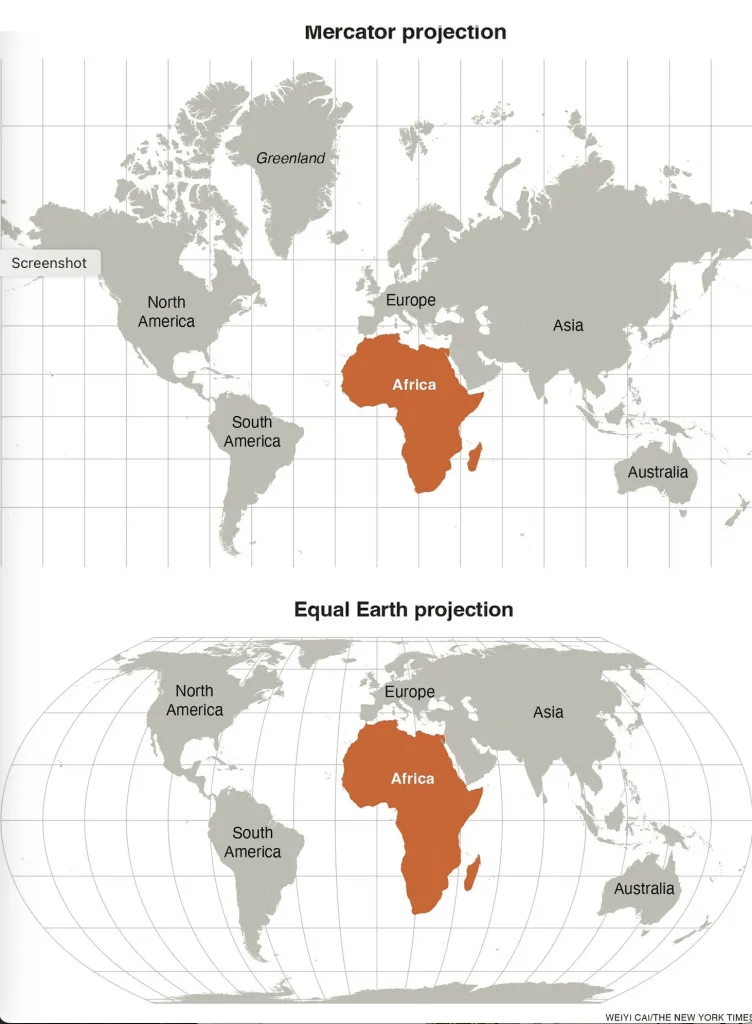
Shortly after, an even stranger vote happened. The UN took up an initiative called “Correct the Map,” pushed by African nations to stop using the traditional 1569 Mercator world map in schools and official international business, replacing it with maps that actually show the true sizes of the continents. The vote wasn’t even close: 164 countries voted in favor, six abstained, and exactly one country voted no.
The United States stood entirely alone.
Think about how wild that is for a second. The Mercator map was drawn back in the 1500s by a European mapmaker named Gerardus Mercator. He wasn’t making a classroom teaching tool; he was making a navigation chart for European sailors steering ships by compass. To flatten a spherical earth onto a flat sheet of paper, it drastically distorts landmasses the farther they sit from the equator.
The result? Greenland looks as big as the entire continent of Africa, even though Africa is actually fourteen times bigger. North America looks like a giant hovering over Africa and South America. In real life, Africa is so massive it could easily swallow the contiguous United States, China, India, Japan, and most of Europe with room left over.
Every modern satellite photo and GPS calculation confirms the old map is a flat-out lie of scale.
Yet, when asked to officially agree on a map that shows the physical earth as it actually exists, the United States dug in its heels and voted “no.”
Why? Because a map is never just a piece of paper. It’s a mirror. If you grow up with a classroom map where your part of the world is drawn twice as big as it really is and sits right in the dead center, you absorb a silent, lifelong lesson: We are naturally larger, naturally more important, and naturally running the show.
Agreeing to an accurate map feels like being shrunk down. It forces an empire to look in the mirror and see itself drawn to scale. And when power is forced to see itself as just one part of the world instead of the center of it, the immediate reaction isn’t humility. It’s irritation.
That exact same irritation plays out in everyday American life.
Whenever writers, historians, or everyday folks highlight the genius of Black inventors, point out how Black neighborhoods were bulldozed to build highways, or explain how modern banks still shortchange Black communities, the pushback from a lot of white readers isn’t thoughtful curiosity. It’s an immediate, defensive eye-roll.
The comments always sound the same: Why does everything have to be about race? Why can’t we just be Americans? If we had a White History Month, you’d call it racist! My family didn’t own slaves, so why are you trying to make me feel guilty?
It’s easy to write this off as bad manners, online trolling, or simple prejudice. But it goes way deeper than that. That irritation is an involuntary reflex. It’s what happens when someone who has lived inside a comfortable, flattering version of history suddenly realizes someone has walked in with truth.
Talking honestly about Black brilliance and Black survival—not as charity cases, but as people who built this country and out-innovated the barriers placed in front of them—threatens the map people have carried in their heads their whole lives.
The Three Excuses: How the Establishment Changes the Subject
When the US voted against the accurate map at the UN, its diplomats gave three official explanations. On paper, they sounded calm and practical. In reality, they are the exact same playbooks people use at the dinner table or online to shut down honest conversations about race.
1. The Vocabulary Trap: The US claimed the map resolution was a “radical ideological project” driven by political correctness, simply because the African sponsors called an accurate map an act of “cognitive justice and memorial repair.” Notice what happened there: instead of arguing about whether the map was scientifically accurate, Washington attacked the words being used. It’s the oldest trick in the book: when you can’t deny the facts, attack the tone of the person pointing them out.
2. “There Are Bigger Things to Worry About”: The American delegation called the vote “superfluous” and a distraction, calling resolutions like it “barnacles” that waste the UN’s time when there are wars to stop and economies to fix. But this is just an excuse to kick the can down the road. If updating the classroom map was really such a trivial little thing, why did the US spend the political capital to stand alone against 164 nations? You don’t fight the entire planet over something you think doesn’t matter.
3. Hiding Behind “Neutrality”: The US argued that the old map is just a practical mathematical tool for navigation and GPS, and that politics shouldn’t pick which map to use. It pretends the status quo is completely neutral. But a map that has taught five hundred years of schoolkids to view the Global South as tiny isn’t “just math.” It’s an ideological habit masquerading as common sense.
The Operating System: The Architecture and the Fool’s Gold
Before we go any further, let’s get something straight: When I write about whiteness, I am not writing about you as an individual.
I’m not sitting in judgment of your character, your parents, or your soul. Human beings have actual cultures, distinct heritages, and rich family traditions. You might be Italian, Irish, German, Polish, Appalachian, or Jewish. Those backgrounds have real history—full of hard work, struggle, beautiful music, and survival.
Whiteness is none of those things. Whiteness isn’t a culture. It isn’t an ethnicity.
Whiteness is a legal system. It was invented in the legal codes of the American colonies in the late 1600s for a very specific business reason: wealthy plantation owners realized that if poor European servants and enslaved African laborers realized they had the same economic enemies and teamed up, the elites would lose their shirts. So they drew a legal line. They created a new legal club called “white” and gave it exclusive rights: the right to own land, the right to vote, and the guarantee that your body would never be sold at an auction block.
Critiquing that broken foundation isn’t an attack on the people living in the house; it’s the only way to fix the house before the whole thing caves in.
Here’s the dirty little secret that the defenders of this setup never want to admit: Whiteness has always been fool’s gold for ordinary white working people.
Back in the 1930s, the great thinker W.E.B. Du Bois called this the “psychological wage.” The wealthy barons running the country knew that if working-class white folks ever realized they were getting squeezed just like Black folks, the game would be over. So they offered poor white workers a counterfeit deal: We’ll pay you lousy wages, work you to the bone in the mills, send you off to fight our wars, and give you zero safety net. But in exchange, we will give you a white skin—which means you will never be at the bottom.
It was a distraction. It convinced generations of working families to fight against their own interests—to oppose strong labor unions, to fight against universal healthcare, and to accept crumbs from the table—just to hold onto the hollow bragging rights of being one step higher on a fake ladder.
Whiteness never made ordinary working-class families rich. It just kept them quiet.
The Six Defenses: How Everyday Denial Protects the Baseline
When you bring up the real history of Black achievement and the legal machinery built to hold it down, people rarely argue with the actual facts. Instead, their defenses usually fall into one of six familiar routines:
- The “Colorblind” Idealist: They love quoting Dr. King’s line about the “content of their character,” but they take it completely out of context. They want to act like race doesn’t exist now that their group has secured the wealth, the property, and the textbooks. Claiming not to “see color” just means demanding that everyone blend into the background—a background that is assumed to be white.
- The Zero-Sum Worrier: They honestly believe that there is only so much praise to go around. If a historian points out that a Black engineer invented a crucial component of the electric light bulb or the telephone, they don’t hear a cool historical fact; they feel like something is being stolen from their heritage.
- The Heritage Defender: This is usually the loudest, angriest group. Their entire identity is built on the idea that the traditional heroes were flawless and that their status was 100% earned by hard work alone. Admitting that Black communities were deliberately held back through state violence and redlining hurts too much, because it means the playing field was never fair. They attack the history to protect their own ego.
- The Clean-Hands Immigrant: They confuse the cause of a system with who benefits from it. Sure, your great-grandfather might have arrived from Italy or Ireland in 1910 with ten cents in his pocket. but eventually when the numbers were getting thin, he was handed a legal ticket to the “white” club. That ticket let his kids buy homes in suburbs with restrictive deeds and join trade unions that locked Black workers out for generations. You don’t have to have built the system to have cashed its checks.
- The Tone Police: They love celebrating the triumphs, but they hate hearing about the crimes. They will happily cheer for George Washington Carver making things from peanuts, but don’t you dare mention the brutal sharecropping system that kept Black farmers in South Carolina and Alabama living in virtual debt slavery. They want Black history to sound like a polite thank-you note.
- The Skeptical Fact-Checker: We teach kids that Thomas Edison single-handedly invented the light bulb and Henry Ford invented the car, completely ignoring the armies of mechanics and assistants doing the actual work. But the second you mention a Black innovator, this person suddenly turns into a hard-nosed patent attorney, looking for any excuse to downgrade the accomplishment to “just an improvement.”
Different words, different tones. But the goal is identical: keep the real map rolled up so nobody sees the true dimensions.
The Historical Precedent: The Great Chain of Being and the Valladolid Debate
This mindset didn’t start with social media, and it didn’t start in America. It goes back more than five hundred years to an old European idea called the Great Chain of Being.
Back in the Middle Ages, thinkers adapted ideas from Aristotle and Christian scholars like Thomas Aquinas to argue that the entire universe was arranged in a strict, vertical ladder designed by God:

In its original medieval formulation, all human beings were on the exact same human step. A king might be treated better than a peasant, but nobody argued that peasants weren’t human beings with souls.
Everything changed in the early 1500s.
When Spanish and Portuguese ships started sailing down the coast of West Africa and over to the Americas, European crowns ran into millions of people they didn’t know existed. The empires wanted gold, silver, and massive cash crops. But their own religion created a problem: if every human being is on the same step on God’s ladder, by what lawful could Christian crowns take their land, and force them to work until they drop?
The answer was simple and brutal: It was not to dismantle the Chain of Being, but to sever the brown and black from the human rung of the ladder.
This came out in the open in 1550 at the famous Valladolid Debate at the Colegio de San Gregorioin Spain. King Charles V ordered a formal hearing to decide a straightforward question: Did Spain have the right to wage war on and conquer native peoples before even trying to convert them to Christianity?
A famous royal scholar named Juan Ginés de Sepúlveda,an eminent humanist scholar and royal court classicist who had never crossed the Atlantic, argued that the answer was yes. Leaning on Aristotle’s doctrine of “natural slavery”, he claimed that some people are born to be masters, and some are born “natural slaves.” Sepúlveda argued that hierarchy was the absolute law of nature: the mind rules the body, the male rules the female, and the civilized rules the barbarian. He claimed that Indigenous Americans lacked fully developed rational souls, declaring them servi a natura (natural slaves). Subjugating them by force was framed not as an act of theft, but as an act of paternal correction required by natural law.
On the other side stood Bartolomé de las Casas, a Dominican friar who had spent decades living in the Americas. Las Casas mounted an uncompromising defense of universal human dignity, declaring famously before the court: “All the peoples of the world are men.” He methodically demonstrated that Indigenous nations possessed lawful sovereignty, advanced civil governance, sophisticated urban centers, and coherent legal codes. To wage war against them was not a holy mission; it was unprovoked, tyrannical robbery.
Las Casas made an incredible defense. But in his early years, desperate to stop the slaughter of the Native Americans, he made a catastrophic suggestion: he advised the Spanish Crown to import enslaved Africans instead.
At the time, Las Casas bought into the self-serving Portuguese excuse that African captives were captured in “fair wars” under local laws, and he swallowed the myth that African workers were naturally suited for hard labor in the heat.
Years later, Las Casas sat down to do the real research for his history of the Americas, and he read the firsthand journals of the Portuguese slave traders. He read accounts of Portuguese ships raiding peaceful villages at night, setting huts on fire, and snatching crying babies from their mothers on the beaches of West Africa.
The realization wrecked him.
In his classic book, History of the Indies, Las Casas gave one of the most honest apologies ever written by a public figure. He wrote that enslaving Black people was just as wicked, unjust, and tyrannical as enslaving Native Americans, and that claiming he “didn’t know any better” at the time wouldn’t save him on Judgment Day. He warned that Spain would eventually pay a terrible price for building its empire on human misery.
His warning was ignored. The economic machine was too profitable to stop. By the 1700s, European scientists dropped the church language, kept the ladder, and called it “science”—drawing charts that placed Europeans at the very top of the human family and everyone else on lower rungs descending toward the apes.
The Accurate Measure: Drawing the World to Scale
Connect the dots across five hundred years, and modern cultural defensiveness suddenly makes total sense.
The person who gets irritated when you talk about Black excellence, the school board that bans books about the real history of slavery and Jim Crow, and the American diplomat who sits at the UN voting against an accurate map of the globe are all dealing with the same basic fear: the panic of not being the center of everything anymore.
The architecture of whiteness was never built to share the stage as an equal partner. It was designed from day one to be the default, the top of the ladder, the biggest thing on the page. It has to keep the scale distorted, because if people see the real measurements, the illusion of effortless, natural dominance vanishes.
When we share the real history of Black culture, uncover the brilliant minds who were written out of the textbooks, and explain the paper trail of how wealth was moved from one community to another, we aren’t picking a fight. We’re just updating the map. We’re taking down the distorted projection and showing the world as it actually is.
Dropping the fake map isn’t an attack on anyone. It is civic duty.
The defense of this five-hundred-year-old hierarchy keeps everyone exhausted, financially insecure, and locked in a manufactured state of scarcity.. When we retire the distorted Mercator projection of our history and our economy, the powerful are terrified because their monopoly is exposed. But the vast majority of human beings—Black, brown, and white—stand only to gain.
An accurate map does not shrink the world; it simply shows the world as it actually is. And an accurate accounting of power does not rob ordinary people of their heritage; it frees them from paying interest on a debt they never owed, in defense of a system that was never built to love them back.
Yet as real as this psychological pushback is, hurt feelings alone don’t explain why state legislatures pass massive laws to block Black progress today. Annoyed comments are just the smoke; they aren’t the fire.
Old ideas have a way of finding lawyers, and ladders of supremacy have a way of turning into actual property deeds.
In Part 2, we’re going to leave the psychology behind and look at the money and the land. We’ll go to a wooden closing table in Denmark, South Carolina, where an explicit racial clause typed into a house deed shows that this isn’t just about pride—it’s about property. And we’ll look at the cold, hard numbers that explain why the establishment fights Black progress today not out of a bad mood, but out of total panic over who actually owns the wealth of this country.
Glossary of Terms
- Bartolomé de las Casas (1484–1566): Early Spanish Dominican friar, historian, and social reformer who served as the first resident Bishop of Chiapas and was officially appointed “Protector of the Indians.” While initially advocating for importing African laborers to spare indigenous populations, he later famously recanted in his Historia de las Indias, equating the immorality of African enslavement to Indigenous subjugation.
- Cognitive Justice: A human rights and epistemological framework asserting the right of diverse knowledge systems, cultural narratives, and spatial representations to coexist without being subordinated by dominant imperial canons.
- Equal-Area Projection: A mathematical cartographic method (such as the Gall-Peters, Hobo-Dyer, or Equal Earth projections) that preserves the proportional area of all geographic regions relative to one another, preventing the visual distortion that inflates subpolar regions and shrinks equatorial continents.
- Great Chain of Being (Scala Naturae): A classical Greek and medieval theological concept asserting that all matter and life exist on a continuous, rigid, divinely ordained vertical hierarchy descending from God and angels down through humanity, animals, plants, and minerals.
- Juan Ginés de Sepúlveda (1494–1573): Spanish humanist, philosopher, and royal court chronicler who argued at the Valladolid Debate that Indigenous Americans were “natural slaves” (servi a natura) under Aristotelian natural law, thereby justifying military conquest and forced labor.
- Mercator Projection: A conformal, cylindrical map projection developed in 1569 by Flemish cartographer Gerardus Mercator. Engineered strictly for marine compass navigation (rhumb lines), it significantly distorts geographic area as latitude increases toward the poles, artificially exaggerating North America and Europe while drastically shrinking Africa and South America.
- Psychological Wage: A socio-economic term coined by civil rights scholar W.E.B. Du Bois in 1935 describing the non-monetary, social status granted to working-class white laborers by the ruling elite. This artificial status served to placate white workers with social superiority over Black laborers, actively discouraging interracial labor solidarity.
- Valladolid Debate (1550–1551): The first formal moral and philosophical council convened in early modern Europe (at the Colegio de San Gregorio in Valladolid, Spain) by Holy Roman Emperor Charles V to deliberate whether European crowns had the legal and divine right to conquer, enslave, and evangelize Indigenous peoples by force.
- Whiteness (Systemic/Legal): An engineered statutory caste and property status first codified in the late 17th-century American colonial legal codes to separate European laborers from enslaved Africans, establish legal immunity from chattel slavery, and limit the rights of property ownership, civic participation, and citizenship to designated European lineages.
Bibliography
- Aristotle.Politics. Translated by Benjamin Jowett. Oxford: Clarendon Press, 1885. (Specifically Book I, Chapters 3–7, outlining the classical doctrine of “natural slavery”).
- Du Bois, W.E.B.Black Reconstruction in America: An Essay Toward a History of the Part Which Black Folk Played in the Attempt to Reconstruct Democracy in North America, 1860–1880. New York: Harcourt, Brace and Company, 1935. (Foundational source for the “public and psychological wage” of whiteness).
- Hanke, Lewis.All Mankind Is One: A Study of the Disputation Between Bartolomé de Las Casas and Juan Ginés de Sepúlveda on the Religious and Intellectual Capacity of the American Indians. DeKalb: Northern Illinois University Press, 1974.
- Las Casas, Bartolomé de.History of the Indies (Historia de las Indias). Translated and edited by Andrée M. Collard. New York: Harper & Row, 1971. (Specifically Book III, Chapter 129, detailing his moral recantation regarding the transatlantic trade in African captives).
- Lovejoy, Arthur O.The Great Chain of Being: A Study of the History of an Idea. Cambridge, Mass.: Harvard University Press, 1936.
- Monmonier, Mark.Rhumb Lines and Map Wars: A Social History of the Mercator Projection. Chicago: University of Chicago Press, 2004.
- Sepúlveda, Juan Ginés de.Democrates Alter, sive de justis belli causis apud Indos (Treatise on the Just Causes of War Against the Indians). Edited and translated by Marcelino Menéndez y Pelayo. Madrid: Boletín de la Real Academia de la Historia, 1892 (originally drafted ca. 1545).
- United Nations General Assembly.Official Records of the General Assembly: Explanation of Vote on the “Correct the Map” Initiative. New York: United Nations Document Records, 2026.
- Zurara, Gomes Eanes de.The Chronicle of the Discovery and Conquest of Guinea (Crónica dos Feitos da Guiné). Translated by Charles Raymond Beazley and Edgar Prestage. London: Hakluyt Society, 1896 (originally compiled ca. 1453).


