
Table of Contents
| Section | Focus |
| I. The Modern Erasure | The impact of Louisiana v. Callais and the shift to the “Intent-Based” legal standard. |
| II. The Shield: What the VRA Guaranteed | The history of the 15th Amendment’s “Parchment Barrier” and the teeth provided by Sections 2 and 5. |
| III. The Engine of Citizenship | A historical perspective on voting as the foundational right that protects all others. |
| IV. The “Invisible Architecture” | Defining Gerrymandering for the non-political and the mechanical theft of power. |
| V. The Louisiana Use Case: “Cracking” the Pie | A deep dive into the 1/3 population reality and the Supreme Court’s rejection of the racial remedy. |
| VI. The Domino Effect: A Shared Struggle | How the fight for Black suffrage unlocked rights for Women, the Asian American community, and LGBTQIA+ citizens. |
| VII. The “Theocratic” Threat | Exposing movements seeking to roll back the 19th Amendment and women’s individual franchise. |
| VIII. The “Colorblind” Loophole | The weaponization of the Reconstruction Amendments to dismantle civil rights in the name of “equality.” |
| IX. Proof of Concept: The 2012 High-Water Mark | Analyzing the tangible, data-driven policy wins from historic 66.2% turnout. |
| X. The Warning: The 2024 Downturn | The protection gap, policy neglect, and the self-fulfilling prophecy of voter apathy. |
| XI. The Path Forward: Countering the Collapse | State-level firewalls, New York’s VRA, and the case for Independent Commissions. |
| XII. Conclusion: Citizenship is a Muscle | A final call to action on why the ballot remains our most essential tool. |
| XIII. Glossary of Terms | Definitions of technical legal and political concepts used in the text. |
| XIV. Bibliography | Selected legal precedents, historical texts, and data sources for further research. |
I. The Modern Erasure: Louisiana v. Callais
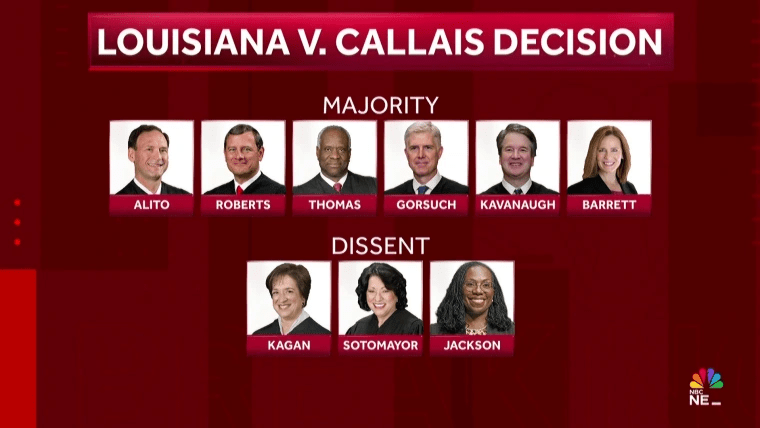
We begin with a sobering reality. On April 29, 2026, the Supreme Court’s 6-3 decision in Louisiana v. Callais effectively placed the Voting Rights Act (VRA) on life support. By striking down a map that created a second majority-Black district in Louisiana, the Court has shifted the legal standard from a “results-based” test to an “intent-based” one.
In plain English: it is no longer enough to show that a map strips a community of its power; you now have to prove the legislators had “malice” in their hearts when they drew it. This ruling grants a “presumption of good faith” to the very people drawing the lines, essentially handing the fox the keys to the hen house.
II. The Shield: What the Voting Rights Act Guaranteed
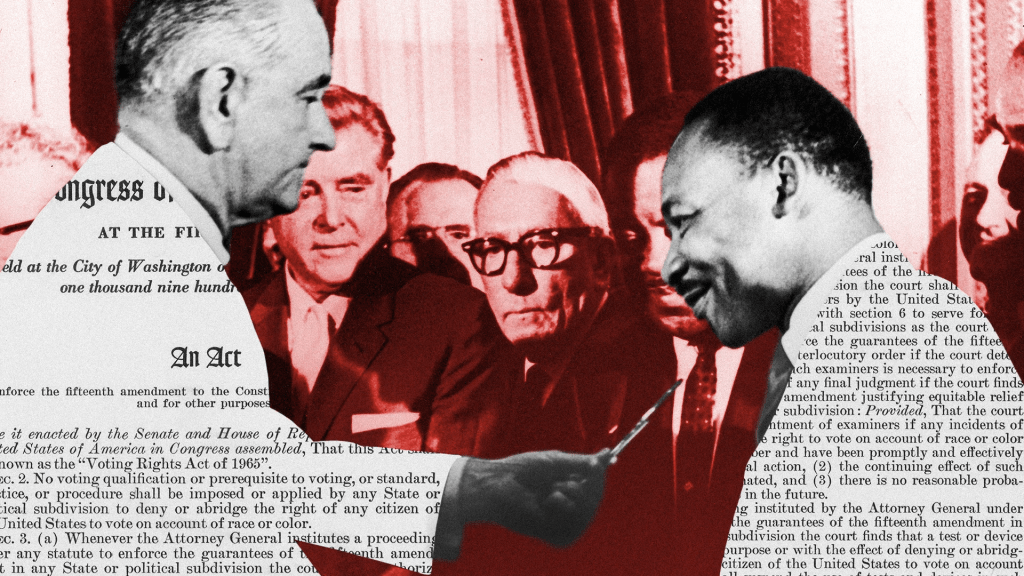
To understand what we are losing, we must remember why the VRA of 1965 was called the “Crown Jewel” of the Civil Rights Movement. Before 1965, the 15th Amendment—which prohibited federal and state governments from denying a citizen the right to vote based on “race, color, or previous condition of servitude”—was a “parchment barrier.” It was a promise with no teeth. In the Jim Crow South, States still created elaborate ways to prevent the Black community from voting.
The VRA changed everything by introducing:
- Section 5 (Pre-clearance): This forced states with a history of discrimination to seek federal approval before changing any voting rule.
- Section 2: This allowed citizens to sue to overturn discriminatory maps and practices like gerrymandering.
The Result: It transformed the American South overnight. In Mississippi alone, Black registration went from under 7% to over 60% in just two years. It was necessary because, without federal oversight, local authorities used literacy tests and poll taxes to maintain a racialized economic and social hierarchy.
III. The Engine of Citizenship: A History of Struggle
In my opinion, voting is the most powerful American right because it is the right that protects all other rights. Our voting history is a tug-of-war. From the founding—where only white male property owners held the lever—to the 19th-century taxpaying requirements, the franchise has always been restricted by those in power to prevent the “wrong people” from changing the economic status quo. When we don’t vote, we aren’t just “staying home”; we are consenting to be governed by those who do not have our interests at heart.
IV. Explaining the “Invisible Architecture” of Gerrymandering
To the average person, “gerrymandering” sounds like political jargon. In reality, it is a mechanical tool used to steal power without firing a shot. To understand it, look at the recent lawsuit in Louisiana.
The Louisiana Use Case
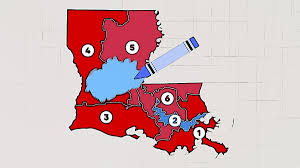
Louisiana’s population is roughly one-third Black. Simple math suggests that in a state with six congressional seats, Black voters should have a fair opportunity to elect candidates of their choice in at least two of them. Yet, for decades, the state was locked into a map with only one majority-Black district.
How does that happen? Think of the state’s voting population as a large pie. If you were to cut that pie fairly, you would have several slices where Black voters could decide the outcome.
V. The Tactic: “Cracking” the Pie
Instead of fair slices, local administrators use a tactic called “cracking.” Imagine taking a concentrated Black community—one that has enough people to form its own voting district—and slicing it into four or five thin pieces. Each of those pieces is then “absorbed” into a much larger, surrounding white district.
The result? The Black community’s influence is diluted to the point of invisibility. They are a minority in every single district, meaning they can never elect a representative who speaks for them. This isn’t a relic of the distant past; this is the exact “invisible architecture” used by Jim Crow administrators that the Supreme Court just gave a “green light” to continue.
When Louisiana was sued over this dilution, the lower courts recognized the unfairness and ordered the creation of a second majority-Black district. However, the Supreme Court has now overturned that decision. Their reasoning? They determined that race was used as the primary factor in drawing that second district.
Think about the absurdity of that logic: even though creating a second district was the only fair and mathematically correct decision based on a population that is one-third Black, the Court struck it down because the remedy was “about race.” Of course it was about race. The first offense—the “cracking” of the community—was explicitly about race. Therefore, any honest remedy must be about race. By blocking the cure because it mentions the disease, the Court is effectively protecting the original infection.
VI. The Domino Effect—Why This Affects Everyone
There is a dangerous misconception that the attack on the Voting Rights Act is “only a Black issue.” History tells a different story. In America, the expansion of rights for Black citizens has always been the “unlocking mechanism” for the rights of everyone else.
From the 15th to the 19th
The 15th Amendment, which technically gave Black men the right to vote in 1870, provided the legal and moral blueprint for the 19th Amendment. Suffragists like Alice Paul and Susan B. Anthony leveraged the language of the 15th Amendment to argue that “sex” should be added to the list of protected categories. Without the breakthrough of Black suffrage, the movement for women’s right to vote would have lacked its foundational legal precedent.
The VRA, the Asian American Community, and LGBQTIA+ Rights
The Voting Rights Act didn’t just stay in 1965; it evolved. In 1975, the Act was expanded to protect “language minorities,” a move that was a game-changer for the Asian American and Pacific Islander (AAPI) community.
- Breaking the Language Barrier: This expansion mandated bilingual ballots and oral voting assistance in jurisdictions with significant non-English speaking populations. For many Asian immigrants who had naturalized and become citizens, this was the moment the “right to vote” became a functional reality.
- The Blueprint for Inclusion: The legal concept that the government has a functional duty to prevent discrimination against a “protected class”—whether based on race, national origin, or language—was forged in the fires of the Black struggle. This paved the way for broader civil rights protections that eventually benefited the LGBTQIA+ community as well.
The strategy is clear: the VRA provided the legal framework to argue that a citizen’s identity should not be a barrier to their participation in American life. Today, the same lawmakers who push to dilute Black votes and restrict language assistance for Asian voters are often the ones sponsoring legislation to strip rights from the LGBTQIA+ community.
The New Threat to Women’s Suffrage
Make no mistake: when they come for one, they are coming for all. We are already seeing the rise of “theocratic” movements, led by figures like Doug Wilson, who has documented ties to high-ranking officials in the current administration. Wilson and his followers openly argue for “household voting”—a return to a time when only the “head of the household” (the man) could vote, effectively stripping women of their individual franchise. By dismantling the VRA today, they are clearing the path to roll back the 19th Amendment tomorrow.
VIII. The “Colorblind” Loophole
The most insidious tactic used by the current Court is the weaponization of the 13th, 14th, and 15th Amendments. These “Reconstruction Amendments” were created explicitly to protect the newly freed Black population. However, the authors intentionally used universal language—referring to “persons” and “citizens” rather than “Black citizens”—to ensure the law would stand the test of time.
Dismantling Rights in the Name of “Equality”
Today’s legal architects are using this lack of explicit mention as a loophole. They argue that any law specifically designed to protect Black voters (like Section 2 of the VRA) is actually a form of “racial discrimination” against white voters because it “takes race into account.”
They are using the very amendments designed to end slavery and ensure equality to strike down the tools we use to achieve it. It is a perverse logic: claiming that the only way to stop discrimination is to stop the government from noticing when discrimination is happening. By declaring America “colorblind,” the Court is choosing to be blind to the very real, data-driven evidence of voter suppression.
IX. Proof of Concept—The 2012 High-Water Mark
For those who say voting doesn’t change anything, we look back to 2012. With a record 66.2% Black turnout, the community didn’t just “express an opinion”—they dictated the national agenda.
- Healthcare as a Right: That turnout protected the Affordable Care Act. The result? The Black uninsured rate dropped by one-third in four years.
- Bending the Arc of Justice: It gave the administration the mandate to launch “My Brother’s Keeper” and prompted the Department of Justice to end the era of mandatory minimums for low-level drug offenses, slowing the engine of mass incarceration.
- The Bench: It allowed for the appointment of the most diverse federal judiciary in history, seeding the courts with judges who understand the lived experience of the marginalized.
X. The Warning: The 2024 Downturn and Its Aftermath
If 2012 showed us the power of presence, 2024 showed us the cost of absence. With Black turnout dipping to 59.6%, the “protection gap” has widened. The negative effects are already surfacing:
- Judicial Reversal: The lack of a clear mandate has allowed for the rapid-fire dismantling of equity programs and the weakening of the VRA we see today.
- Policy Neglect: When turnout drops, politicians shift their focus to “likely voters”—who are often older and wealthier—leading to stagnation in policies regarding the minimum wage, student debt, and urban infrastructure.
- The Vicious Cycle: Low turnout in 2024 emboldened state legislatures to pass the very gerrymandered maps that make people feel their vote doesn’t matter, creating a self-fulfilling prophecy of disenfranchisement.
XI. The Path Forward: Countering the Collapse
The dismantling of federal protections is a crisis, but it is not a defeat. As the federal shield dissolves, the front line of democracy has shifted to the states. We are building a firewall ourselves.
- The State-Level Firewall: If the U.S. Supreme Court won’t protect Section 2, the states must. New York’s own John R. Lewis Voting Rights Act (2022) restores the “pre-clearance” protections lost at the federal level.
- Independent Redistricting: The best way to stop gerrymandering is to take the pen away from politicians. States with Citizen-Led Commissions have proven that we can have competitive elections and fair maps when the people, not the parties, draw the lines.
- Reducing the “Cost” of Voting: We counter suppression with accessibility. From “Golden Day” registration to pre-registering 16-year-olds, we must make the ballot as accessible as the air we breathe.
XII. Conclusion: Citizenship is a Muscle
Voting is the key to citizenship because it is a self-correcting mechanism. The effort to eradicate the Voting Rights Act is happening because those in power know exactly how much your vote is worth. They wouldn’t work this hard to take it if it didn’t have the power to change the world.
The response to the Callais decision must be a surge. We must support State Voting Rights Acts (like the one we have in New York) and demand Independent Redistricting Commissions. Let’s treat the ballot like the historical treasure it is—a tool our ancestors bled for, and the only one capable of building a truly representative America for all citizens.
Glossary of Terms
- Cracking: A gerrymandering technique that spreads voters of a particular group across many districts to deny them a sufficiently large voting block in any one district.
- Packing: Concentrating as many voters of one type as possible into a single electoral district to reduce their influence in other districts.
- Pre-clearance (Section 5): A defunct requirement of the VRA that mandated specific jurisdictions seek federal approval before changing voting laws.
- Vote Dilution: The practice of reducing the effectiveness of a particular group’s crown voting power through redistricting or changes in election systems.
- Standard of Intent: A legal requirement where plaintiffs must prove legislators meant to discriminate, rather than just proving the law has a discriminatory effect.
- Independent Redistricting Commission (IRC): A body of non-politician citizens tasked with drawing district lines to prevent partisan or racial gerrymandering.
- Theocratic Movement: Political movements (like those led by Doug Wilson) that seek to base government and law on specific religious interpretations, often targeting individual voting rights.
Selected Bibliography & Further Reading
Legal Precedents & Cases
- Louisiana v. Callais, 601 U.S. ___ (2026): The Supreme Court ruling regarding the creation of Louisiana’s second majority-minority district.
- Shelby County v. Holder, 570 U.S. 529 (2013): The landmark case that struck down the VRA’s pre-clearance formula.
- Rucho v. Common Cause, 588 U.S. ___ (2019): The ruling declaring that partisan gerrymandering claims are non-justiciable in federal courts.
Historical & Academic Texts
- Anderson, Carol. One Person, No Vote: How Voter Suppression Is Destroying Our Democracy. Bloomsbury Publishing, 2018.
- Keyssar, Alexander. The Right to Vote: The Contested History of Democracy in the United States. Basic Books, 2000.
- New York State Senate. The John R. Lewis Voting Rights Act of New York (S.1046). 2022.
Data Sources
- U.S. Census Bureau: Current Population Survey, Voting and Registration in the Election of November 2012 & 2024.
- The Brennan Center for Justice: The State of Voting 2026: Trends in State Voting Rights Acts.
- MIT Election Data + Science Lab: Voter Turnout and Performance Metrics by Demographic.
