

Table of Contents
- The Siege of Brooklyn
- The Foundation of the Dream
- The Power of the Deed: A Historical Perspective
- From Massacres to Modernity
- The Legal Front: Civil Rights and Housing
- The Anatomy of a Modern Heist
- The Erasure of Generational Wealth
- The Systemic Shield
- Protecting the Future
- Glossary of Terms
- Bibliography
1. The Siege of Brooklyn
The scene on Jefferson Avenue in Bed-Stuy this past Wednesday was a visceral reminder that the battle for Brooklyn isn’t just being fought in corporate boardrooms (see eminent domain)—it’s being fought on the front stoops of our ancestors. When New York City Council Member Chi Ossé stood in front of a family brownstone to block a city marshal, he wasn’t just protesting an eviction; he was standing against a “paper massacre.”
The resulting images of a sitting elected official being wrestled to the ground and handcuffed by police sent a shockwave through the community. They were protesting the eviction of Carmela Cherington, a grandmother fighting to keep a family home that advocates allege was snatched through a predatory, fraudulent web of deed theft. For those of us living in these neighborhoods, this isn’t just a headline—it’s our daily reality. Your phone buzzes with unsolicited texts: “Cash for your property, close in 24 hours.” You step outside to see strangers slow-rolling in SUVs, taking pictures of your neighbors’ houses, cataloging “disrepair” like vultures circling a wounded animal. These predatory realtors and speculators aren’t looking for a “win-win” deal; they are looking for a way to sever a family from its greatest asset. They are the scouts for a modern heist that targets our seniors and our legacy.
2. The Foundation of the Dream

This aggressive, boots-on-the-ground targeting is the tip of the spear in a war for the very soil we stand on. It serves as a grim reminder that the bedrock of the American Dream is not a job, a degree, or a salary; it is property ownership. In the United States, land is the ultimate currency of freedom, the primary vehicle for generational wealth, and historically, the prerequisite for citizenship.
3. The Power of the Deed: A Historical Perspective

To understand why deed theft is so devastating, one must first acknowledge the historical weight of a deed in America. In the early Republic, property ownership was the gatekeeper to the franchise. Voting was restricted to white, property-owning men because the Founding Fathers believed that only those with a “stake in the soil” possessed the necessary independence and responsibility to govern. To own land was to be recognized as a person with a voice; to be landless was to be a dependent, invisible to the state.
For Black Americans, the quest for property has always been an uphill battle against state-sanctioned theft. Following the Civil War, the promise of “forty acres and a mule” was a recognition that true liberation required an economic foundation. When that promise was rescinded by President Andrew Johnson, it set a precedent that Black property rights were negotiable.
4. From Massacres to Modernity
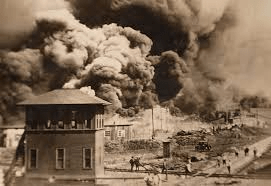
Despite systemic hurdles, by the early 20th century, Black communities had built thriving “Black Wall Streets” and agricultural hubs. This success often acted as a “trigger” for violence. In the Tulsa Massacre of 1921, and similar atrocities in Rosewood and Elaine, the catalyst was often the sight of Black prosperity rooted in land. When these towns were burned, it wasn’t just lives that were lost—it was the land. After owners were murdered or driven out, their property was frequently seized by white residents or local governments through adverse possession or forced sales. The message was clear: ownership was a privilege the state would not protect for all.
5. The Legal Front: Civil Rights and Housing
By the mid-20th century, the tactics changed from overt violence to systemic exclusion. Redlining and restrictive covenants ensured that even as the white middle class built massive wealth through the post-WWII housing boom, Black families were boxed into neighborhoods where property values were suppressed.

The Fair Housing Act of 1968, a cornerstone of the Civil Rights Act, was designed to dismantle this. It was an admission that without the right to buy property in high-value neighborhoods, Black Americans would remain perennially behind in the race for generational wealth. However, the Fair Housing Act has been under constant assault since its inception. In recent years, we have seen a concentrated effort to weaken its enforcement, effectively trying to reverse the progress of the Civil Rights era. But while legal challenges to the Fair Housing Act move slowly through the courts, a more blatant and aggressive tactic has emerged on the streets: deed theft.
6. The Anatomy of a Modern Heist
Deed theft is the “paper version” of a town massacre. It is the practice of stealing a home through fraudulent filings, forgery, or deceit. Instead of torches and guns, the modern thief uses a notary stamp and a fake signature.
This tactic is surgically targeted. It focuses on neighborhoods where property values have skyrocketed due to gentrification—places like Bed-Stuy, where a brownstone purchased for $40,000 in the 1970s is now worth $3 million. The targets are almost always seniors, who may have paid off their mortgages and are “equity rich but cash poor.” These elders are the keepers of a family’s generational wealth; their homes are the inheritance intended for their children and grandchildren.
Scammers use several sophisticated methods to execute this theft:
- Outright Forgery: Filing a forged deed with the city register, transferring the title to a shell company.
- The “Stack of Papers” Trick: Approaching a senior with “help” for a loan modification or tax lien, then slipping a deed transfer into a stack of documents for them to sign.
- Equity Stripping: Once the thief has the deed, they immediately take out massive loans against the house, pocket the cash, and disappear, leaving the house in foreclosure.
7. The Erasure of Generational Wealth
When a home is stolen, it isn’t just a building that is lost; it is the “nest egg” for the next three generations. For a Black family in Brooklyn, that home represents the ability to fund a grandchild’s college education, provide a down payment for a child’s first home, or ensure a dignified retirement for an elder. In recent investigative reports, we see the visceral pain of this loss. Victims aren’t just fighting for shelter; they are fighting for the legacy of their parents who worked union jobs for thirty years to secure that property. When a deed is stolen, that thirty years of labor is transferred, in an instant, to a predatory speculator.
8. The Systemic Shield
One of the most disturbing aspects of deed theft is the difficulty of reversing it. Because the theft is recorded in the city’s official register, it carries a “presumption of regularity.” When a victim calls the police, they are often told it is a “civil matter.” This effectively forces a 70-year-old victim to hire an expensive lawyer to fight a multi-million dollar shell company in court for years. In many cases, the “thieves” are protected by the very laws designed to ensure the stability of property transfers.
This is why leaders like Council Member Chi Ossé are calling for an eviction moratorium in cases of suspected deed theft and NYC Mayor Zoran Mamdani Established the Mayor’s Office Of Deed Theft Prevention. The current system allows a thief to evict the rightful owner before the fraud is even fully investigated. This is a perversion of the “American Dream” of property ownership. If the state cannot protect the deed, then the bedrock of American stability is crumbling.
9. Protecting the Future

The fight against deed theft is the front line of the modern civil rights movement. If property ownership is the source of power in America, then losing that property is a form of disenfranchisement. To protect generational wealth, homeowners must be proactive:
- Sign up for ACRIS alerts: In New York, the Automated City Register Information System can notify you the moment a document is filed against your property.
- Estate Planning: Houses should be placed in trusts or have clear wills to prevent “partition sales.”
- Community Watch: Neighbors must look out for one another. If you see suspicious “investors” circling an elder’s home, say something.
From the restricted voting booths of the 1700s to the burning streets of Tulsa, and now to the quiet forgery of deeds in Brooklyn, the tactic of land theft has changed, but the goal remains the same: to prevent Black Americans from anchoring themselves in the American soil. Deed theft is not just a crime against an individual; it is an attack on the future of an entire community.
Glossary of Terms
- ACRIS (Automated City Register Information System): The public record system used in NYC to search and track property-related documents like deeds and mortgages.
- Deed Theft: A fraudulent scheme where a property’s title is illegally transferred through forgery or deceit.
- Equity Stripping: A process where a fraudulent owner takes out loans against a property’s value, pocketing the cash and leaving the home in debt.
- Fair Housing Act (1968): A federal law prohibiting discrimination in the sale, rental, and financing of housing based on race, religion, national origin, or sex.
- Generational Wealth: Assets passed down from one generation to the next, often serving as the primary source of financial stability for families of color.
- Partition Sale: A court-ordered sale of a property, often triggered when a speculator buys a small share of a family property and sues to force a sale of the entire asset.
Bibliography
- Democracy Now! (April 24, 2026). NYC Councilmember Chi Ossé Arrested at “Deed Theft” Protest. * News 12 Brooklyn. (April 22, 2026). NYC Council Member Arrested at Brooklyn Eviction amid Deed Theft Dispute. * BRIC TV. (January 10, 2017). Deed Theft is Aiding Gentrification in Bed-Stuy, Brooklyn. * HOT 97 Mornings with Mero. (February 11, 2026). Chi Ossé Exposes NYC Deed Theft: How Seniors Are Losing Their Homes Legally.
- PIX11 News. (September 3, 2025). Brooklyn senior blames deed theft for loss of brownstone.
- CBS New York. (April 2, 2026). Data shows 240% increase in N.Y. deed theft complaints from 2023 to 2025.
- U.S. Department of Justice. The Fair Housing Act of 1968: Historical Context and Enforcement.
