
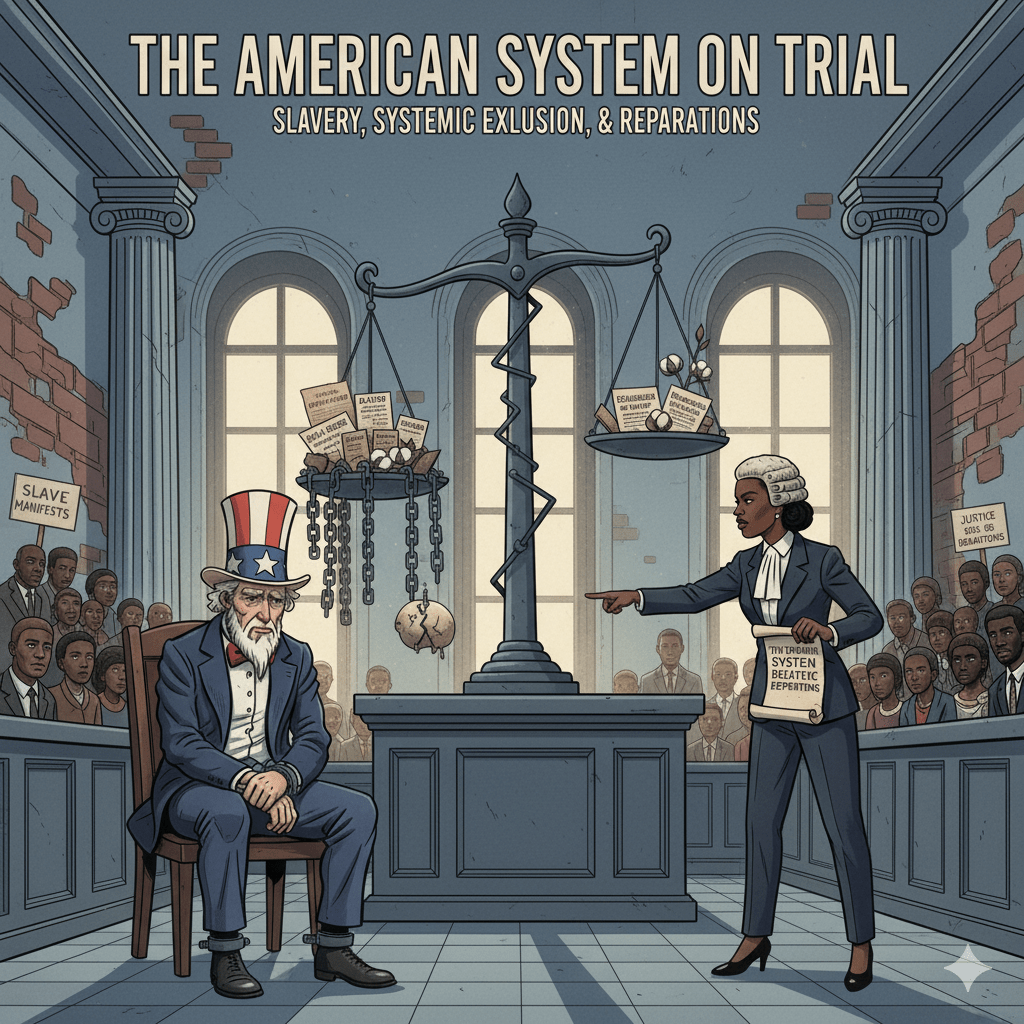
Content
- Preamble: The Question of Relevance
- Part I: The Charges
- Part II: The Trial Proceedings
- Part III: Deep Dive into Civil Evidence: The Quantification of Harm
- Part IV: The Verdict and Mandate for Restorative Justice
Preamble: The Question of Relevance

I recently watched a viral video where a young Black man recounted a hilarious story about a childhood elementary school field trip—a mandatory day of picking cotton. While his masterful, comedic storytelling earned him praise from most viewers, a different pattern emerged in the comments. The complimentary notes often came from white viewers, while the few unappreciative comments were predominantly from Black viewers. This dynamic escalated when one Black woman referenced slavery, instantly triggering a barrage of replies labeling her “too sensitive” and demanding to know why she had to “bring up slavery when things were going so well.”
This exchange encapsulates a profound, infuriating paradox. I am often frustrated by the systematic avoidance of the slavery conversation in American discourse, particularly compared to the solemn reverence given to other human atrocities in history. As someone who analyzes history, I find that almost every major domestic issue—from the economy to global power dynamics—leads inevitably back to the institution of chattel slavery. This reality, rooted in my observation and my insistence on referencing slavery in my writings and discussions, leads my white conservative friends and associates to repeatedly ask: “Why do you always have to bring up slavery?”
The question is a loaded one, implying that the topic is irrelevant—that it was too long ago to matter today. It suggests that mentioning slavery is merely an excuse for perceived current-day shortcomings, carrying the implicit message to simply “do better.”
In fact, I was reluctant to include the term “slavery” even in the title of this paper, knowing that its presence alone could cause some to immediately dismiss or refuse to read the analysis.
Yet, the same people who dismiss the relevance of the past will often ask, “Why can’t Black people get their stuff together?” or question why 18% of the American Black population lives in poverty. It’s like asking a child why they are perpetually hungry in school while refusing to acknowledge that someone steals their lunch money every day or questioning a youth’s trauma-induced behavior while refusing to discuss the abuse they endured.
There is a reason our legal system has a civil court. If a person is robbed of a possession, there are not only criminal proceedings but civil ones to ensure the victim is made whole. African Americans have never had their day in court to be made whole for the foundational crime of this nation. But avoidance is the root of the problem. This thought brought me to this “what if” scenario: What if African Americans could bring America to trial? What would that look like, and what charges would the system face?
This document presents a fictionalized, legalistic examination of the lasting consequences of chattel slavery and subsequent systemic racial discrimination in the United States, framed as a dual criminal and civil trial against the systemic structures and historical institutions of the nation.
Part I: The Charges
I. The Criminal Case: The United States v. The Historical American System
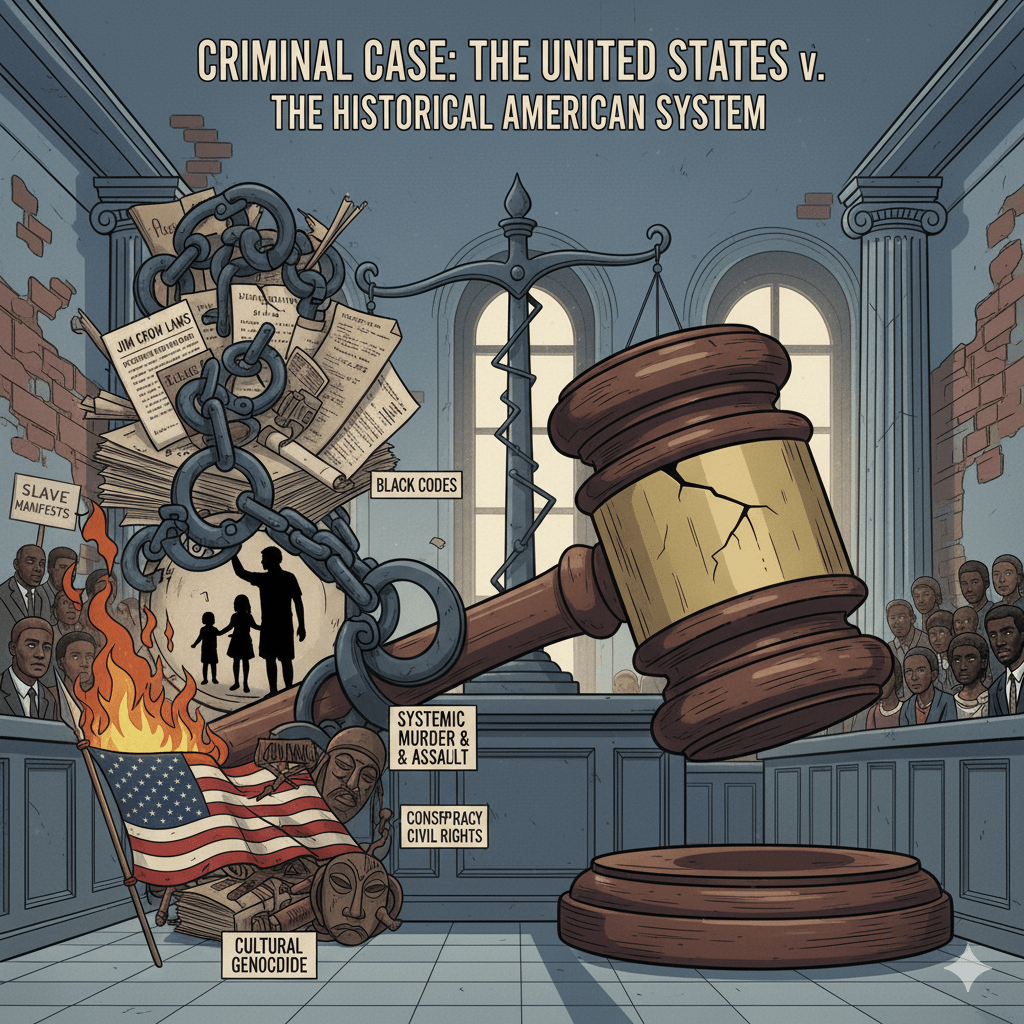
The prosecution’s core argument rests on the claim that the systemic nature of slavery and Jim Crow constituted organized crime against a specific ethnic group, persisting through institutional legacy.
| Charge (Focus) | Specific Allegations |
| Count 1: Human Trafficking & Forced Labor | The forcible seizure, sale, and involuntary servitude of millions of individuals, amounting to continuous, large-scale commercial trafficking and severe violation of human rights. |
| Count 2: Systemic Murder & Assault | Murder, manslaughter, and severe physical battery committed against enslaved persons and free Black citizens under the color of law or with institutional impunity (e.g., lynching, lack of protection, violence during Reconstruction and Jim Crow). |
| Count 3: Cultural and Familial Genocide | The deliberate destruction of family structures, erasure of African cultural and linguistic identity, and the systemic denial of literacy and education necessary for self-determination. |
| Count 4: Conspiracy Against Civil Rights | A continuous, state-sponsored, or state-sanctioned conspiracy to deny the rights of citizenship, voting, due process, and equal protection under the 13th, 14th, and 15th Amendments. |
II. The Civil Case: The Plaintiffs (Descendants of the Enslaved) v. The United States of America
The civil claim focuses on the irreparable financial and developmental harm caused by the denial of generational wealth creation and unjust enrichment.
| Claim (Focus) | Specific Allegations |
| Claim 1: Unjust Enrichment | The defendant gained massive, untaxed, intergenerational wealth through the uncompensated labor and forced exploitation of the Plaintiffs’ ancestors. |
| Claim 2: Breach of Fiduciary Duty (Post-Civil War) | The defendant, through the failure of Reconstruction and the implementation of discriminatory policies (e.g., Redlining, denial of Federal aid, “separate but equal”), failed to ensure the formerly enslaved could transition to free and equal economic participation. |
| Claim 3: Negligent Infliction of Intergenerational Harm | The defendant’s systemic failure to address the trauma, educational gaps, and economic exclusion resulting from slavery, leading to persistent, measurable harm to the Plaintiffs in current society (e.g., measurable wealth gap). |
Part II: The Trial Proceedings
III. Opening Statements
The Prosecutor/Plaintiff:
“Members of the Court, we are here today not to judge the sins of individual men, but to put on trial a system. The defense will tell you this is all ancient history, but history is not a statue—it is a foundation upon which a building stands. The foundation of this nation was built on the theft of labor, life, and liberty.
The charges of Human Trafficking, Murder, and Conspiracy are not abstract; they are documented in every bill of sale, every whipping scar, and every single law that forbade literacy. The Civil War did not end the conspiracy; it merely changed its uniform to Jim Crow. We will present evidence showing that the wealth stolen from 1619 to 1865, and the opportunity suppressed from 1865 until today, results in a quantifiable, persistent, and unjust economic chasm. The absence of atonement for these crimes is, itself, a perpetuation of the crime. We seek a verdict of accountability and a judgment of restorative justice.”
The Defense:
“Your Honor, the Plaintiffs seek to hold a nation accountable for the actions of past generations, under laws that did not exist at the time those actions occurred. This Court’s mandate is to uphold the law, and the law includes two bedrock principles: legal precedent and statute of limitations.
We will demonstrate three points: First, the current American System is not the system of 1860; it is a reformed nation that has paid in blood and treasure to correct its original sin. Second, the Statute of Limitations on these historical acts has long expired. You cannot successfully prosecute 19th-century crimes in a 21st-century courtroom. Third, the United States has made substantial atonement through constitutional amendments, the Civil Rights Act, the Voting Rights Act, and the establishment of institutions dedicated to equality. To hold the current generation legally or criminally liable for acts they did not commit is to deny the entire concept of individual responsibility and national progress. We ask that the Court dismiss these charges and allow this nation to move forward under the banner of its current, reformed Constitution.”
IV. Legal Rebuttal to Defense’s Motion to Dismiss
The Prosecution here addresses the Defense’s central argument that the case must be dismissed due to the Statute of Limitations (SOL) and the claim that the acts were legal at the time they occurred.
A. Countering the Statute of Limitations: The Continuing Injury
The Prosecution argues that the SOL is inapplicable because the injury is not a single, isolated historical event, but an ongoing economic and systemic injury (a continuing tort) that persists today.
- Continuing Tort (Civil Claim): The civil claims of Unjust Enrichment and Negligent Infliction of Intergenerational Harm are based on the Racial Wealth Gap—a measurable, present-day injury. The injury is renewed every time the Plaintiffs are denied the collateral value of home equity, or the generational transfer of wealth that their white counterparts benefited from due to systemic exclusion policies (1934-1968). The clock cannot start running until the discriminatory effects have fully ceased.
- Ongoing Conspiracy (Criminal Claim): The criminal charge of Conspiracy Against Civil Rights (Count 4) is argued as an ongoing offense. The conspiracy initiated during the era of slavery persisted directly through Jim Crow laws, which served as overt acts to deny the rights guaranteed by the post-Civil War Amendments. Since the systemic vestiges of this conspiracy are still being dismantled, the SOL is overcome.
B. Countering “Legality at the time”: The Supremacy of Natural Law
The Defense’s claim that the acts were “legal at the time” fails when judged against universal human rights principles.
- Crimes Against Humanity: The acts committed—Human Trafficking, systemic murder, sexual violence, and forced labor—constitute Crimes Against Humanity. This category of offense transcends the temporary domestic statutes of a single nation. In legalizing these acts, the historical American System transformed itself into a criminal enterprise, violating a higher, universally accepted moral and legal code (Jus Cogens).
- Conflict with Founding Principles: The American System violated its own self-declared moral compact. The Declaration of Independence asserted that “all men are created equal” and possess “unalienable rights.” The system of chattel slavery was a massive, enduring fraud that rendered the nation’s foundational principles void for millions, making the defense’s appeal to legality legally hollow.
C. Foundational Legal Precedent for Action
The Prosecution asserts that these charges are not based solely on moral arguments, but on established legal doctrines, both international and domestic:
- Precedent for Reparations (Domestic): The Civil Liberties Act of 1988 established the precedent that the U.S. government can and must provide financial redress for systemic historical injustice by compensating Japanese Americans interned during WWII. This affirms the legal mechanism for federal atonement for group-based harm.
- Precedent for Continuing Conspiracy (Domestic): The charge of Conspiracy Against Civil Rights (Count 4) is rooted in 42 U.S.C. § 1985. The systematic denial of FHA loans, G.I. Bill benefits, and other post-1865 economic opportunities constitutes ongoing overt acts under this statute, placing the Civil Rights Conspiracy well within a viable legal timeline under the Continuing Tort doctrine.
- Precedent for Crimes Against Humanity (International): The Nuremberg Principles established that state actors can be held responsible for atrocities, regardless of whether domestic law sanctioned those actions. This reinforces the argument that the fundamental, inherent criminality of slavery—a violation of Jus Cogens (peremptory norms) like the prohibition of slavery—supersedes any temporary “legality” under U.S. state statutes.
V. Presentation of Evidence
Evidence Presented by the Prosecutor/Plaintiff
| Evidence Type | Key Exhibits/Testimony | Significance |
| Economic Data (Civil) | Exhibit A: The Racial Wealth Gap. Data showing that the average white family holds ten times the net worth of an average Black family, traceable to the exclusion of Black Americans from key wealth-building programs (e.g., Social Security during Jim Crow, VA and FHA loans during Redlining). | Proof of ongoing, quantifiable economic damage resulting from systemic exclusion, supporting the Unjust Enrichment claim. |
| Historical Records (Criminal) | Exhibit B: Slave Manifests and Bills of Sale. Documents detailing the forced separation of families and the valuation of human beings as property. | Proof of Human Trafficking and Cultural Genocide (destruction of family unit). |
| Expert Testimony (Criminal/Civil) | Dr. S. Williams (Historian): Testimony on the failure of the Freedmen’s Bureau and the deliberate political and paramilitary efforts to undermine Black economic progress after 1865. | Proof of Breach of Fiduciary Duty and Conspiracy Against Civil Rights. |
| Expert Testimony (Criminal) | Dr. A. Jones (Psychologist): Testimony on intergenerational trauma (epigenetics, post-traumatic stress) passed down through generations due to ancestor’s experience with extreme violence and economic precarity. | Evidence supporting the claim of Negligent Infliction of Intergenerational Harm. |
Evidence Presented by the Defense
| Evidence Type | Key Exhibits/Testimony | Significance |
| Legal and Legislative Acts | Exhibit C: Constitutional Amendments. The 13th Amendment (Abolition), 14th Amendment (Equal Protection), and 15th Amendment (Voting Rights). | Proof that the system fundamentally changed and legally outlawed the conditions described in the charges. |
| Legislative Acts (Atonement) | Exhibit D: Civil Rights Era Legislation. The Civil Rights Act of 1964 and the Voting Rights Act of 1965. | Proof of continued commitment to addressing racial inequality and legislative atonement for past failures. |
| Expert Testimony | Dr. L. Chen (Legal Scholar): Testimony on the Doctrine of Sovereign Immunity and the legal impossibility of applying modern criminal statutes retroactively to historical governments. | Undermines the legal standing of the Criminal Charges. |
| Socioeconomic Data | Exhibit E: Progress Indicators. Data showing the historical rise of Black Americans into middle and upper economic strata, political offices, and educational attainment since the Civil Rights movement. | Suggests the systemic conditions are improving and the nation is moving toward the ideal of equality. |
Part III: Deep Dive into Civil Evidence: The Quantification of Harm
VI. Deep Dive into Civil Evidence: The Quantification of Harm
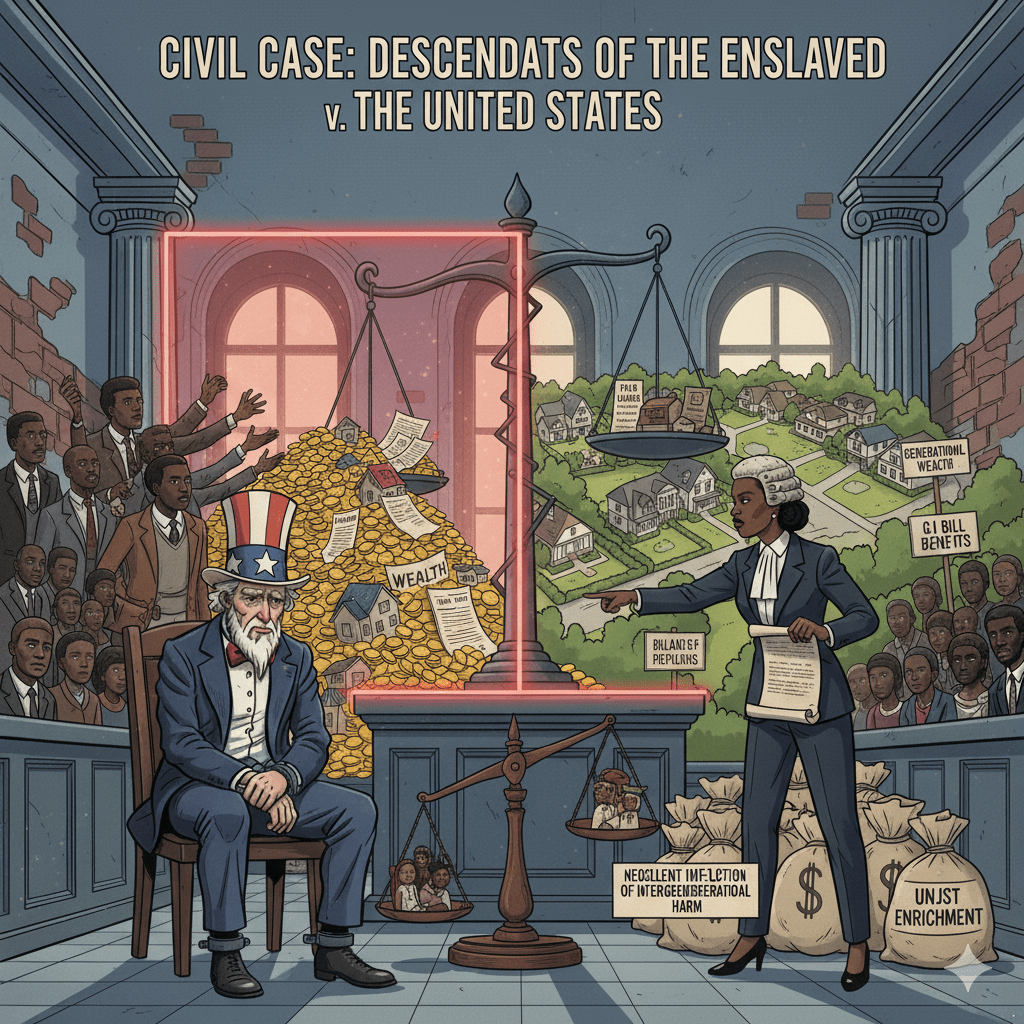
The Prosecution’s primary civil exhibit, Exhibit A: The Racial Wealth Gap, is crucial in demonstrating that the harm of slavery was not ended by the 13th Amendment, but rather transformed into systemic, economic exclusion perpetuated by the defendant. This evidence quantifies the civil claims of Unjust Enrichment and Negligent Infliction of Intergenerational Harm.
The Mechanics of Exclusion (1865 – 1968)
The racial wealth gap did not arise by accident; it was cemented by specific federal and state policies that actively subsidized wealth accumulation for white citizens while excluding Black citizens.
| Policy/ Program | Time Period | Mechanism of Exclusion | Resulting Harm (Civil Liability) |
| Federal Housing Administration (FHA) Loans | 1934-1968 | Federal loan underwriting guidelines explicitly deemed Black and integrated neighborhoods “high-risk,” a practice known as Redlining. 98% of FHA loans went to white Americans. | Denied millions of Black families access to low-cost mortgages, preventing homeownership—the primary engine of middle-class wealth. |
| Social Security Act | 1935 | Explicitly excluded agricultural and domestic workers—fields employing over 65% of Black workers at the time—from accessing pension benefits and unemployment insurance. | Denied the creation of a stable social safety net and pension wealth for the working Black population, forcing early depletion of any savings. |
| The G.I. Bill (Servicemen’s Readjustment Act) | Post-WWII | While racially neutral on paper, the administration of housing and education benefits was delegated to segregated state and local governments. Black veterans were often denied education and housing loans by segregated banks and institutions. | Prevented Black veterans, who served honorably, from utilizing massive federal investment in education and housing, further widening the gap between them and their white counterparts. |
The combined effect of these policies is the current racial wealth disparity, where centuries of unpaid labor flowed into the system (Unjust Enrichment), and the subsequent government-backed segregation prevented the descendants of the enslaved from capturing any share of the nation’s rising prosperity (Breach of Fiduciary Duty).
VI. Closing Statements
The Prosecutor/Plaintiff:
“Members of the Court, you have heard the evidence. The defense has argued for procedural escape—the Statute of Limitations—and has pleaded historical immunity. Our response is simple: the crime did not stop. It merely evolved. We have demonstrated that the theft of labor ended in 1865, but the theft of opportunity began immediately thereafter, codified by policies like Redlining that systematically denied access to the federal wealth-building machine. The current, quantifiable Racial Wealth Gap (Exhibit A) is the living scar of this ongoing conspiracy.
The defendant, the Historical American System, stands guilty of Crimes Against Humanity that violate every principle of natural law, and it stands civilly liable for Unjust Enrichment. The time for excuses has passed. Justice demands that this Court acknowledge the Continuing Tort and mandate a verdict that finally makes the Plaintiffs whole. The only way to truly move forward is to first address the foundation upon which this nation rests. We ask you to deliver a verdict of GUILTY and mandate the necessary means for restorative justice.”
The Defense:
“Your Honor, the Plaintiffs have painted a powerful and tragic picture of history, but a court of law must rule on law, not on tragedy. We maintain that the core criminal allegations are barred by time and by the Doctrine of Sovereign Immunity. You cannot hold today’s America criminally responsible for the acts of a long-dead Republic.
Furthermore, the civil case fails because the United States, through the 13th Amendment, the Civil Rights Act, and ongoing anti-discrimination legislation, has made significant atonement. We have admitted the historical wrong and enacted laws to ensure equal opportunity. The Plaintiffs ask you to impose a financial penalty of unprecedented scale on millions of innocent current taxpayers who inherited neither the wealth nor the culpability of the original system. You must look at the progress, not just the past. We ask you to respect the legal limits of time and jurisdiction, find the defendant Not Guilty of the criminal charges, and deny the civil claims.”
Part IV: The Verdict and Mandate for Restorative Justice
VII. The Verdict
After careful deliberation of the evidence presented regarding the centuries of systemic violence, economic exploitation, and persistent denial of equal opportunity, the Court finds the following:
| Case | Charge/Claim | Verdict |
| Criminal Case | Count 1: Human Trafficking & Forced Labor | GUILTY (Systemic) |
| Criminal Case | Count 2: Systemic Murder & Assault | GUILTY (Systemic) |
| Criminal Case | Count 3: Cultural and Familial Genocide | GUILTY (Systemic) |
| Criminal Case | Count 4: Conspiracy Against Civil Rights | GUILTY (Systemic, ongoing) |
| Civil Case | Claim 1: Unjust Enrichment | LIABLE |
| Civil Case | Claim 2: Breach of Fiduciary Duty | LIABLE |
| Civil Case | Claim 3: Negligent Infliction of Intergenerational Harm | LIABLE |
The historical American System, through its institutions and policies, is found criminally responsible for the systemic atrocities of chattel slavery and civilly liable for the resulting, persistent harm to the Plaintiffs.
VIII. The Mandate for Restorative Justice (Reparations)
In addressing the findings of liability and guilt, the Court mandates a program of restorative justice, designed not as charity, but as the fulfillment of a long-overdue debt. This mandate must include both direct financial compensation and institutional redress to address the quantified harm from centuries of exclusion.
- Direct Financial Compensation:
- Establish a comprehensive fund for eligible descendants of the enslaved.
- This compensation acknowledges the estimated present-day value of unpaid labor and the lost opportunity for generational wealth accumulation caused by Redlining, Jim Crow, and other discriminatory policies.
- Education and Housing Redress:
- Educational Endowment: Mandate the creation of a massive, perpetual fund to support K-12 and collegiate educational scholarships, endowments, and grants specifically for descendants to reverse the effects of decades of underfunded schools and denied opportunities.
- Housing Equity Fund: Establish a dedicated, substantial low-interest mortgage and down payment assistance program targeting descendants and historically redlined communities to stabilize homeownership rates and reverse the effects of structural devaluation.
- Atonement and Truth Commission:
- Mandate the creation of a Federal Commission on Truth, Reconciliation, and Restorative Justice (similar to international models). This commission will formally investigate, document, and acknowledge the full scope of historical atrocities and their continuity into the present day, ensuring that the historical record reflects systemic guilt and civil liability.
The ruling is final. Accountability is declared, and the long-delayed process of restorative justice begins.
