
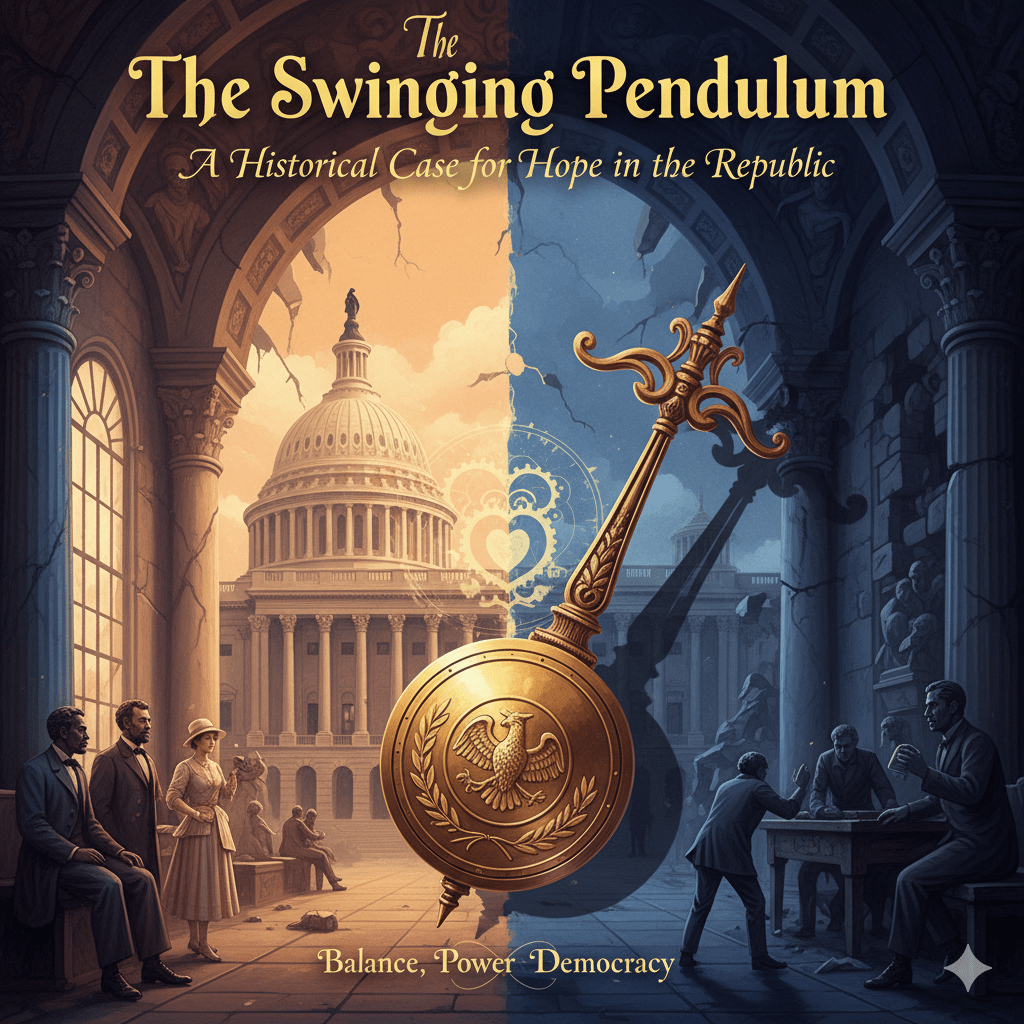
Like many Americans today, I am deeply concerned about the current political direction. The rhetoric is harsh, the partisan divide is wide, and the actions of this administration—guided by an uncompromising agenda—are testing the limits of constitutional power. When we see a consolidation of influence across all three branches of government, it’s fair to ask: Is this the stress test that finally shatters the American experiment?
My answer, anchored in the evidence of history, is a confident “no.”
American democracy is not a fragile artifact; it’s a dynamic, self-correcting machine. The Constitution provides an enduring framework for the peaceful resolution of diverse and conflicting viewpoints. This design creates a political system that acts like a pendulum, swinging dramatically between conservative and liberal dominance, but always finding its way back toward a moderate center. This push and pull is not a sign of failure, but a vital feature of a healthy republic.
I. The Founding Tests: Limits and Law
The earliest days proved the system’s resilience. The Election of 1800 marked the first peaceful transfer of power, from the Federalists to the Democratic-Republicans. The defeated Federalists tried to entrench power through the Judiciary Act of 1801, but the subsequent case of Marbury v. Madison (1803) established Judicial Review—the Supreme Court’s most vital check on the other branches. Even the immense expansion of federal power under Jefferson with the Louisiana Purchase was quickly tempered by the practical realities of governing.
II. The One True Failure: The Civil War
The one time the system fundamentally failed was over the moral catastrophe of slavery. Decades of unsustainable compromises, like the Missouri Compromise (1820) and the Compromise of 1850, attempted to maintain a dangerous sectional balance. The final swing with the Kansas-Nebraska Act of 1854 shattered that balance, leading to the Civil War.
- The Correction: This failure forced the system to correct its fatal flaw. The Reconstruction Amendments (13th, 14th, and 15th) permanently established human rights and federal enforcement of Equal Protection, removing the legal basis for any future sectional break of that magnitude.
III. Swings and Societal Impact
History shows that extreme swings inevitably trigger massive societal corrections:
| Era of Extremism | Resulting Correction | Societal Impact |
| Gilded Age (Extreme Laissez-Faire benefiting the wealthy elite) | Progressive Era (Antitrust laws, Income Tax) | Benefited the poor and working class through regulation and wealth redistribution. |
| Jim Crow South (Decades of segregation and oppression) | Civil Rights Movement (Civil Rights Act of 1964, Voting Rights Act of 1965) | Redefined rights for African Americans, empowering minorities nationwide and challenging white elite power. |
| Obama Era (Liberal expansion, cultural shifts) | Trump-led Reaction (A forceful swing fueled by cultural identity and perceived loss of power) | Demonstrated that a major swing to the left will generate an equally massive, disruptive swing back, ensuring the pendulum is constantly in motion. |
IV. The Modern Test: Eroding Norms
Today’s crisis is not about policy; it’s about the erosion of democratic norms. The differences between historical abuses and current challenges lie in the openness and sustained scope of the assault:
- Challenging the Courts: While FDR tried to pack the court, the current concern is the volume of ideological appointments combined with the verbal undermining of the courts’ authority through public attacks.
- Attacking the Bureaucracy: Unlike Nixon’s hidden abuses, today’s call to replace non-partisan career civil servants with political loyalists is often an open declaration of policy, weakening the neutral structure of the federal government.
- Circumventing Congress: The aggressive use of the Unitary Executive Theory and executive orders to revoke established regulations is viewed as a direct attempt to seize legislative power.
V. The System’s Defense Mechanisms
My hope resides in the belief that the current test is the activation of its defense mechanisms—the very constitutional and civic tools designed to resist authoritarian power.
How the System Resists
| Defense Mechanism | Activation Point | Assurance Against Failure |
| The Judiciary | Legal Challenges forcing the Executive to litigate and justify its actions. | Lower courts, bound by legal precedent and procedure, maintain inertia against extreme ideological shifts. |
| The Legislature | Subpoenas, Investigations, and the power of the purse (budget control). | This failure is temporary and cyclical. The minority party is empowered to win the next election by documenting the majority’s capitulation. |
| The Public (Civic Response) | A Free Press continuing to investigate; Mass Mobilization through protest; Voting and Electoral Mobilization. | The inevitability of the pendulum means that going too far ensures the opposition will eventually gain power, reversing extreme policies. |
While the defense mechanisms are strained and distorted by partisanship, they have not been eliminated. The process is working through immense political friction, relying on the public’s right to vote and the courts’ continued existence as the non-negotiable final arbiters of the Constitution.
The Constitution did not promise a country free of political turmoil; it promised a framework designed to survive it. That enduring frame is why, even in this moment of extreme stress, I still have confidence in the American Republic.
For detailed version click this link
