

Introduction
America has a color problem. At least the right-wing conservatives think so. There is too much coffee in the milk. As recently as 1970 the white population in America was close to 90%. As of 2020 it’s at a record low of 61%, projected to be less than 50% by 2050. The central policy of Make America Great Again is immigration. Why? America has always had a complicated relationship with immigration, our identity to the world is that we are a “nation of immigrants”, and that was fine when we were comprised mostly of a certain kind of immigrant. The color problem is directly affected by immigration. We had milk with very little coffee in it for most of our existence but starting from 1965 it is rapidly moving towards coffee with milk in it. Why 1965? The Immigration and Nationality Act of 1965 removed the immigration restrictions against nations with people of color. Then add the civil rights laws that took the handcuffs off the Black, Hispanic, and Asian population, this set the color change in motion. It wasn’t just the color change, though. Women and people of color began to show up in places where it was rare to see them, in universities and corporate America. Despite these changes, for three decades only a small segment of the white population was complaining, it was like frogs slowly being cooked in gradually boiling water, not noticing the heat being turned up. At the turn of the century though, a few things tipped them off. Obama’s election was the first warning. Then we elected a Black/Asian woman, Kamala Harris as a Vice President. Then, gasp, she ran for President and came this close to winning. Concern spread from just the extreme edges of the conservative party to even the moderates. Things were moving too fast. It had to be slowed down. But modern politics wouldn’t get it done. Politics had become too sensitive. The brash unapologetic politics of pre 1960s America was needed and Trump rang that bell. His brashness, his willingness to lie, cheat, and steal made him perfect for the job. Trump became the answer to the color problem. All his baggage didn’t matter. Trump once said, “I could stand in the middle of Fifth Avenue and shoot somebody, and I wouldn’t lose any voters”. He knew what America wanted. He still does, and he knows how to give it to them.
ICE, ICE and Separated Babies

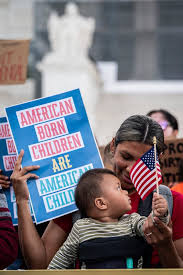
The president won a second term amid widespread demand for more immigration enforcement. Since taking office, Trump has called on U.S. Immigration and Customs Enforcement to do all in its power to deliver “the single largest Mass Deportation Program in History.” His administration has also pushed to limit access to federal benefits for immigrants who lack legal status, sought to revoke the citizenship of immigrants who commit crimes and is working to end birthright citizenship for children born to those without legal status or who are in the country temporarily.
Stories of detention by Immigration and Customs Enforcement (ICE) often highlight the human cost of immigration enforcement, revealing the difficulties individuals and families face when caught in the system.

Here are some examples of heartbreaking stories:
- Separation of families: A common theme is the separation of parents from their children, causing immense emotional distress for both of them. One woman recounted being separated from her son after being detained, finding herself in a cell with other women while her son was housed with other young children.
- Detention of U.S. citizens: Some individuals who are U.S. citizens report being detained by ICE without reasonable suspicion or probable cause, leading to feelings of heartbreak and accusations of criminal behavior against the agents involved, according to FOX 5 New York.
- Impact on children: Children, including U.S. citizens, are deeply affected by the detention or deportation of their parents, leading to fear and emotional trauma. One story highlights the heartbreak of a father who missed his daughter’s graduation after being detained.
- Loss of livelihoods and community impact: Detention and deportation can lead to significant economic hardship for families, leaving them without their primary source of income.
- Questionable treatment within detention facilities: Accounts of detention often describe confusing schedules, feelings of fear and loneliness, and a sense of not mattering. Some detainees report unequal treatment based on language spoken, where those who speak English might be treated better than others.
- Detention of individuals attempting to leave the U.S.: In some cases, people trying to leave the U.S. have been detained by ICE, despite having the means to return to their home countries. This can be particularly jarring when individuals have been traveling on tourist visas without prior issues.
- Sudden disruption of lives: The stories emphasize the sudden and unexpected nature of ICE detentions, often upending lives that are otherwise stable and focused on education and personal growth, as in the case of a student on the honor roll mentioned by The 19th News.
- Nory Sontay Ramos thought her immigration check-in was routine. Five days later, she and her mother were swiftly deported to Guatemala — a country she barely remembers.
- Elzon Lemus, a Hispanic U.S. citizen from Brentwood and lifelong Long Island resident, was detained by ICE agents without reasonable suspicion, his attorneys say.
These accounts highlight the significant emotional, social, and economic consequences that can result from ICE detention, affecting individuals, families, and communities.
Trump’s Immigration Policies Echo Contentious Chapters of American History
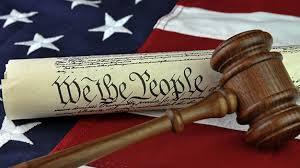
Donald Trump’s approach to immigration marks a significant departure from the more recent, family-and-skills-based immigration system. However, his policies and rhetoric find deep resonance in the more contentious and restrictionist eras of American history. From the construction of a border wall to attempts to limit legal immigration and increase deportations, his administration’s actions mirror historical precedents set during periods of heightened anti-immigrant sentiment. Back when America was tough and great. His supporters feel that America had become to soft but do we really want to regress to these attitudes? Was America successful then because of these attitudes or despite them?
A History of Welcomes and Walls
The United States has always had a complex and often contradictory relationship with immigration. While the nation was built by immigrants, it has also experienced significant waves of nativism and legislative efforts to restrict who is allowed to enter.
The 19th and early 20th centuries saw large-scale immigration from Europe, which was initially met with a relatively open-door policy. However, as the demographics of immigrants shifted from Northern and Western Europe to Southern and Eastern Europe, and as Asian immigrants began to arrive, so too did the backlash. This culminated in landmark pieces of restrictive legislation:
- The Chinese Exclusion Act of 1882: This was the first significant law restricting immigration into the United States. It explicitly barred an entire ethnic group, reflecting widespread racism and economic anxiety.
- The Immigration Act of 1924 (National Origins Quota Act): This law established a quota system that severely limited immigration from Southern and Eastern Europe and almost completely barred immigration from Asia. The goal was to maintain the existing ethnic makeup of the country, favoring immigrants from Northern and Western Europe.
These policies remained largely in effect until the Immigration and Nationality Act of 1965, which abolished the national origins quota system and established a preference system based on family relationships and job skills. This act dramatically diversified the sources of immigration to the United States.
Parallels in Policy and Rhetoric
Donald Trump’s MAGA rooted immigration policies and the rhetoric surrounding them often echo these earlier, more exclusionary periods of American history. Which is when America was great in he and his followers’ eyes.
Emphasis on Restriction and Exclusion: Trump’s focus on building a wall on the U.S.-Mexico border and his administration’s implementation of policies like the “travel ban” targeting several Muslim-majority countries are modern manifestations of the historical desire to restrict entry based on national origin and religion. The rhetoric of “invasion” used to describe the situation at the southern border recalls the alarmist language used to justify past restrictions.
“America First” and Economic Anxiety: The “America First” slogan, central to Trump’s political identity, has historical roots in pre-World War II isolationism and has been invoked to argue for protecting American jobs and resources from foreign competition. This sentiment was a driving force behind the restrictive quotas of the 1920s and the “Operation Wetback” campaign of the 1950s, which saw the mass deportation of Mexican immigrants.
Shifting Focus of Enforcement: During his first term, the Trump administration expanded the categories of undocumented immigrants prioritized for deportation, moving beyond those with serious criminal records to include those with minor offenses or no criminal record at all. This approach is reminiscent of the broad-stroke enforcement seen in earlier periods of mass deportation.
Attempts to Limit Legal Immigration: Beyond unauthorized immigration, the Trump administration also took steps to curb legal immigration. These included proposals to move towards a more “merit-based” system that would prioritize high-skilled, English-speaking immigrants over those with family ties. This reflects a similar desire to socially engineer the immigrant population as was seen in the national origins quota system of 1924.
A Departure from the Post-1965 Consensus
While Trump’s policies have historical parallels, they also represent a significant break from the bipartisan consensus that has largely governed immigration policy since 1965. The emphasis on family reunification and the acceptance of a more diverse immigrant population have been hallmarks of the modern era. His administration’s sharp turn towards restrictionism challenges this long-standing framework.
Make America Great Again: To make the MAGA movement work, this radical departure from the tolerant policies of post 1965 was needed. Before 1965, America was a deeply segregated and discriminatory society, and this discrimination was often overt, legally sanctioned, and unapologetically enforced. The reasons for this widespread discrimination were complex, rooted in a combination of historical factors, deeply ingrained ideologies, economic interests, and legal frameworks. The results however were indisputable. It successfully maintained a caste system where the white population occupied the top rung strictly because they were white. With this understanding it is not surprising that the majority of white America voted for Donald Trump. Here are some of the items that shaped pre-1965 America.
Here’s why America discriminated and largely didn’t apologize for it:
- Legacy of Slavery and White Supremacy:
- Economic System: The institution of slavery, which lasted for over 200 years, was foundational to the American economy, particularly in the South. The immense wealth generated by enslaved labor created a powerful vested interest in maintaining a system that deemed Black people as property rather than human beings.
- Racial Ideology: To justify slavery and subsequent racial hierarchies, an elaborate ideology of white supremacy was developed. This ideology claimed that white people were inherently superior—biologically, intellectually, and morally—to non-white people, especially Black people. This “scientific racism” provided a supposed rationale for unequal treatment and inferior status.
- Dred Scott v. Sandford (1857): This Supreme Court decision explicitly declared that Black people, whether enslaved or free, could not be American citizens and “had no rights which the white man was bound to respect.” This judicial endorsement of Black inferiority set a powerful legal precedent.
- Jim Crow Laws and “Separate but Equal”:
- Post-Reconstruction Backlash: After the Civil War and the brief period of Reconstruction (1865-1877), Southern states, and to some extent Northern states, enacted “Jim Crow” laws. These were state and local statutes that legalized racial segregation and discrimination in virtually every aspect of public life: schools, transportation, housing, employment, healthcare, public facilities (restrooms, water fountains), and even cemeteries.
- Plessy v. Ferguson (1896): The Supreme Court’s ruling in Plessy v. Ferguson enshrined the doctrine of “separate but equal,” declaring that segregation was constitutional as long as the separate facilities were equal. In practice, facilities for Black Americans were almost always inferior or non-existent, and the ruling essentially gave legal blessing to systemic inequality.
- Disenfranchisement: Jim Crow laws also systematically disenfranchised Black voters through poll taxes, literacy tests, grandfather clauses, and intimidation, effectively eliminating their political power.
- Social and Cultural Norms:
- Socialization: Generations of Americans were raised in a society where segregation and racial hierarchy were the norm. These discriminatory practices were embedded in daily life, reinforced by media, educational institutions, religious organizations, and community structures.
- Fear of “Social Equality”: A pervasive fear among many white Americans was that granting equal rights would lead to “social equality,” particularly interracial marriage and the breakdown of racial purity, which was considered an existential threat to white society.
- Nativism and Xenophobia: Discrimination wasn’t limited to Black Americans. Throughout various periods, immigrants from different parts of the world (e.g., Irish, Italian, Eastern European Jews, Chinese, Japanese, Mexican) faced severe discrimination, often fueled by nativism, economic anxieties, and perceived cultural differences. Laws like the Chinese Exclusion Act of 1882 and the Immigration Act of 1924 (which set national origin quotas) explicitly discriminated against non-white immigrant groups.
- “Us vs. Them”: Discrimination often served to define who belonged and who didn’t, creating a sense of superiority and solidarity among the dominant group.
- Lack of Federal Enforcement and Political Will:
- States’ Rights Argument: Many in power, especially in the South, invoked the doctrine of “states’ rights” to resist federal intervention in matters of race, arguing that racial policies were internal state affairs.
- Congressional Inaction: For decades, Congress largely failed to pass meaningful civil rights legislation. Southern Democrats held significant power and used filibusters and other legislative tactics to block such efforts.
- Presidential Reluctance: While some presidents made limited gestures towards civil rights, most were reluctant to push aggressively for federal action due to political expediency, fear of alienating Southern voters, or their own biases.
- Judicial Rollbacks: Even after the Reconstruction Amendments (13th, 14th, 15th) were passed, Supreme Court decisions like The Civil Rights Cases (1883) and Plessy v. Ferguson (1896) significantly weakened their impact, essentially giving states a free hand to discriminate
In essence, before 1965, a deeply entrenched system of racial hierarchy was maintained through a combination of legal structures, economic imperatives, pervasive social norms, and a lack of political will to challenge the status quo. For many who benefited from or were raised within this system, discrimination was simply “the way things were” – a natural order that did not require apology, but rather upholding. The significant shift after 1965 came primarily due to the sustained pressure of the Civil Rights Movement, which exposed the moral bankruptcy and inherent unfairness of these systems, forcing a national reckoning and legislative change. Which is why project 2025 and the Trump administration policies is geared towards weakening the Civil Rights Laws.
What is an American?
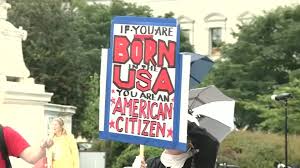
There are a group of Americans who long for the pre-1965 era and they elected Trump to bring them back. But how do you put the genie back in the bottle? As much as they want it, we are not in those unapologetic times. Sure, Trump can write executive orders, but those orders must have some grounds. There must be some basis that can hold up in court.
Trump’s strategy has been to attack the laws that changed everything, the Civil Rights Laws. He can’t just change these laws however. Changing Laws Requires Legislation: To change or repeal an existing law like the Civil Rights Act, new legislation would have to be passed by Congress through the same process by which the original law was enacted. This means a bill would need to be introduced in either the House or the Senate, go through committee review and votes, and then pass both chambers before being presented to the President. While a President cannot change laws through executive orders or other unilateral actions, their administration’s interpretation and enforcement of existing laws can influence their impact. So he is attacking what I consider the basic flaw in these laws. Everyone knows that these laws were written to protect the rights of African Americans, but the laws never specifically mention African Americans. The 1965 laws states that our society cannot discriminate based on race, so he contends that the very programs these laws birthed are unlawful because they discriminate on the basis of race. Add the fact that he has the judiciary and legislative branches stacked in his favor, he has gained momentum with this strategy.
He has taken the same tact to attack the post-1965 position on immigration. He has targeted the document that first introduced the concept of American citizenship, The 14th Amendment. He is challenging what it means to be an American.
The 14th Amendment

Americans are the citizens and nationals of the United States of America. The United States is home to people of various racial and ethnic backgrounds; consequently, U.S. federal law does not equate nationality with race or ethnicity but rather with citizenship.
In the United States, the principle of jus soli (right of soil) is applied, meaning that a person’s nationality is determined by the location of their birth. If you were born in the United States and subject to the jurisdiction of the United States, you would be a U.S. citizen at birth.
You are a United States citizen if you were born anywhere in the United States or its territories, including Puerto Rico, Guam and the U.S. Virgin Islands. You are also a U.S. citizen if you were born in another country and then naturalized.
The 14th Amendment states: All persons born or naturalized in the United States, and subject to the jurisdiction thereof, are citizens of the United States and of the State wherein they reside. Birthright Citizenship or jus soli was established well before the U.S. Constitution and was enshrined in the Fourteenth Amendment. It was necessary to include the citizenship clause in the Fourteenth Amendment because the Supreme Court’s Dred Scott decision of 1857 had denied citizenship to the children of slaves. Following the Civil War, the Fourteenth Amendment righted that injustice and became the foundation for civil rights law, equal protection, and due process in the United States.”
What does Birthright Citizenship mean?
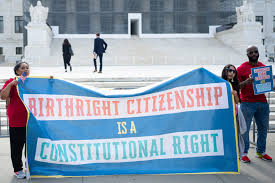
On his first day in office, President Trump issued an executive order, he named, “Protecting the Meaning and Value of American Citizenship,” seeking to redefine birthright citizenship, particularly for children of undocumented immigrants or those temporarily in the US.
Executive Order 14160 reads:
“Section 1. Purpose. The privilege of United States citizenship is a priceless and profound gift. The Fourteenth Amendment states: “All persons born or naturalized in the United States, and subject to the jurisdiction thereof, are citizens of the United States and of the State wherein they reside.” That provision rightly repudiated the Supreme Court of the United States’s shameful decision in Dred Scott v. Sandford, 60 U.S. (19 How.) 393 (1857), which misinterpreted the Constitution as permanently excluding people of African descent from eligibility for United States citizenship solely based on their race.
But the Fourteenth Amendment has never been interpreted to extend citizenship universally to everyone born within the United States. The Fourteenth Amendment has always excluded from birthright citizenship persons who were born in the United States but not “subject to the jurisdiction thereof.” Consistent with this understanding, the Congress has further specified through legislation that “a person born in the United States, and subject to the jurisdiction thereof” is a national and citizen of the United States at birth, 8 U.S.C. 1401, generally mirroring the Fourteenth Amendment’s text.”
In this executive order Trump is attempting to change an ages old interpretation of the clause, “subject to the jurisdiction thereof.” He is presenting an interpretation that positions this phrase to mean that birthright citizenship should only be granted to those born to a citizen of the United States. That has never been the accepted interpretation. The accepted interpretation has always been that to be granted birthright citizenship, the person born on American soil must be under the complete and full authority of U.S. law, and not under the authority or allegiance of a foreign power at the time of their birth.
As many of Trump’s orders, this executive order has been met with multiple legal challenges and, as of July 10, 2025, has been blocked by federal courts nationwide. A federal judge in New Hampshire, for example, issued a preliminary injunction against the order.
The Supreme Court has, however, limited the ability of lower courts to issue nationwide injunctions, meaning that while the order is blocked in some places, it may be allowed to proceed in others depending on further court rulings. The Supreme Court is expected to address the constitutionality of the order itself in its upcoming term beginning in October.
Most legal scholars contend that birthright citizenship, based on the 14th Amendment and backed by over a century of legal precedent (including United States v. Wong Kim Ark), cannot be altered unilaterally by executive order or even by Congress without a constitutional amendment.
A constitutional amendment to change birthright citizenship would require a two-thirds vote in both houses of Congress and ratification by three-quarters of the states – a difficult and unlikely process given the current political climate.
Subject to the jurisdiction thereof
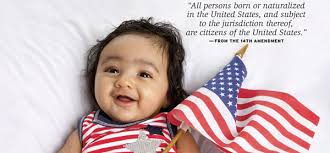
Since its ratification in 1868 the 14th Amendment provided citizenship for all that was born in the United States barring a few exceptions. Here’s a breakdown of what it means and, importantly, what it excludes:
Under U.S. Law: This is the general rule. If you are born within the geographical boundaries of the United States (including its territories), you are typically subject to its laws. This means you owe allegiance to the U.S. and are entitled to its protections. This is the basis of “birthright citizenship” or jus soli (right of the soil) .
Exclusions: The “subject to the jurisdiction thereof” clause was specifically intended to exclude certain categories of people from automatic citizenship, even if they were born on U.S. soil:
Children of foreign diplomats: Diplomats and their families are considered to be under the jurisdiction of their own country, not the host country (the U.S.). They enjoy diplomatic immunity and are not fully subject to U.S. laws.
Children of enemy forces in hostile occupation: If a foreign army were to occupy U.S. territory, any children born to those occupying forces would not be considered U.S. citizens because their allegiance would be to the invading power, not the U.S.
Native Americans (originally): At the time the 14th Amendment was ratified, many Native American tribes were considered sovereign nations. Therefore, individuals born within those tribal jurisdictions were considered to be subject to their tribal laws and allegiances, not the full jurisdiction of the United States. This exclusion was later addressed and reversed by the Indian Citizenship Act of 1924, which granted full citizenship to all Native Americans.
Further support of this interpretation came in a key Supreme Court Interpretation: United States v. Wong Kim Ark (1898). This case is central to understanding the phrase. The Supreme Court ruled that a child born in the United States to Chinese immigrant parents who were permanent residents (but not citizens) was indeed a U.S. citizen. The Court affirmed that the default rule is birthright citizenship for virtually all persons born on U.S. soil, with the specific exceptions mentioned above. The fact that the parents were not citizens or were even ineligible for naturalization did not prevent their U.S.-born child from being a citizen, as long as the child was “subject to the jurisdiction” of the United States.
Trump is ignoring this precedent and orchestrating the largest mass deportation effort in American history, even under the weight of federal injunctions telling him to cease and desist, he is following his usual tact and saying, make me! He is attempting to take us back to a time before 1965 when America had no heart and no consciousness. The sad part is that more than half of America voted for him to do it. I don’t know where America is going from here. Will Trump succeed? Will America survive if he does? I think this is shaping to be a classic case of, “be careful what you wish for, you might get it”. The world is a much different place than when America reigned as king, artificially elevating the status of its white population while suppressing the status of its other citizens. The world is much more competitive and America has lost ground in the economic race. This is a time when America needs to tap into all its resources, not stifle them.
Since 1965 the talent pool has grown outside of the white population:

- There is greater diversity in student bodies. The percentage of white students in US colleges dropped from over 80% in 1976 to 57% by 2016, indicating a significant increase in non-white enrollment.
- The American workforce has become increasingly diverse in terms of gender, race, religion, age, and sexual orientation. Demographic trends indicate that by 2050, one of every two US workers will be a person of color.
- In 1966, African American officials and managers comprised less than 1% of all officials and managers; by 2008, this increased to 6.94%.
- African American participation rates in the overall workforce increased from 8.2% in 1966 to 14% in 2013.
- There have been notable increases in African American representation in professional and management categories.
- Hispanic/Latinx Workers: Hispanic workers have seen increases in representation in a wide range of top-ranking careers since 2010.
- Asian Workers: Asian workers are notably represented in STEM occupations.
- Women: women’s college completion rates skyrocketed. By 2010, women between 26-28 years old had an eight-percentage-point lead over men in college degree receipt.
- Advanced Degrees: Women now earn the majority of master’s degrees and more than half of all doctoral and professional degrees. This has opened doors to professions previously dominated by men.
My point is that America might have excelled in a time where the emphasis was on whiteness, but the richest talent pool no longer exists exclusively in the white community, specifically white men. America will not survive as a great global power if it does not embrace the talents of all its citizens. Following the objectives of MAGA policies like project 2025 will only undermine Americas success, and fail to make it great again.
Edward Odom

