

I recently came across a YouTube reel of the comedian Godfrey as a guest on a popular podcast, The Pivot, speaking of how the movie Shaft, starring Richard Roundtree saved Warner Brothers (actually it was MGM), Wesley Snipes as Blade saved Marvel, In Living Color saved Fox, and Empire with Taraji P. Henson & Terrence Howard saved Fox again. Here is the link to the video, (Video). His main point was that Black people sell. He says, “its just this old adage, of hatred, and this fear of other people’s success. They’ve got to get over it.” Godfrey is referring to the narrative that there is no value in investing in anything regarding black people and about America’s constant war against black American progress. He is expressing his belief that if white America could just get over it, this irrational hatred, there is proven data to support how black America has and can contribute to the economy. And, in my opinion, not just contribute, but unrestrained, take it to levels not yet seen before. Our current President has a personal history of conflict with black Americans and he has brought this conflict with him to the White House. He is using his substantial power to facilitate the removal of programs that not only support black Americans but all Americans. The support he has received from the public to successfully pass his legislation was at first mind boggling to me but with further thought, understandable.
There is a significant portion of American society that feel the black community has never contributed anything to American society except menial service, and that the programs that white America perceive to be created to support black people are just a waste of their tax payer dollars. This is how legislation like the “big beautiful bill” is passed successfully. This feeling however could not be substantiated if black/American history was known, if the facts were known. Godfrey in this video was just trying to give some of the facts about the contributions of black people to this economy, to this society. I will expound on these facts in this article.
The Unsung Lifeline: How Black Innovation Rescued American Industries
I consider myself an educated black man and I was intrigued by this Godfrey’s conversation. One day I will analyze why these bits of information interest me so. Maybe because through all of my schooling, even having had African American studies in college, I was never taught the value of black people. Especially the economic value. Contrarily, what I was taught growing up in the 1970s was how worthless black people are. How they were a drain on society, not an asset. So when I see information like how the film Blade, which featured a black character, saved Marvel, I am fascinated. It’s not just the fact that I grew up reading Marvel’s comic books. Marvel has had a colossal financial impact on the film industry. It has the highest-grossing franchise; the Marvel Cinematic Universe (MCU) is the highest-grossing film franchise in history, having collectively earned over $30 billion globally. This surpasses even the Star Wars franchise. It has generated massive film revenues; MCU films have consistently generated billions in box office revenues, including Avengers: Endgame, becoming one of the highest-grossing films of all time. Many MCU films have crossed the $1 billion mark.
How many know however, that this entertainment behemoth had declared bankruptcy in 1996 but the 1998 film “Blade” starring a black actor, Wesley Snipes, provided a lifeline and made possible the Marvel we know today. I often write about the lack of, and suppression of, information regarding the contributions of Black people in America. It does a disservice to the American people when they are ignorant of these contributions. It lends to the disrespect of Black citizens and often to the lack of support for policies that would provide much needed resources for Black communities. As I eluded to earlier, this is evident in what is going on now with the rollback of many programs that help to support Black families. The majority of white America support these rollbacks, even though it harms many of their own communities. All because they believe the narrative that Black people did not and do not contribute to the economy. This led me to research the validity of Godfrey’s claims.
Black Culture Has Always Fueled the American Economy
The narrative of American economic prosperity is often told through broad strokes of industrial might, technological advancement, and consumerism. Yet, beneath these sweeping generalizations lies a foundational truth: the indelible and multifaceted contributions of Black culture have been, and continue to be, an indispensable engine driving the nation’s economic growth. From the forced labor that built early wealth to the cultural innovations that define global trends, and from resilient entrepreneurship to pivotal media successes, Black culture’s economic footprint is both historically profound and dynamically contemporary. Yet, as a DEI leader I still find myself having to explain why these programs benefit corporations and are not financial drains on the organizations that implement them. The Black culture have always been a major contributor to the American economy and while the specific claims in the YouTube video of “saving” corporations from bankruptcy require nuanced examination, the consistent pattern reveals Black-led content and consumer power as critical forces in shaping industries and generating billions.
Historically, the very bedrock of American wealth was laid by the forced labor of enslaved African Americans. By 1860, the economic value of four million enslaved people was estimated at $4 billion, a sum that surpassed the combined worth of all U.S. banks, railroads, and factories at the time. In today’s terms, this translates to as much as $1.6 trillion, underscoring slavery’s role as America’s largest financial asset and the source of its most exported commodity, cotton, which propelled the U.S. into a leading global economy. A little-known fact: slave-backed securities were one of our nation’s first wealth-building vehicles. Slave-backed securities were financial instruments used in the antebellum South that leveraged the value of enslaved people to secure loans and facilitate trade. Following emancipation, Black communities, despite facing systemic barriers like segregation and discriminatory lending, demonstrated remarkable ingenuity. The Greenwood District in Tulsa, famously known as “Black Wall Street,” exemplified this resilience, boasting 108 Black-owned businesses by 1921, a self-sufficient economic hub born out of necessity and vision. This legacy of wealth creation and economic self-determination, often achieved in the face of profound discrimination, underscores Black culture’s integral role in the nation’s formation and ongoing sustenance.
From Bankruptcy to Blockbusters
The entertainment industry provides compelling examples of Black culture’s direct economic impact. The 1998 film Blade, starring Wesley Snipes, is widely credited with providing a crucial lifeline to Marvel Comics. Released when Marvel was in dire financial straits, having declared bankruptcy in 1996 due to a comic book market crash and high corporate debt, Blade grossed an impressive $131 million worldwide on a $45 million budget. Its commercial triumph proved the viability of Marvel characters on the big screen, fundamentally revaluing Marvel’s intellectual property and paving the way for lucrative licensing deals and the eventual Marvel Cinematic Universe. Similarly, Shaft (1971), an MGM production, generated $13 million worldwide on a modest $500,000 budget. Its considerable financial return provided a vital financial boost to MGM’s film division during a period of corporate restructuring. It almost single-handedly created the “blaxploitation” genre, demonstrating Hollywood’s capacity to tap into the “rich and mostly untapped market at the time, of African American consumers”.
On television, In Living Color, which premiered in 1990, was instrumental in establishing the nascent Fox network’s identity. As a “fledgling” network with limited reach, Fox needed content that could attract a strong viewership.
In Living Color, with its groundbreaking satirical take on African American culture and predominantly Black cast, was an “immediate success”. A bold move to air a live episode opposite the 1992 Super Bowl halftime show resulted in over 20 million viewers flipping channels, showcasing Fox’s ability to capture a massive audience and challenge established networks. While Fox’s ultimate ascension was bolstered by acquiring NFL broadcast rights, In Living Color created the cultural buzz and attracted the demographic necessary for its growth. Later, Empire (2015-2020) was a monumental financial success for Fox, generating $124.5 million in ad revenue in 2015 and $125.5 million in 2016, making it the “most valuable show on broadcast TV” (excluding sports). While Fox was not on the verge of bankruptcy in 2015, Empire‘s immense profitability underscored the powerful economic leverage of culturally resonant content. The WB network also found its footing through Black-led programming. Launched in 1995, The WB heavily relied on and achieved significant early success with Black sitcoms like The Wayans Bros., The Parent ‘Hood, Sister, Sister, The Jamie Foxx Show, and The Steve Harvey Show. These shows built a loyal audience, defining the network’s identity and proving its viability in a competitive landscape.
How Black Buying Power and Business Growth Fuel the American Economy
Beyond the screen, Black consumers wield immense and growing economic power. Their collective buying power was estimated at $1.2 trillion in 2017, projected to reach $1.54 trillion by 2025, and $1.7 trillion by 2030. This demographic is not merely large but also a powerful trendsetter, actively “setting digital trends and leading engagement”. Nielsen research highlights that Black consumer choices possess a “cool factor” that creates a “halo effect,” influencing not only consumers of color but also the broader mainstream market, leading to “sizable general market returns” for brands that connect with them. Black consumers exerted significant influence across various industries in 2020. Their spending power was estimated at $1.6 trillion in 2020 and is projected to reach $2.1 trillion by 2026. Black consumers dominate the ethnic hair and beauty market and make significant investments in the general beauty marketplace. In fashion, Black households spend approximately 30% more on visible goods like clothing than white households with similar incomes. Black consumers demonstrate a high level of engagement with the sneaker market. A Mintel report from 2022 indicates that 88% of Black consumers purchased sneakers in the prior 12 months, and are among the most likely demographics to purchase multiple pairs.
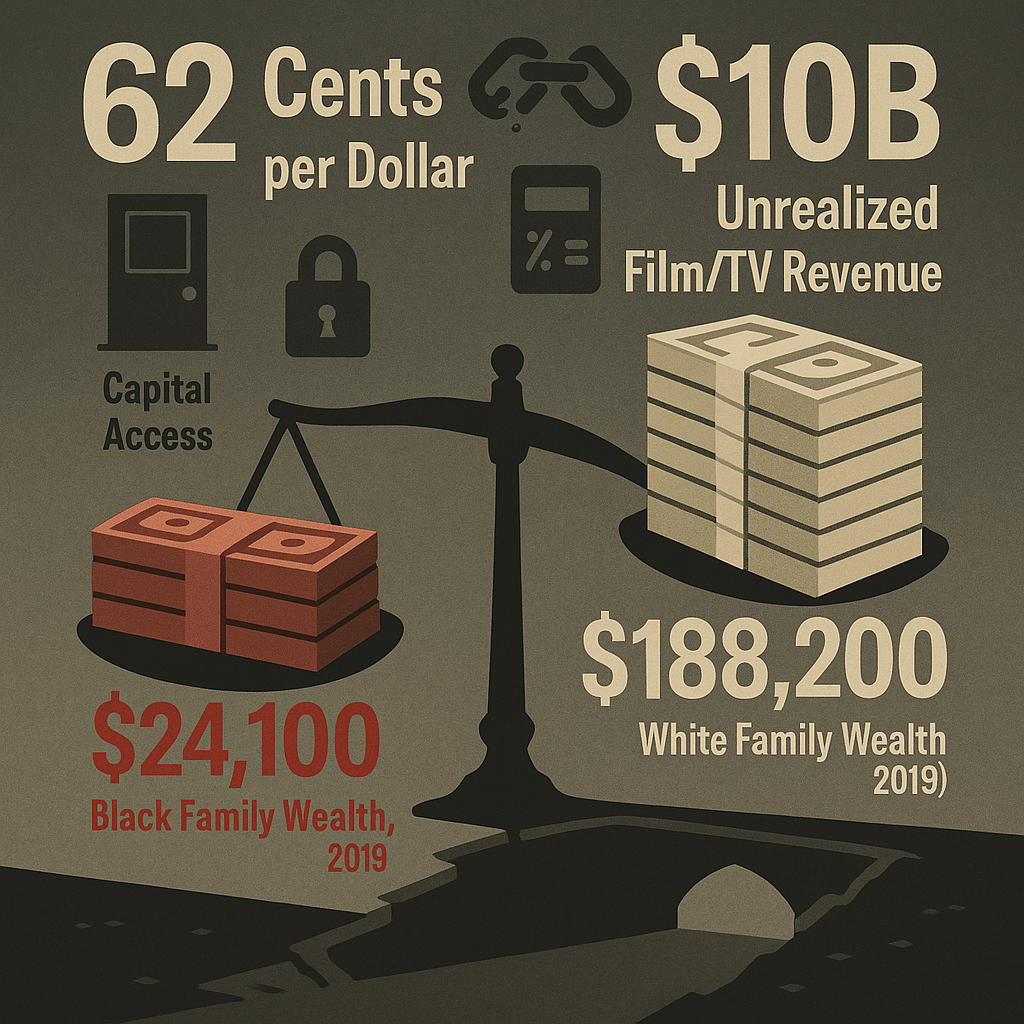
Black entrepreneurship, despite facing severe systemic barriers, is a dynamic force for economic development. From 2017 to 2022, Black-owned businesses accounted for over half of the net new employer businesses created in the U.S. Specifically, Brookings reported that over half of the roughly 132,000 new employer businesses created between 2017 and 2022 were Black-owned. This growth contributed significantly to the overall economic landscape, adding $212 billion in revenue and employing an average of eight people per firm in 2022. According to Brookings this growth directly contributes to closing the racial wealth gap by providing jobs, fostering financial literacy, and reinvesting in local economies. However, Black entrepreneurs face profound challenges: specifically, according to the Federal Reserve’s 2019 Survey of Consumer Finances, the median net worth of white families was $188,200, which was 7.8 times higher than that of their Black counterparts, at $24,100. This gap is a continuation of decades-long trends in wealth inequality directly impacting access to startup capital. According to McKinsey and company, black entrepreneurs start with significantly less capital ($35,000 on average compared to $107,000 for white founders) and face higher rates of loan denials and more stringent application processes. According to World Business Chicago, only 1% of venture capital funding goes to Black founders. These disparities highlight how systemic structures actively hinder the full potential of Black wealth creation, representing billions in unrealized gains for the national economy.
Black Inventors and the Unsung Innovations that Built America
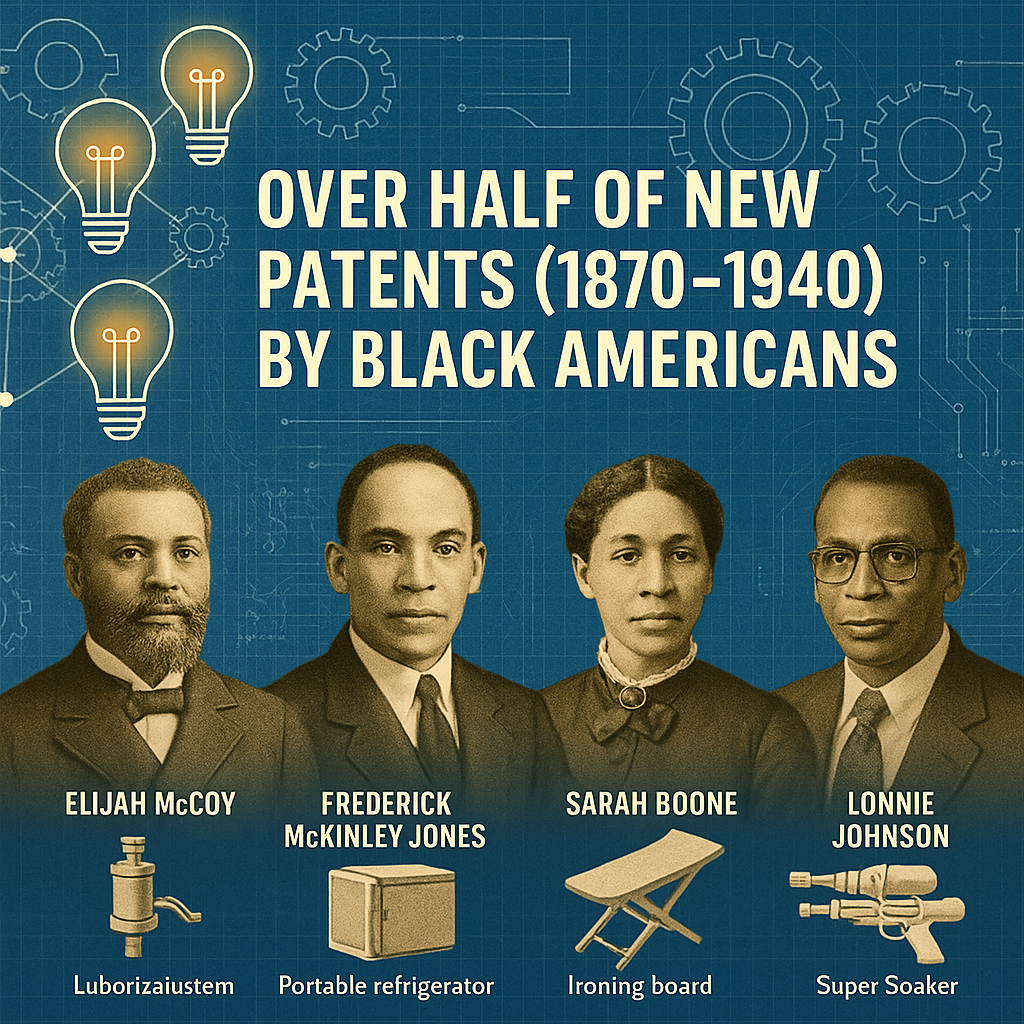
Beyond entrepreneurship, Black inventors have profoundly shaped America’s industrial and technological landscape. Despite facing severe impediments, including repressive institutions and denial of access to education and property rights, their innovations were crucial to spurring economic growth. Historically, the U.S. patent system often excluded Black inventors, with slave owners exploiting and taking credit for their enslaved individuals’ inventions. Yet, during the “Golden Age of Invention” (1870-1940), Black Americans contributed more patents than immigrants from all countries except Germany and England. Notable inventors include Elijah McCoy, who revolutionized machine lubrication; Thomas Jennings, who invented dry cleaning; Norbert Rillieux, who created a revolutionary sugar-refining process; Sarah Boone, who invented the ironing board; Frederick McKinley Jones, who revolutionized food preservation with portable refrigeration units; and Lonnie Johnson, whose Super Soaker water gun generated over $1 billion in sales. This legacy of innovation, often achieved against immense odds, underscores the profound and often unacknowledged economic value generated by Black intellectual capital. You can read more about Black inventors and their inventions in my article, “Celebrating Black Inventions: A Rich Legacy”.
Unlocking the Full Economic Potential of Black America’s Cultural Contributions
The economic influence of Black culture extends deeply into various cultural industries. In music, African Americans have been integral to U.S. music-making since before the nation’s founding. The “race records” phenomenon in the 1920s, sparked by Mamie Smith’s “Crazy Blues,” ushered in an era of Black music recordings and spurred the formation of Black-owned independent labels. More recently, Hip-Hop’s economic impact is so pervasive that experts find it difficult to quantify, generating $15.9 billion from music streams and purchases alone in 2022. In fashion, Black Americans are significant trendsetters, influencing global tastes and trends. Black consumers are up to 2.3 times more likely than non-Black consumers to switch to a Black-owned apparel or footwear brand, and their spending on apparel and footwear is projected to grow to $70 billion by 2030. In culinary arts, African Americans brought planting and cooking techniques that formed the foundation of Southern diets, and historically, Black Americans made livelihoods as street vendors, contributing to thriving local economies. According to McKinsey and company, Black consumers’ spending on food is projected to grow from $120 billion in 2021 to $200 billion by 2030. In sports, Black athletes “unquestionably dominate” two of the highest-revenue professional leagues: NFL (70% Black players, $23 billion revenue) and the NBA (75% Black players, $11.3 billion revenue).43 Iconic Black athletes like Michael Jordan and LeBron James are among the highest-paid athletes of all time, and major broadcasting networks relied on their influence for high ratings.
Despite these profound and multifaceted contributions, Black Americans continue to experience “far more precarious economic conditions” than the population as a whole. The racial wealth gap persists and is increasing: in 2019, the median white family had $188,200 in wealth, compared to just $24,100 for Black families. Income disparities are stark, with Black households earning only 62 cents for every dollar earned by white households. Systemic barriers, including discriminatory banking structures, employment practices, and the historical exploitation of intellectual property, continue to limit economic opportunities and suppress the full economic potential of Black communities. McKinsey research suggests that addressing racial inequities in film and television alone could unlock an additional $10 billion in annual revenues, quantifying the economic cost of this systemic undervaluing.
Really Making America Great Again
In conclusion, I believe Godfrey was on to something in this YouTube reel. Imagine the possibilities. If black culture has contributed this much to the American economy with all of the barriers put in its way, what would happen if these barriers were removed? Remember this, Brookings reported that over half of the roughly 132,000 new employer businesses created between 2017 and 2022 were Black-owned. This growth contributed significantly to the overall economic landscape, adding $212 billion in revenue and employing an average of eight people per firm in 2022. Imagine :
- If the median net worth of white families wasn’t 7.8 times higher than that of their Black counterparts translating in more funding to invest in businesses.
- If black entrepreneurs didn’t start with significantly less capital ($35,000 on average compared to $107,000 for white founders) but instead was on par.
- If Black businesses didn’t face higher rates of loan denials and a more stringent application processes.
- If 10% of venture capital funding went to Black business founders instead of 1%.
$212 billion contributed to the economy in a year from a segment of the community that is 11% of the population is nothing to scoff at but how much more could it be if the restrictions were stopped. The legitimacy of Black culture’s major contributions to the American economy is not merely confirmed but stands as a foundational and ongoing driver of national prosperity. From the historical creation of wealth and the pioneering spirit of entrepreneurs and inventors to the immense consumer power and cultural innovations that shape global trends, Black culture has consistently enriched and propelled the U.S. economy. Acknowledging these profound contributions is not just a matter of historical accuracy or social justice; it is an economic imperative.
The reason this administration can so successfully implement strategies aimed at removing black history, DEI programs, or more critically, economic programs that are essential to all Americans is because these strategies are cloaked in eliminating “black” programs. And just as the narrative existed when I was a kid growing up in the rural South, the narrative still exist that “black” programs are just a drain on the economy because black people have done nothing to contribute to it.
White Americans need to understand that if America is to grow economically, addressing the systemic inequities that continue to limit the full economic potential of Black communities and creators, will be crucial for unlocking substantial unrealized economic growth and innovation for the entire nation, If you want America to grow, if you want it to be on top of the global economy once again, then white America needs to do as Godfrey said in the video and “get over it”! Black culture has made major contributions to the American economy despite the obstacles put in its way. If you want America to be great again, fix this! Allowing this administration to continue down this road of denial and self-destruction is the equivalent of “cutting off ones nose to spite its face”.
Edward Odom

