
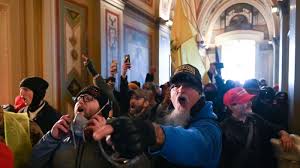
Photo by Roberto Schmidt/Getty Images
One of my all-time favorite quotes, and I don’t know who said it is, “When you’re accustomed to privilege, equality feels like oppression”. That quote had white America pegged. One of the primary accomplishments that led to Donald Trump’s political success is the mobilization of disenfranchised white men. One of the headlines of the 2012 Presidential campaign was the demise of the white American male voter as a dominant force in the political landscape. Four years later after Trump won the 2016 election it was a much different story. The Trump campaign was able to identify, mobilize, manipulate, and use white men’s frustrations to create a whole movement. This movement, “Make America Great Again”, feeds on white men’s fear, anxiety and rage. What are the elements of this frustration? They are downward mobility, increased racial and gender equality, and an outdated sense of masculinity. In his book, “Angry White Men: American Masculinity at the End of an Era”, author Michael Kimmel says that white men are suffering from what he calls “aggrieved entitlement”. This frustration and Trump’s manipulation, caused the unprecedented attack on the Capitol building on January 6th but this frustration is not new. It’s the same frustration that led angry white mobs to burn down and massacre black citizens in towns like Rosewood and Tulsa. It’s the same frustration that motivated white mobs to lynch over 4,000 black Americans from 1896 to 1950.
Today this frustration is primarily evident in working-class white men. To understand this frustration, you must understand white privilege. It consists of several elements:
- Political Power
- Resources
- Segregation
- Deference
The privilege of political power and the economy
I said in one of my previous articles that early America was a country club for rich white men. After America became an established nation the only people that had a say in how the country was run were land-owning white men. The Constitution established a federal democratic republic form of government. That is, we have an indivisible union of 50 sovereign States. It is a democracy because people govern themselves. It is representative because people choose elected officials by free and secret ballot. In a democratic republic the power of the citizen is in the vote. The Constitution recognized that the states had the power to set voting requirements. A few states initially allowed free Black men to vote (that was eventually taken away in all states), and New Jersey also included unmarried and widowed women who owned property (that right was also eventually taken away) but generally, states limited this right to property-owning or tax-paying White males (about 6% of the population).
By the end of the 1820s, attitudes and state laws had shifted in favor of universal white male suffrage. The 1828 presidential election was the first in which non-property-holding white males could vote in most states. Voters and interest groups have a powerful impact on virtually every possible economic policy. Consequently, America’s early class structure had land-owning white men at the upper-class and the African slaves at the sub-lower class. The financial position of the working-class white men determined how they fell along the class lines. America is a capitalist economy. A capitalist economy fundamentally depends on the working class. Capitalism relies on the labor of the working class to produce goods and services, generate profits, and drive economic growth. The success of the upper class depends on keeping the working class on the hamster wheel. White men controlled the power of the vote until 1920 when women were also given the right which means white men controlled the economy for centuries.
The privilege of preferential access and control of resources
If you control political power, you control the economy. If you control the economy, you control the access and exclusivity to the best of resources. White men had first choice to the best jobs, places to live, education, health care, restaurants, hotels, and entertainment outlets. If you were white and had enough money, there was no restriction on access to these things and there was no competition except from other white people to gain access.
Another important part of upper-class control was the ability to keep the working-classes divided. Lower class white Americans and black Americans could never be allowed to unify. There were psychological and physical barriers that kept these classes separate. First the separation was accomplished by the physical restraints of slavery and after the Civil War it was done by segregation. After the physical separation of slavery was removed, the psychological barrier of race was still in effect. This barrier was reinforced with the notion of white supremacy. The white lower-class was comforted with the idea that black people were inferior to them in all ways. They believed, and in some ways were led to believe by scientific journals and the manipulation of religion, that their whiteness, and that alone made them better. This mindset along with the physical barriers of the Jim Crow restrictions to black Americans created the separation that the upper class needed to control the working class.
Segregation
Competition wasn’t the only exclusivity that white people enjoyed. All those items I mentioned were the spoils of participating in the American dream but more importantly to many white Americans there was the exclusivity of space. There were places that a black person couldn’t go even if they had the money. White Americans did not share spaces with black Americans. Segregation was just as important, if not more important than the exclusive access to resources.
Segregation was always the norm. Races were separated by neighborhoods in the North and in the South the only place where white and black people shared spaces was on the plantations. The biggest dilemma that Lincoln faced with the abolition of slavery was the question of what to do with these former enslaved after they were freed.
For much of his career, Lincoln believed that colonization—or the idea that most of the black population should leave the United States and settle in Africa or Central America—was the best way to confront the problem of slavery. His two great political heroes, Henry Clay and Thomas Jefferson, had both favored colonization; both were enslavers who took issue with aspects of slavery but saw no way that black and white people could live together peaceably.
Lincoln first publicly advocated for colonization in 1852, and in 1854 said that his first instinct would be “to free all the slaves and send them to Liberia” (the African state founded by the American Colonization Society in 1821). Nearly a decade later, even as he edited the draft of the preliminary Emancipation Proclamation in August of 1862, Lincoln hosted a delegation of freed Black men and women at the White House in the hopes of getting their support on a plan for colonization in Central America. Given the “differences” between the two races and the hostile attitudes of white people towards Black people, Lincoln argued, it would be “better for us both, therefore, to be separated.”
After the Civil War, the reconstruction period (maintained by the presence of Union soldiers in the south) ushered in an era of advancement for the new African American citizens. They were full participants in society and began to occupy seats in local and federal government. This quickly came to an end after the “great compromise” between the two political parties that resulted in the Union soldiers vacating the south. With physical intimidation by groups like the Ku Klux Klan and legislation created because of the 1896 Ferguson vs. Plessy Supreme court decision, the newly acquired civil rights quickly diminished. The notion of separate but equal was born. We now know that the “equal” part of the legislation was a farce. It was just the diversion to make the “separate” part of the legislation more palatable to the moral sentiment of the country, and it was the “separate” part that allowed Jim Crow to last for almost a hundred years. More importantly segregation made it easier to keep all the important resources from black America.
Deference
I grew up in a small South Carolina town in the 1960s and 70s. The town had a railroad track that divided the town. One side was the black side and the other the white. As a young African American boy, I knew early on that when I went to the white side of town, there was a certain deference that black people had to give to white people. This deference was given to even the lowest profile white people. As a black person you could be smarter, more accomplished, it didn’t matter. More importantly, white people expected this deference. They felt insulted, disrespected if they felt that you felt that you were better than them and depending on their status or temperament that could spell trouble for a black person. As a black person there was rarely any recourse if a white person decided to act out their frustration against you. My father told me many stories of them walking to school and white kids in school buses would pass by and spit out the window at them. There was one time that he as a small boy accidentally drank from the white-water fountain and a white man put a pistol to his head. My grandfather was standing right there and could do nothing but hope that the white man calmed down. If my grandfather intervened, he would be the one that would be shot or taken to jail. This aspect of white privilege had been passed down from generation to generation and no form of legislation could just make the psychological part of that privilege go away. And understand, the psychological elements of this privilege affected both sides. The air of superiority that it gave to the white man and the air of inferiority that it ingrained in the black man was long lasting.
The loss of privilege
Just as the abolition of slavery created the problem of what to do with the newly freed black Americans, the abolition of segregation by the Civil Rights laws of 1964 caused a similar issue. These laws made the white-only restrictions of Jim Crow illegal. After a few years of resistance by the southern states, black Americans had the legal right to go where they wanted. I was born in South Carolina in a small town in 1962, and my schools were not integrated until 1971, a full seven years after the civil rights law. As a six-year-old, when my grandmother took me to the doctor, I had to sit in the colored only section. The colored only section was purposely kept dim, and the walls were not frequently painted, and the furniture was old and worn. This was the kind of psychological manipulation that sent the message to the black people that we were not good enough, but more importantly it told the white people that they were better and deserved the finer things. Eventually, however, even the most stubborn of the southern states had to comply with the civil rights laws and the physical restrictions like the colored only signs were removed. It took a lot longer for the psychological restrictions to go away and some would argue that they never did.
Civil Rights takes hold
After Jim Crow, white America still had the advantage of finances to give them exclusivity to some places and services but after a few decades, black Americans began to appear more prevalently in places where they had no access before. They were in the workplace with white-collar jobs. They had the money to send their children to schools of higher education. They had the money to buy homes. They could go to the same movie theaters, restaurants, amusement parks, and hotels as white Americans. This was troubling to white Americans. Especially the white working class. They had no desire to share these spaces with black people. The laws could change the rules but not the mindset. Until then, there was never an America where white people were not a class above black people. The advent of immigrants invading their space was troubling but not as troubling as black Americans working and living shoulder to shoulder with them. It was an assault to their ego, to the centuries of the notion of superiority. It would take time however for the access to these spaces to become the norm for black Americans. The 1970s, 80s, and 90s brought progress but it was slow. The decade of the 2000s, however, brought the advancement of technology and the three decades of higher education in the black communities began to break down more of the financial barriers. as a result of the Civil Rights laws, white America began to see more and more of not just black Americans, but also immigrants and women in spaces where they were excluded from before. It was a slow boil, so the progress hadn’t been readily noticeable to this point, but it was undeniable in 2008 when an African American, Barack Obama was elected President for the first time in American history.
The wakeup call
The 2008 election was a wakeup call to white America. Some had become accustomed to sharing spaces with Black Americans, immigrants, women, and the LGBTQIA+ community, but the election of Obama signaled a larger shift. The possibility of white America losing the privilege that was always an American birthright seemed like a reality. There was an immediate backlash. There were more police shootings of black men during this time than the three decades following the Civil Rights passage. It led to the election of Donald Trump in 2016. Only his outrageous behavior during his presidency and his mishandling of the pandemic led to him losing the 2020 election to Joe Biden.
White men are still frustrated. Political Power is not guaranteed to them anymore. Yes, Trump won the 2024 election by a narrow margin of 1.26% of the popular vote, but there was a real possibility that a Black woman could have been President. She became a nominee in a major political party, and no one knew for sure the outcome until the night of the election. A woman becoming president is a real possibility in the future. That was an impossibility in the white man’s world not so long ago.
America is still a very segregated society but that is mostly where people live. Black people are prevalent in the workplace and universities and access to services is only limited to their financial resources.
The loss of deference
In all of the losses, the loss of deference is probably white men’s most disturbing. The current generation of black children do not have the psychological markers that prompt them to be passive in exchanges with white men. White men more easily feel disrespected when they engage with young black men and boys. In my opinion the loss of deference is the primary cause of the police shootings of black men. Adult white men of today grew up watching their father and grandfathers move through society differently. White men expected to win especially if it was against a black man. You want to make a working-class white man angry. Show him something that a working-class black man has that he can’t get.
The privilege of denying privilege
The existence of white privilege has been denied by white people since forever. Some admit they have privilege but deny it is because they are white. Others just deny privilege altogether. The hardest group to have this discussion with is the white-working class because they may not necessarily have more resources than black people. What they don’t understand or won’t admit to is that white privilege is a lot more than the things or even the money. If you put the poorest white person side by side with the poorest black person, with the same intellect and gave them the same quality clothes and the same amount of money it would be exponentially harder for the black person to progress compared to the white man. And the key part of it, is that the reason would not be because the white man is smarter or more talented, it would strictly be because he is white. The system is set up for him to have the advantage.
The difficult part of this conversation is the white man’s claim that affirmative action, a set of policies that aim to increase opportunities for people who are underrepresented in certain areas, and to prevent discrimination, actually discriminate against him. His claim is that the system actually is set up to give the black man the advantage. This has been debated since the Civil Rights Act and despite multiple lawsuits there has never been any substantial proof that affirmative action has cost a white person a job. In a 2009 NBC article a representative of the ACLU commented, ” “We like to believe there is an equal playing field. In fact, there isn’t,” said Parker of the ACLU. “In this country, whites are still advantaged in many ways. You can say we shouldn’t take race into consideration, but that just continues the advantage.”
://www.nbcnews.com/id/wbna30462129
A change has come
The frustrated white man does not want change. When Barack Obama campaigned for the presidency, he told white middle American that he would provide opportunities for them to go to college or trade school to learn a new skill relevant to today’s work environment. They resisted because they wanted the coal mines and the steel mills to be revived. They wanted their kids to be able to work in the factory and still be able to buy a house and raise a family like their fathers and grandfathers did. That also is a privilege. The world changed around them, and their privilege tells them that they don’t have to change. They instead will change the world to bend to their will. Trump told them he will turn the clock back to when their whiteness was currency. That he would bring back the factories and the steel mills. He won in 2016 on this promise and didn’t deliver. They voted for him again in 2024 hoping that he will. He has come out swinging. This time he is going for what they believe is the root of the problem, the civil rights laws. After all, it is civil rights that opened the door for the competition. It took away the segregation and provided equal access to the political and economic power.
The problem for them is that the world has changed. There are a significant number of black Americans, immigrants and women who are experienced, qualified, with resources. Peeling back the civil rights laws will certainly be problematic. It will make it harder to fight against attacks on voting rights or to fight against discrimination in the workplace and to provide equal access to higher education but harder is not an insurmountable barrier. They cannot take away what is already earned. Yes, the next four years will be difficult and there will be setbacks, but these communities now have resources. It is time to leverage those resources and move forward. We’re not going back.
Edward Odom

https://mytwocents.pEd Odom
